Kirjojen hintavertailu. Mukana 12 152 606 kirjaa ja 12 kauppaa.

Kirjailija

Bernd Sturmfels

Kirjat ja teokset yhdessä paikassa: 14 kirjaa, julkaisuja vuosilta 1989-2024, suosituimpien joukossa Combinatorial Commutative Algebra. Vertaile teosten hintoja ja tarkista saatavuus suomalaisista kirjakaupoista.

14 kirjaa

Kirjojen julkaisuhaarukka 1989-2024.

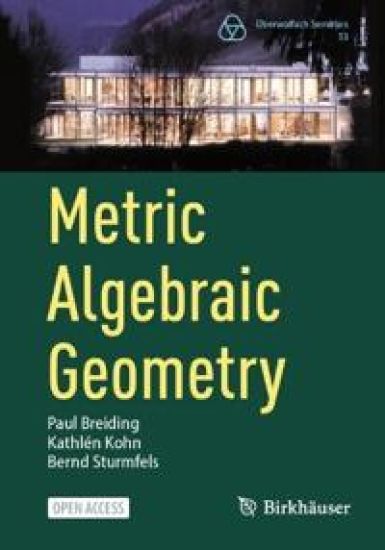
Metric Algebraic Geometry

Metric Algebraic Geometry

Paul Breiding; Kathlén Kohn; Bernd Sturmfels

BIRKHAUSER VERLAG AG
2024
nidottu
Metric algebraic geometry combines concepts from algebraic geometry and differential geometry. Building on classical foundations, it offers practical tools for the 21st century. Many applied problems center around metric questions, such as optimization with respect to distances.After a short dive into 19th-century geometry of plane curves, we turn to problems expressed by polynomial equations over the real numbers. The solution sets are real algebraic varieties. Many of our metric problems arise in data science, optimization and statistics. These include minimizing Wasserstein distances in machine learning, maximum likelihood estimation, computing curvature, or minimizing the Euclidean distance to a variety.This book addresses a wide audience of researchers and students and can be used for a one-semester course at the graduate level. The key prerequisite is a solid foundation in undergraduate mathematics, especially in algebra and geometry. This is an openaccess book.
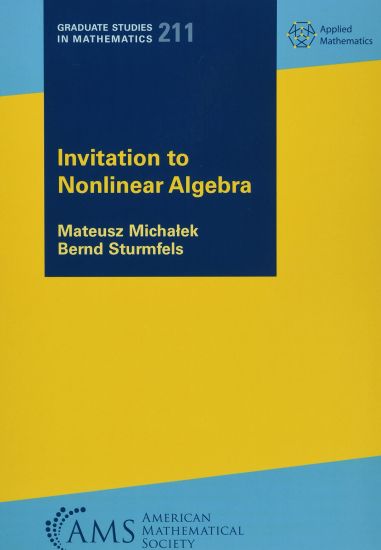
Invitation to Nonlinear Algebra

Invitation to Nonlinear Algebra

Mateusz Michalek; Bernd Sturmfels

American Mathematical Society
2021
nidottu
Nonlinear algebra provides modern mathematical tools to address challenges arising in the sciences and engineering. It is useful everywhere, where polynomials appear: in particular, data and computational sciences, statistics, physics, optimization. The book offers an invitation to this broad and fast-developing area. It is not an extensive encyclopedia of known results, but rather a first introduction to the subject, allowing the reader to enter into more advanced topics. It was designed as the next step after linear algebra and well before abstract algebraic geometry. The book presents both classical topics--like the Nullstellensatz and primary decomposition--and more modern ones--like tropical geometry and semidefinite programming. The focus lies on interactions and applications. Each of the thirteen chapters introduces fundamental concepts. The book may be used for a one-semester course, and the over 200 exercises will help the readers to deepen their understanding of the subject.
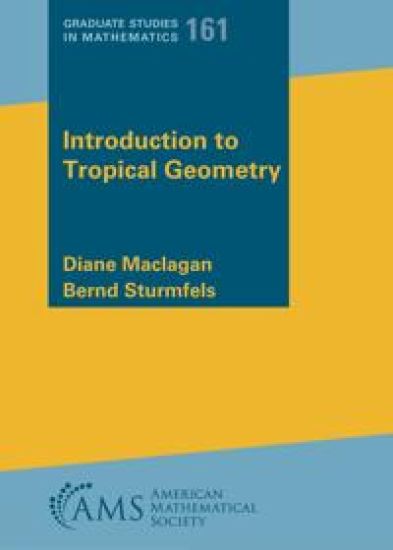
Introduction to Tropical Geometry

Introduction to Tropical Geometry

Diane Maclagan; Bernd Sturmfels

AMERICAN MATHEMATICAL SOCIETY
2015
nidottu
Tropical geometry is a combinatorial shadow of algebraic geometry, offering new polyhedral tools to compute invariants of algebraic varieties. It is based on tropical algebra, where the sum of two numbers is their minimum and the product is their sum. This turns polynomials into piecewise-linear functions, and their zero sets into polyhedral complexes. These tropical varieties retain a surprising amount of information about their classical counterparts.Tropical geometry is a young subject that has undergone a rapid development since the beginning of the 21st century. While establishing itself as an area in its own right, deep connections have been made to many branches of pure and applied mathematics.This book offers a self-contained introduction to tropical geometry, suitable as a course text for beginning graduate students. Proofs are provided for the main results, such as the Fundamental Theorem and the Structure Theorem. Numerous examples and explicit computations illustrate the main concepts. Each of the six chapters concludes with problems that will help the readers to practice their tropical skills, and to gain access to the research literature.
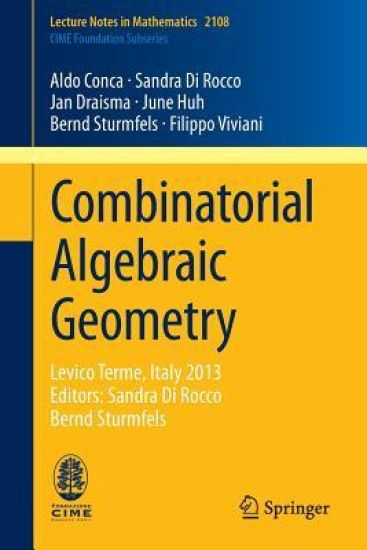
Combinatorial Algebraic Geometry

Combinatorial Algebraic Geometry

Aldo Conca; Sandra Di Rocco; Jan Draisma; June Huh; Bernd Sturmfels; Filippo Viviani

Springer International Publishing AG
2014
nidottu
Combinatorics and Algebraic Geometry have enjoyed a fruitful interplay since the nineteenth century. Classical interactions include invariant theory, theta functions and enumerative geometry. The aim of this volume is to introduce recent developments in combinatorial algebraic geometry and to approach algebraic geometry with a view towards applications, such as tensor calculus and algebraic statistics. A common theme is the study of algebraic varieties endowed with a rich combinatorial structure. Relevant techniques include polyhedral geometry, free resolutions, multilinear algebra, projective duality and compactifications.
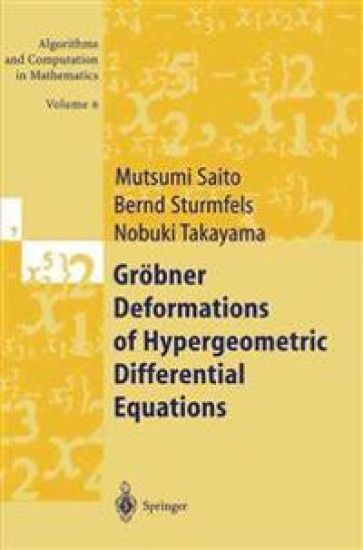
Gröbner Deformations of Hypergeometric Differential Equations

Gröbner Deformations of Hypergeometric Differential Equations

Mutsumi Saito; Bernd Sturmfels; Nobuki Takayama

Springer-Verlag Berlin and Heidelberg GmbH Co. K
2011
nidottu
In recent years, new algorithms for dealing with rings of differential operators have been discovered and implemented. A main tool is the theory of Gröbner bases, which is reexamined here from the point of view of geometric deformations. Perturbation techniques have a long tradition in analysis; Gröbner deformations of left ideals in the Weyl algebra are the algebraic analogue to classical perturbation techniques. The algorithmic methods introduced here are particularly useful for studying the systems of multidimensional hypergeometric PDEs introduced by Gelfand, Kapranov and Zelevinsky. The Gröbner deformation of these GKZ hypergeometric systems reduces problems concerning hypergeometric functions to questions about commutative monomial ideals, and leads to an unexpected interplay between analysis and combinatorics. This book contains a number of original research results on holonomic systems and hypergeometric functions, and raises many open problems for future research in this area.
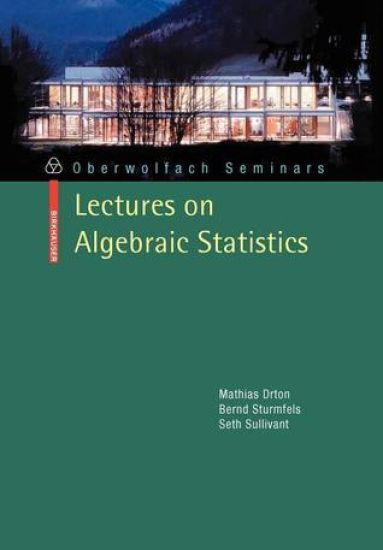
Lectures on Algebraic Statistics

Lectures on Algebraic Statistics

Mathias Drton; Bernd Sturmfels; Seth Sullivant

Birkhauser Verlag AG
2008
nidottu
How does an algebraic geometer studying secant varieties further the understanding of hypothesis tests in statistics? Why would a statistician working on factor analysis raise open problems about determinantal varieties? Connections of this type are at the heart of the new field of "algebraic statistics". In this field, mathematicians and statisticians come together to solve statistical inference problems using concepts from algebraic geometry as well as related computational and combinatorial techniques. The goal of these lectures is to introduce newcomers from the different camps to algebraic statistics. The introduction will be centered around the following three observations: many important statistical models correspond to algebraic or semi-algebraic sets of parameters; the geometry of these parameter spaces determines the behaviour of widely used statistical inference procedures; computational algebraic geometry can be used to study parameter spaces and other features of statistical models.
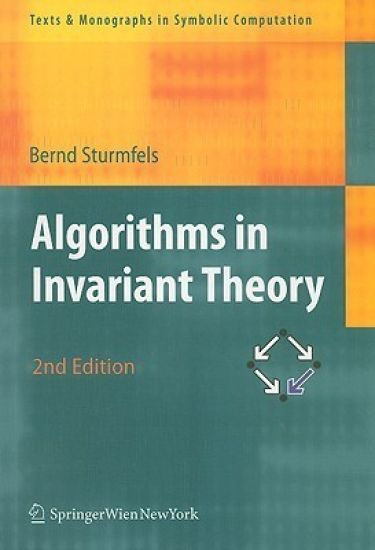
Algorithms in Invariant Theory

Algorithms in Invariant Theory

Bernd Sturmfels

Springer Verlag GmbH
2008
nidottu
J. Kung and G.-C. Rota, in their 1984 paper, write: “Like the Arabian phoenix rising out of its ashes, the theory of invariants, pronounced dead at the turn of the century, is once again at the forefront of mathematics”. The book of Sturmfels is both an easy-to-read textbook for invariant theory and a challenging research monograph that introduces a new approach to the algorithmic side of invariant theory. The Groebner bases method is the main tool by which the central problems in invariant theory become amenable to algorithmic solutions. Students will find the book an easy introduction to this “classical and new” area of mathematics. Researchers in mathematics, symbolic computation, and computer science will get access to a wealth of research ideas, hints for applications, outlines and details of algorithms, worked out examples, and research problems.
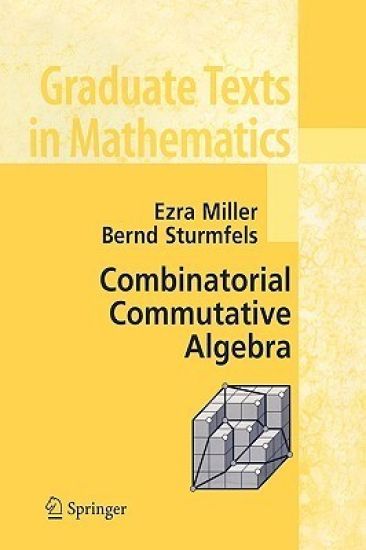
Combinatorial Commutative Algebra

Combinatorial Commutative Algebra

Ezra Miller; Bernd Sturmfels

Springer-Verlag New York Inc.
2005
nidottu
Combinatorial commutative algebra is an active area of research with thriving connections to other fields of pure and applied mathematics. This book provides a self-contained introduction to the subject, with an emphasis on combinatorial techniques for multigraded polynomial rings, semigroup algebras, and determinantal rings. The eighteen chapters cover a broad spectrum of topics, ranging from homological invariants of monomial ideals and their polyhedral resolutions, to hands-on tools for studying algebraic varieties with group actions, such as toric varieties, flag varieties, quiver loci, and Hilbert schemes. Over 100 figures, 250 exercises, and pointers to the literature make this book appealing to both graduate students and researchers.
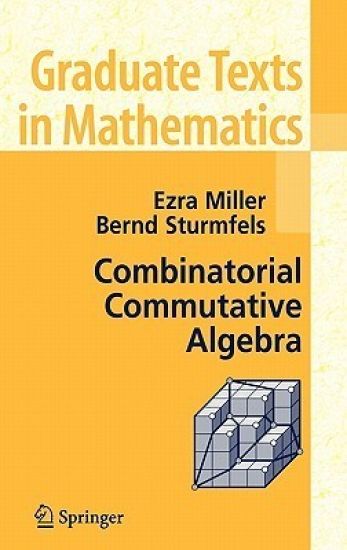
Combinatorial Commutative Algebra

Combinatorial Commutative Algebra

Ezra Miller; Bernd Sturmfels

Springer-Verlag New York Inc.
2004
sidottu
Combinatorial commutative algebra is an active area of research with thriving connections to other fields of pure and applied mathematics. This book provides a self-contained introduction to the subject, with an emphasis on combinatorial techniques for multigraded polynomial rings, semigroup algebras, and determinantal rings. The eighteen chapters cover a broad spectrum of topics, ranging from homological invariants of monomial ideals and their polyhedral resolutions, to hands-on tools for studying algebraic varieties with group actions, such as toric varieties, flag varieties, quiver loci, and Hilbert schemes. Over 100 figures, 250 exercises, and pointers to the literature make this book appealing to both graduate students and researchers.
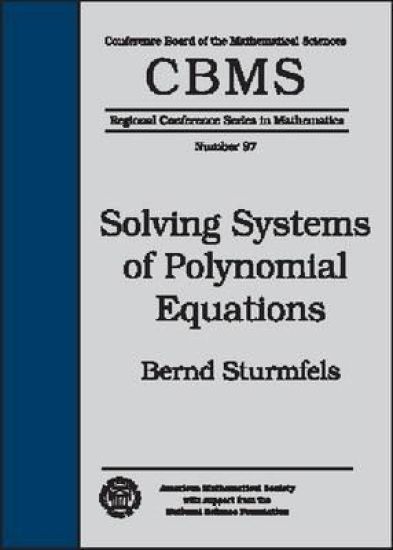
Solving Systems of Polynomial Equations

Solving Systems of Polynomial Equations

Bernd Sturmfels

Amer Mathematical Society
2002
pokkari
A classic problem in mathematics is solving systems of polynomial equations in several unknowns. Today, polynomial models are ubiquitous and widely used across the sciences. They arise in robotics, coding theory, optimization, mathematical biology, computer vision, game theory, statistics, and numerous other areas. This book furnishes a bridge across mathematical disciplines and exposes many facets of systems of polynomial equations. It covers a wide spectrum of mathematical techniques and algorithms, both symbolic and numerical.The set of solutions to a system of polynomial equations is an algebraic variety - the basic object of algebraic geometry. The algorithmic study of algebraic varieties is the central theme of computational algebraic geometry. Exciting recent developments in computer software for geometric calculations have revolutionized the field. Formerly inaccessible problems are now tractable, providing fertile ground for experimentation and conjecture. The first half of the book gives a snapshot of the state of the art of the topic.Familiar themes are covered in the first five chapters, including polynomials in one variable, Grobner bases of zero-dimensional ideals, Newton polytopes and Bernstein's Theorem, multidimensional resultants, and primary decomposition.The second half of the book explores polynomial equations from a variety of novel and unexpected angles. It introduces interdisciplinary connections, discusses highlights of current research, and outlines possible future algorithms. Topics include computation of Nash equilibria in game theory, semidefinite programming and the real Nullstellensatz, the algebraic geometry of statistical models, the piecewise-linear geometry of valuations and amoebas, and the Ehrenpreis-Palamodov theorem on linear partial differential equations with constant coefficients.Throughout the text, there are many hands-on examples and exercises, including short but complete sessions in MapleR, MATLABR, Macaulay 2, Singular, PHCpack, CoCoA, and SOSTools software. These examples will be particularly useful for readers with no background in algebraic geometry or commutative algebra.Within minutes, readers can learn how to type in polynomial equations and actually see some meaningful results on their computer screens. Prerequisites include basic abstract and computational algebra. The book is designed as a text for a graduate course in computational algebra.
Oriented Matroids

Oriented Matroids

Anders Björner; Michel Las Vergnas; Bernd Sturmfels; Neil White; Gunter M. Ziegler

Cambridge University Press
1999
pokkari
Oriented matroids are a very natural mathematical concept which presents itself in many different guises and which has connections and applications to many different areas. These include discrete and computational geometry, combinatorics, convexity, topology, algebraic geometry, operations research, computer science and theoretical chemistry. This is the second edition of the first comprehensive, accessible account of the subject. It is intended for a diverse audience: graduate students who wish to learn the subject from scratch; researchers in the various fields of application who want to concentrate on certain aspects of the theory; specialists who need a thorough reference work; and others at academic points in between. A list of exercises and open problems ends each chapter. For the second edition, the authors have expanded the bibliography greatly to ensure that it remains comprehensive and up-to-date, and they have also added an appendix surveying research since the work was first published.
Gröbner Deformations of Hypergeometric Differential Equations

Gröbner Deformations of Hypergeometric Differential Equations

Mutsumi Saito; Bernd Sturmfels; Nobuki Takayama

Springer-Verlag Berlin and Heidelberg GmbH Co. K
1999
sidottu
In recent years, new algorithms for dealing with rings of differential operators have been discovered and implemented. A main tool is the theory of Gröbner bases, which is reexamined here from the point of view of geometric deformations. Perturbation techniques have a long tradition in analysis; Gröbner deformations of left ideals in the Weyl algebra are the algebraic analogue to classical perturbation techniques. The algorithmic methods introduced here are particularly useful for studying the systems of multidimensional hypergeometric PDEs introduced by Gelfand, Kapranov and Zelevinsky. The Gröbner deformation of these GKZ hypergeometric systems reduces problems concerning hypergeometric functions to questions about commutative monomial ideals, and leads to an unexpected interplay between analysis and combinatorics. This book contains a number of original research results on holonomic systems and hypergeometric functions, and raises many open problems for future research in this area.
Grobner Bases and Convex Polytopes

Grobner Bases and Convex Polytopes

Bernd Sturmfels

Amer Mathematical Society
1995
pokkari
This book is about the interplay of computational commutative algebra and the theory of convex polytopes. It centers around a special class of ideals in a polynomial ring: the class of toric ideals. They are characterized as those prime ideals that are generated by monomial differences or as the defining ideals of toric varieties (not necessarily normal). The interdisciplinary nature of the study of Grobner bases is reflected by the specific applications appearing in this book. These applications lie in the domains of integer programming and computational statistics. The mathematical tools presented in the volume are drawn from commutative algebra, combinatorics, and polyhedral geometry.
Computational Synthetic Geometry

Computational Synthetic Geometry

Jürgen Bokowski; Bernd Sturmfels

Springer-Verlag Berlin and Heidelberg GmbH Co. K
1989
nidottu
Computational synthetic geometry deals with methods for realizing abstract geometric objects in concrete vector spaces. This research monograph considers a large class of problems from convexity and discrete geometry including constructing convex polytopes from simplicial complexes, vector geometries from incidence structures and hyperplane arrangements from oriented matroids. It turns out that algorithms for these constructions exist if and only if arbitrary polynomial equations are decidable with respect to the underlying field. Besides such complexity theorems a variety of symbolic algorithms are discussed, and the methods are applied to obtain new mathematical results on convex polytopes, projective configurations and the combinatorics of Grassmann varieties. Finally algebraic varieties characterizing matroids and oriented matroids are introduced providing a new basis for applying computer algebra methods in this field. The necessary background knowledge is reviewed briefly. The text is accessible to students with graduate level background in mathematics, and will serve professional geometers and computer scientists as an introduction and motivation for further research.