Kirjojen hintavertailu. Mukana 12 595 353 kirjaa ja 12 kauppaa.

Kirjailija

Bernhard P. Lampe

Kirjat ja teokset yhdessä paikassa: 6 kirjaa, julkaisuja vuosilta 2000-2020, suosituimpien joukossa Computer Controlled Systems. Vertaile teosten hintoja ja tarkista saatavuus suomalaisista kirjakaupoista.

6 kirjaa

Kirjojen julkaisuhaarukka 2000-2020.

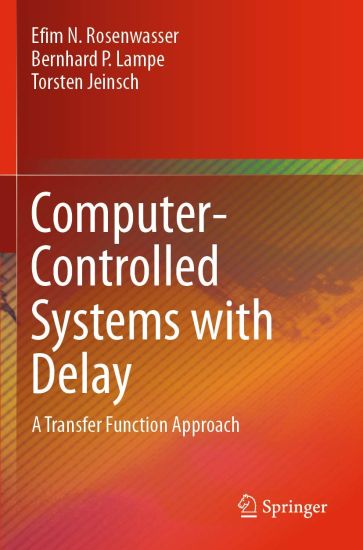
Computer-Controlled Systems with Delay

Computer-Controlled Systems with Delay

Efim N. Rosenwasser; Bernhard P. Lampe; Torsten Jeinsch

Springer Nature Switzerland AG
2020
nidottu
Computer-Controlled Systems with Delay is a systematic study of the problems of analysis and synthesis for multidimensional sampled-data (SD) systems with delay. It is based on the frequency polynomial method, in which the concept of a parametric transfer matrix (PTM) plays a key role. Until now, no alternative general methods have been available to solve the above problems. The text is divided into three parts: background information from the theory of polynomial and rational matrices, helps the reader to acquire the basic understanding necessary to use the main content of the book without addressing additional sources; methods for the mathematical description of multidimensional SD systems with delay, based on the concept of the PTM; and optimization methods for multidimensional SD systems with delay, including H2 andL2 optimization as well as H2 optimization for colored input signals. The monograph is completed by three appendices. An algorithm for constructing the set of pathological sampling periods for a continuous SISO object with delay is provided first. MATLAB®-toolbox algorithms representing methods described in the book and application examples for selected optimization problems are given in the second. A solution to the problem of guaranteeing the required performance in a class of stochastic disturbances for SD systems with delay is considered in the third. Computer-Controlled Systems with Delay is intended for engineers, scientists and teachers working in modern control theory. It will also benefit post-graduate students taking courses in related disciplines. The book continues the description of the authors’ research results on developing methods for SD systems theory which are based onthe PTM concept and published in the monographs Computer Controlled Systems and Multivariable Computer-controlled Systems.
Computer-Controlled Systems with Delay

Computer-Controlled Systems with Delay

Efim N. Rosenwasser; Bernhard P. Lampe; Torsten Jeinsch

Springer Nature Switzerland AG
2019
sidottu
Computer-Controlled Systems with Delay is a systematic study of the problems of analysis and synthesis for multidimensional sampled-data (SD) systems with delay. It is based on the frequency polynomial method, in which the concept of a parametric transfer matrix (PTM) plays a key role. Until now, no alternative general methods have been available to solve the above problems. The text is divided into three parts: background information from the theory of polynomial and rational matrices, helps the reader to acquire the basic understanding necessary to use the main content of the book without addressing additional sources; methods for the mathematical description of multidimensional SD systems with delay, based on the concept of the PTM; and optimization methods for multidimensional SD systems with delay, including H2 andL2 optimization as well as H2 optimization for colored input signals. The monograph is completed by three appendices. An algorithm for constructing the set of pathological sampling periods for a continuous SISO object with delay is provided first. MATLAB®-toolbox algorithms representing methods described in the book and application examples for selected optimization problems are given in the second. A solution to the problem of guaranteeing the required performance in a class of stochastic disturbances for SD systems with delay is considered in the third. Computer-Controlled Systems with Delay is intended for engineers, scientists and teachers working in modern control theory. It will also benefit post-graduate students taking courses in related disciplines. The book continues the description of the authors’ research results on developing methods for SD systems theory which are based onthe PTM concept and published in the monographs Computer Controlled Systems and Multivariable Computer-controlled Systems.
Computer Controlled Systems

Computer Controlled Systems

Efim N. Rosenwasser; Bernhard P. Lampe

Springer London Ltd
2012
nidottu
Digital elements such as signal processors, microcontrollers or industrial PCs are widely used for filtering and control of continuous-time processes or plants. Because of the serial operation mode of these digital elements the continuous­ time processes cannot be served continuously. That is why continuous-time and discrete-time signals occur simultaneously in systems of this kind. The continuous (real) time also contains the discrete time instants - therefore, a complete and accurate description of such systems in continuous time is pos­ sible. However, this description proves to be more complicated, because the hybrid system becomes time-variable, also in cases, where all continuous-time processes and all digital elements are time invariant. Often digital elements operate with a fixed time period T, that leads to a periodically time-variable system. Besides the time sampling the use of analogue to digital and digital to analogue converters together with the finite numerical precision of the processors also results in amplitude quantization of the measuring and control signals. Taking into account these effects would lead to nonlinear models. Because these effects are often of minor influence but difficult in handling, in theory and practice it is generally accepted to consider mainly the pure time-quantization effect. Systems containing both continuous-time and discrete-time signals are usually called sampled-data systems (SD systems).
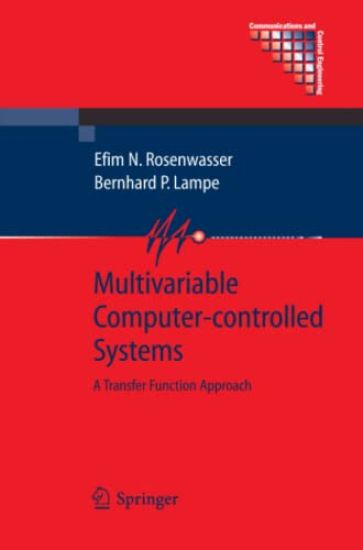
Multivariable Computer-controlled Systems

Multivariable Computer-controlled Systems

Efim N. Rosenwasser; Bernhard P. Lampe

Springer London Ltd
2010
nidottu
Although the transfer function approach is widely used in classical control theory, computer-controlled continuous-time processes are a very important subset of periodic sampled-data systems which are not treatable using ordinary transfer functions. The authors show how parametric transfer functions, which incorporate time-dependence, can be used to give a complete exposition of analysis and design methods for multi-input, multi-output (MIMO) sampled-data systems. Multivariable Computer-controlled Systems is divided into three parts: - Preliminary algebraic material necessary in later chapters. - Control problems, important in their own right but also having a substantial bearing on what follows. - Frequency methods for the investigation of MIMO sampled-data systems (parametric discrete-time models; stability; stochastic methods; H2 optimization and L2 design). Appendices covering basic mathematical formulae and two MATLAB® toolboxes round out this self-contained guide.
Multivariable Computer-controlled Systems

Multivariable Computer-controlled Systems

Efim N. Rosenwasser; Bernhard P. Lampe

Springer London Ltd
2006
sidottu
Although the transfer function approach is widely used in classical control theory, computer-controlled continuous-time processes are a very important subset of periodic sampled-data systems which are not treatable using ordinary transfer functions. The authors show how parametric transfer functions, which incorporate time-dependence, can be used to give a complete exposition of analysis and design methods for multi-input, multi-output (MIMO) sampled-data systems. Multivariable Computer-controlled Systems is divided into three parts: - Preliminary algebraic material necessary in later chapters. - Control problems, important in their own right but also having a substantial bearing on what follows. - Frequency methods for the investigation of MIMO sampled-data systems (parametric discrete-time models; stability; stochastic methods; H2 optimization and L2 design). Appendices covering basic mathematical formulae and two MATLAB® toolboxes round out this self-contained guide.
Computer Controlled Systems

Computer Controlled Systems

Efim N. Rosenwasser; Bernhard P. Lampe

Springer London Ltd
2000
sidottu
Digital elements such as signal processors, microcontrollers or industrial PCs are widely used for filtering and control of continuous-time processes or plants. Because of the serial operation mode of these digital elements the continuous­ time processes cannot be served continuously. That is why continuous-time and discrete-time signals occur simultaneously in systems of this kind. The continuous (real) time also contains the discrete time instants - therefore, a complete and accurate description of such systems in continuous time is pos­ sible. However, this description proves to be more complicated, because the hybrid system becomes time-variable, also in cases, where all continuous-time processes and all digital elements are time invariant. Often digital elements operate with a fixed time period T, that leads to a periodically time-variable system. Besides the time sampling the use of analogue to digital and digital to analogue converters together with the finite numerical precision of the processors also results in amplitude quantization of the measuring and control signals. Taking into account these effects would lead to nonlinear models. Because these effects are often of minor influence but difficult in handling, in theory and practice it is generally accepted to consider mainly the pure time-quantization effect. Systems containing both continuous-time and discrete-time signals are usually called sampled-data systems (SD systems).