Kirjojen hintavertailu. Mukana 12 595 353 kirjaa ja 12 kauppaa.

Kirjailija

Berthold-georg Englert

Kirjat ja teokset yhdessä paikassa: 25 kirjaa, julkaisuja vuosilta 2006-2025, suosituimpien joukossa Lectures On Quantum State Estimation. Vertaile teosten hintoja ja tarkista saatavuus suomalaisista kirjakaupoista.

25 kirjaa

Kirjojen julkaisuhaarukka 2006-2025.

Lectures On Quantum State Estimation

Lectures On Quantum State Estimation

Berthold-georg Englert

WORLD SCIENTIFIC PUBLISHING CO PTE LTD
2025
sidottu
This is the 7th book in the author's 'Lectures on ...' book series, and the first aimed at graduate-level readers (two additional graduate texts are in preparation). Primarily intended for physics graduate students, the book is accessible to advanced undergraduates and will appeal to students with a background in statistics and a keen interest in quantum physics. By the end of this book, readers will be well-prepared for working on research projects that require the drawing of inference from the noisy data collected in quantum experiments, as epitomized by quantum state estimation.The book begins with chapters on the basics of estimation theory and the basics of quantum theory. This includes, in particular, the roles played by the frequentist methods of statistics, which are crucial when planning an experiment, and the Bayesian methods, which are the tools for drawing inference from the actual data gathered. A central concept is that of optimal error regions that supplement the point estimators ('best guesses') with the analogs of error bars in the high-dimensional parameter space; there is, in particular, the plausible region which comprises all point estimators supported by the data.Practical applications require the evaluation of high-dimensional integrals with the aid of Monte Carlo integration. For that, one needs to draw samples of quantum states from the relevant distributions, namely the priors and posteriors of Bayesian methodology. The book discusses the algorithms well-suited for this kind of sampling, which is central to the processing of real-life data.The book illustrates all concepts with pertinent examples and offers numerous exerciseswhich the readers can practice and perfect their skills with. The presentation is detailed and does not skip technical steps, which makes the book particularly valuable for self-studying readers and as textbook adopted by lecturers teaching courses on this or related topics. While the book is based on lecture notes developed for the author's courses on quantum state estimation at NUS and BIT, this book also offers a comprehensive account of the concepts and methods developed in the author's group at CQT and presents this material in textbook form for the first time.
Lectures On Quantum State Estimation

Lectures On Quantum State Estimation

Berthold-georg Englert

WORLD SCIENTIFIC PUBLISHING CO PTE LTD
2025
nidottu
This is the 7th book in the author's 'Lectures on ...' book series, and the first aimed at graduate-level readers (two additional graduate texts are in preparation). Primarily intended for physics graduate students, the book is accessible to advanced undergraduates and will appeal to students with a background in statistics and a keen interest in quantum physics. By the end of this book, readers will be well-prepared for working on research projects that require the drawing of inference from the noisy data collected in quantum experiments, as epitomized by quantum state estimation.The book begins with chapters on the basics of estimation theory and the basics of quantum theory. This includes, in particular, the roles played by the frequentist methods of statistics, which are crucial when planning an experiment, and the Bayesian methods, which are the tools for drawing inference from the actual data gathered. A central concept is that of optimal error regions that supplement the point estimators ('best guesses') with the analogs of error bars in the high-dimensional parameter space; there is, in particular, the plausible region which comprises all point estimators supported by the data.Practical applications require the evaluation of high-dimensional integrals with the aid of Monte Carlo integration. For that, one needs to draw samples of quantum states from the relevant distributions, namely the priors and posteriors of Bayesian methodology. The book discusses the algorithms well-suited for this kind of sampling, which is central to the processing of real-life data.The book illustrates all concepts with pertinent examples and offers numerous exerciseswhich the readers can practice and perfect their skills with. The presentation is detailed and does not skip technical steps, which makes the book particularly valuable for self-studying readers and as textbook adopted by lecturers teaching courses on this or related topics. While the book is based on lecture notes developed for the author's courses on quantum state estimation at NUS and BIT, this book also offers a comprehensive account of the concepts and methods developed in the author's group at CQT and presents this material in textbook form for the first time.

Lectures On Quantum Mechanics - Volume 3: Perturbed Evolution

Lectures On Quantum Mechanics - Volume 3: Perturbed Evolution

Berthold-georg Englert

WORLD SCIENTIFIC PUBLISHING CO PTE LTD
2024
sidottu
Note: *The three volumes are not sequential but rather independent of each other and largely self-contained.Basic Matters is a first introduction to quantum mechanics that does not assume any prior knowledge of the subject. The emphasis is on the general structure as the necessary foundation of any understanding. Starting from the simplest quantum phenomenon, the Stern-Gerlach experiment with its choice between two discrete outcomes, and ending with one-dimensional continuous systems, the physical concepts and notions as well as the mathematical formalism of quantum mechanics are developed in successive, manageable steps. The presentation is modern inasmuch as the natural language of the trade — Dirac's kets and bras and so on — is introduced early, and the temporal evolution is dealt with in a picture-free manner, with Schrödinger's and Heisenberg's equations of motion side by side and on equal footing.The reader of Simple Systems is not expected to be familiar with the material in Basic Matters, but should have the minimal knowledge of a standard brief introduction to quantum mechanics with its typical emphasis on one-dimensional position wave functions. The step to Dirac's more abstract and much more powerful formalism is taken immediately, followed by reviews of quantum kinematics and quantum dynamics. The important standard examples (force-free motion, constant force, harmonic oscillator, hydrogen-like atoms) are then treated in considerable detail, whereby a nonstandard perspective is offered wherever it is deemed feasible and useful. A final chapter is devoted to approximation methods, from the Hellmann-Feynman theorem to the WKB quantization rule.Perturbed Evolution has a closer link to Simple Systems than it has to Basic Matters, but any reader familiar with the subject matter of a solid introduction to quantum mechanics — such as Dirac's formalism of kets and bras, Schrödinger's and Heisenberg's equations of motion, and the standard examples that can be treated exactly, with harmonic oscillators and hydrogen-like atoms among them — can cope with the somewhat advanced material of this volume. The basics of kinematics and dynamics are reviewed at the outset, including discussions of Bohr's principle of complementarity and Schwinger's quantum action principle. The Born series, the Lippmann-Schwinger equation, and Fermi's golden rule are recurring themes in the treatment of the central subject matter — the evolution in the presence of perturbing interactions for which there are no exact solutions as one has them for the standard examples in Simple Systems. The scattering by a localized potential is regarded as a perturbed evolution of a particular kind and is dealt with accordingly. The unique features of the scattering of indistinguishable quantum objects illustrate the nonclassical properties of bosons and fermions and prepare the groundwork for a discussion of multi-electron atoms.
Lectures On Quantum Mechanics - Volume 1: Basic Matters

Lectures On Quantum Mechanics - Volume 1: Basic Matters

Berthold-georg Englert

WORLD SCIENTIFIC PUBLISHING CO PTE LTD
2024
sidottu
Note: *The three volumes are not sequential but rather independent of each other and largely self-contained.Basic Matters is a first introduction to quantum mechanics that does not assume any prior knowledge of the subject. The emphasis is on the general structure as the necessary foundation of any understanding. Starting from the simplest quantum phenomenon, the Stern-Gerlach experiment with its choice between two discrete outcomes, and ending with one-dimensional continuous systems, the physical concepts and notions as well as the mathematical formalism of quantum mechanics are developed in successive, manageable steps. The presentation is modern inasmuch as the natural language of the trade — Dirac's kets and bras and so on — is introduced early, and the temporal evolution is dealt with in a picture-free manner, with Schrödinger's and Heisenberg's equations of motion side by side and on equal footing.The reader of Simple Systems is not expected to be familiar with the material in Basic Matters, but should have the minimal knowledge of a standard brief introduction to quantum mechanics with its typical emphasis on one-dimensional position wave functions. The step to Dirac's more abstract and much more powerful formalism is taken immediately, followed by reviews of quantum kinematics and quantum dynamics. The important standard examples (force-free motion, constant force, harmonic oscillator, hydrogen-like atoms) are then treated in considerable detail, whereby a nonstandard perspective is offered wherever it is deemed feasible and useful. A final chapter is devoted to approximation methods, from the Hellmann-Feynman theorem to the WKB quantization rule.Perturbed Evolution has a closer link to Simple Systems than it has to Basic Matters, but any reader familiar with the subject matter of a solid introduction to quantum mechanics — such as Dirac's formalism of kets and bras, Schrödinger's and Heisenberg's equations of motion, and the standard examples that can be treated exactly, with harmonic oscillators and hydrogen-like atoms among them — can cope with the somewhat advanced material of this volume. The basics of kinematics and dynamics are reviewed at the outset, including discussions of Bohr's principle of complementarity and Schwinger's quantum action principle. The Born series, the Lippmann-Schwinger equation, and Fermi's golden rule are recurring themes in the treatment of the central subject matter — the evolution in the presence of perturbing interactions for which there are no exact solutions as one has them for the standard examples in Simple Systems. The scattering by a localized potential is regarded as a perturbed evolution of a particular kind and is dealt with accordingly. The unique features of the scattering of indistinguishable quantum objects illustrate the nonclassical properties of bosons and fermions and prepare the groundwork for a discussion of multi-electron atoms.
Lectures On Quantum Mechanics - Volume 2: Simple Systems

Lectures On Quantum Mechanics - Volume 2: Simple Systems

Berthold-georg Englert

WORLD SCIENTIFIC PUBLISHING CO PTE LTD
2024
sidottu
Note: *The three volumes are not sequential but rather independent of each other and largely self-contained.Basic Matters is a first introduction to quantum mechanics that does not assume any prior knowledge of the subject. The emphasis is on the general structure as the necessary foundation of any understanding. Starting from the simplest quantum phenomenon, the Stern-Gerlach experiment with its choice between two discrete outcomes, and ending with one-dimensional continuous systems, the physical concepts and notions as well as the mathematical formalism of quantum mechanics are developed in successive, manageable steps. The presentation is modern inasmuch as the natural language of the trade — Dirac's kets and bras and so on — is introduced early, and the temporal evolution is dealt with in a picture-free manner, with Schrödinger's and Heisenberg's equations of motion side by side and on equal footing.The reader of Simple Systems is not expected to be familiar with the material in Basic Matters, but should have the minimal knowledge of a standard brief introduction to quantum mechanics with its typical emphasis on one-dimensional position wave functions. The step to Dirac's more abstract and much more powerful formalism is taken immediately, followed by reviews of quantum kinematics and quantum dynamics. The important standard examples (force-free motion, constant force, harmonic oscillator, hydrogen-like atoms) are then treated in considerable detail, whereby a nonstandard perspective is offered wherever it is deemed feasible and useful. A final chapter is devoted to approximation methods, from the Hellmann-Feynman theorem to the WKB quantization rule.Perturbed Evolution has a closer link to Simple Systems than it has to Basic Matters, but any reader familiar with the subject matter of a solid introduction to quantum mechanics — such as Dirac's formalism of kets and bras, Schrödinger's and Heisenberg's equations of motion, and the standard examples that can be treated exactly, with harmonic oscillators and hydrogen-like atoms among them — can cope with the somewhat advanced material of this volume. The basics of kinematics and dynamics are reviewed at the outset, including discussions of Bohr's principle of complementarity and Schwinger's quantum action principle. The Born series, the Lippmann-Schwinger equation, and Fermi's golden rule are recurring themes in the treatment of the central subject matter — the evolution in the presence of perturbing interactions for which there are no exact solutions as one has them for the standard examples in Simple Systems. The scattering by a localized potential is regarded as a perturbed evolution of a particular kind and is dealt with accordingly. The unique features of the scattering of indistinguishable quantum objects illustrate the nonclassical properties of bosons and fermions and prepare the groundwork for a discussion of multi-electron atoms.
Lectures On Quantum Mechanics (In 3 Companion Volumes)

Lectures On Quantum Mechanics (In 3 Companion Volumes)

Berthold-georg Englert

WORLD SCIENTIFIC PUBLISHING CO PTE LTD
2024
sidottu
Note: *The three volumes are not sequential but rather independent of each other and largely self-contained.Basic Matters is a first introduction to quantum mechanics that does not assume any prior knowledge of the subject. The emphasis is on the general structure as the necessary foundation of any understanding. Starting from the simplest quantum phenomenon, the Stern-Gerlach experiment with its choice between two discrete outcomes, and ending with one-dimensional continuous systems, the physical concepts and notions as well as the mathematical formalism of quantum mechanics are developed in successive, manageable steps. The presentation is modern inasmuch as the natural language of the trade — Dirac's kets and bras and so on — is introduced early, and the temporal evolution is dealt with in a picture-free manner, with Schrödinger's and Heisenberg's equations of motion side by side and on equal footing.The reader of Simple Systems is not expected to be familiar with the material in Basic Matters, but should have the minimal knowledge of a standard brief introduction to quantum mechanics with its typical emphasis on one-dimensional position wave functions. The step to Dirac's more abstract and much more powerful formalism is taken immediately, followed by reviews of quantum kinematics and quantum dynamics. The important standard examples (force-free motion, constant force, harmonic oscillator, hydrogen-like atoms) are then treated in considerable detail, whereby a nonstandard perspective is offered wherever it is deemed feasible and useful. A final chapter is devoted to approximation methods, from the Hellmann-Feynman theorem to the WKB quantization rule.Perturbed Evolution has a closer link to Simple Systems than it has to Basic Matters, but any reader familiar with the subject matter of a solid introduction to quantum mechanics — such as Dirac's formalism of kets and bras, Schrödinger's and Heisenberg's equations of motion, and the standard examples that can be treated exactly, with harmonic oscillators and hydrogen-like atoms among them — can cope with the somewhat advanced material of this volume. The basics of kinematics and dynamics are reviewed at the outset, including discussions of Bohr's principle of complementarity and Schwinger's quantum action principle. The Born series, the Lippmann-Schwinger equation, and Fermi's golden rule are recurring themes in the treatment of the central subject matter — the evolution in the presence of perturbing interactions for which there are no exact solutions as one has them for the standard examples in Simple Systems. The scattering by a localized potential is regarded as a perturbed evolution of a particular kind and is dealt with accordingly. The unique features of the scattering of indistinguishable quantum objects illustrate the nonclassical properties of bosons and fermions and prepare the groundwork for a discussion of multi-electron atoms.
Lectures On Quantum Mechanics - Volume 1: Basic Matters

Lectures On Quantum Mechanics - Volume 1: Basic Matters

Berthold-georg Englert

WORLD SCIENTIFIC PUBLISHING CO PTE LTD
2024
nidottu
Note: *The three volumes are not sequential but rather independent of each other and largely self-contained.Basic Matters is a first introduction to quantum mechanics that does not assume any prior knowledge of the subject. The emphasis is on the general structure as the necessary foundation of any understanding. Starting from the simplest quantum phenomenon, the Stern-Gerlach experiment with its choice between two discrete outcomes, and ending with one-dimensional continuous systems, the physical concepts and notions as well as the mathematical formalism of quantum mechanics are developed in successive, manageable steps. The presentation is modern inasmuch as the natural language of the trade — Dirac's kets and bras and so on — is introduced early, and the temporal evolution is dealt with in a picture-free manner, with Schrödinger's and Heisenberg's equations of motion side by side and on equal footing.The reader of Simple Systems is not expected to be familiar with the material in Basic Matters, but should have the minimal knowledge of a standard brief introduction to quantum mechanics with its typical emphasis on one-dimensional position wave functions. The step to Dirac's more abstract and much more powerful formalism is taken immediately, followed by reviews of quantum kinematics and quantum dynamics. The important standard examples (force-free motion, constant force, harmonic oscillator, hydrogen-like atoms) are then treated in considerable detail, whereby a nonstandard perspective is offered wherever it is deemed feasible and useful. A final chapter is devoted to approximation methods, from the Hellmann-Feynman theorem to the WKB quantization rule.Perturbed Evolution has a closer link to Simple Systems than it has to Basic Matters, but any reader familiar with the subject matter of a solid introduction to quantum mechanics — such as Dirac's formalism of kets and bras, Schrödinger's and Heisenberg's equations of motion, and the standard examples that can be treated exactly, with harmonic oscillators and hydrogen-like atoms among them — can cope with the somewhat advanced material of this volume. The basics of kinematics and dynamics are reviewed at the outset, including discussions of Bohr's principle of complementarity and Schwinger's quantum action principle. The Born series, the Lippmann-Schwinger equation, and Fermi's golden rule are recurring themes in the treatment of the central subject matter — the evolution in the presence of perturbing interactions for which there are no exact solutions as one has them for the standard examples in Simple Systems. The scattering by a localized potential is regarded as a perturbed evolution of a particular kind and is dealt with accordingly. The unique features of the scattering of indistinguishable quantum objects illustrate the nonclassical properties of bosons and fermions and prepare the groundwork for a discussion of multi-electron atoms.
Lectures On Quantum Mechanics - Volume 2: Simple Systems

Lectures On Quantum Mechanics - Volume 2: Simple Systems

Berthold-georg Englert

WORLD SCIENTIFIC PUBLISHING CO PTE LTD
2024
nidottu
Note: *The three volumes are not sequential but rather independent of each other and largely self-contained.Basic Matters is a first introduction to quantum mechanics that does not assume any prior knowledge of the subject. The emphasis is on the general structure as the necessary foundation of any understanding. Starting from the simplest quantum phenomenon, the Stern-Gerlach experiment with its choice between two discrete outcomes, and ending with one-dimensional continuous systems, the physical concepts and notions as well as the mathematical formalism of quantum mechanics are developed in successive, manageable steps. The presentation is modern inasmuch as the natural language of the trade — Dirac's kets and bras and so on — is introduced early, and the temporal evolution is dealt with in a picture-free manner, with Schrödinger's and Heisenberg's equations of motion side by side and on equal footing.The reader of Simple Systems is not expected to be familiar with the material in Basic Matters, but should have the minimal knowledge of a standard brief introduction to quantum mechanics with its typical emphasis on one-dimensional position wave functions. The step to Dirac's more abstract and much more powerful formalism is taken immediately, followed by reviews of quantum kinematics and quantum dynamics. The important standard examples (force-free motion, constant force, harmonic oscillator, hydrogen-like atoms) are then treated in considerable detail, whereby a nonstandard perspective is offered wherever it is deemed feasible and useful. A final chapter is devoted to approximation methods, from the Hellmann-Feynman theorem to the WKB quantization rule.Perturbed Evolution has a closer link to Simple Systems than it has to Basic Matters, but any reader familiar with the subject matter of a solid introduction to quantum mechanics — such as Dirac's formalism of kets and bras, Schrödinger's and Heisenberg's equations of motion, and the standard examples that can be treated exactly, with harmonic oscillators and hydrogen-like atoms among them — can cope with the somewhat advanced material of this volume. The basics of kinematics and dynamics are reviewed at the outset, including discussions of Bohr's principle of complementarity and Schwinger's quantum action principle. The Born series, the Lippmann-Schwinger equation, and Fermi's golden rule are recurring themes in the treatment of the central subject matter — the evolution in the presence of perturbing interactions for which there are no exact solutions as one has them for the standard examples in Simple Systems. The scattering by a localized potential is regarded as a perturbed evolution of a particular kind and is dealt with accordingly. The unique features of the scattering of indistinguishable quantum objects illustrate the nonclassical properties of bosons and fermions and prepare the groundwork for a discussion of multi-electron atoms.
Lectures On Quantum Mechanics - Volume 3: Perturbed Evolution

Lectures On Quantum Mechanics - Volume 3: Perturbed Evolution

Berthold-georg Englert

WORLD SCIENTIFIC PUBLISHING CO PTE LTD
2024
nidottu
Note: *The three volumes are not sequential but rather independent of each other and largely self-contained.Basic Matters is a first introduction to quantum mechanics that does not assume any prior knowledge of the subject. The emphasis is on the general structure as the necessary foundation of any understanding. Starting from the simplest quantum phenomenon, the Stern-Gerlach experiment with its choice between two discrete outcomes, and ending with one-dimensional continuous systems, the physical concepts and notions as well as the mathematical formalism of quantum mechanics are developed in successive, manageable steps. The presentation is modern inasmuch as the natural language of the trade — Dirac's kets and bras and so on — is introduced early, and the temporal evolution is dealt with in a picture-free manner, with Schrödinger's and Heisenberg's equations of motion side by side and on equal footing.The reader of Simple Systems is not expected to be familiar with the material in Basic Matters, but should have the minimal knowledge of a standard brief introduction to quantum mechanics with its typical emphasis on one-dimensional position wave functions. The step to Dirac's more abstract and much more powerful formalism is taken immediately, followed by reviews of quantum kinematics and quantum dynamics. The important standard examples (force-free motion, constant force, harmonic oscillator, hydrogen-like atoms) are then treated in considerable detail, whereby a nonstandard perspective is offered wherever it is deemed feasible and useful. A final chapter is devoted to approximation methods, from the Hellmann-Feynman theorem to the WKB quantization rule.Perturbed Evolution has a closer link to Simple Systems than it has to Basic Matters, but any reader familiar with the subject matter of a solid introduction to quantum mechanics — such as Dirac's formalism of kets and bras, Schrödinger's and Heisenberg's equations of motion, and the standard examples that can be treated exactly, with harmonic oscillators and hydrogen-like atoms among them — can cope with the somewhat advanced material of this volume. The basics of kinematics and dynamics are reviewed at the outset, including discussions of Bohr's principle of complementarity and Schwinger's quantum action principle. The Born series, the Lippmann-Schwinger equation, and Fermi's golden rule are recurring themes in the treatment of the central subject matter — the evolution in the presence of perturbing interactions for which there are no exact solutions as one has them for the standard examples in Simple Systems. The scattering by a localized potential is regarded as a perturbed evolution of a particular kind and is dealt with accordingly. The unique features of the scattering of indistinguishable quantum objects illustrate the nonclassical properties of bosons and fermions and prepare the groundwork for a discussion of multi-electron atoms.
Lectures On Quantum Mechanics (In 3 Companion Volumes)

Lectures On Quantum Mechanics (In 3 Companion Volumes)

Berthold-georg Englert

WORLD SCIENTIFIC PUBLISHING CO PTE LTD
2024
nidottu
Note: *The three volumes are not sequential but rather independent of each other and largely self-contained.Basic Matters is a first introduction to quantum mechanics that does not assume any prior knowledge of the subject. The emphasis is on the general structure as the necessary foundation of any understanding. Starting from the simplest quantum phenomenon, the Stern-Gerlach experiment with its choice between two discrete outcomes, and ending with one-dimensional continuous systems, the physical concepts and notions as well as the mathematical formalism of quantum mechanics are developed in successive, manageable steps. The presentation is modern inasmuch as the natural language of the trade — Dirac's kets and bras and so on — is introduced early, and the temporal evolution is dealt with in a picture-free manner, with Schrödinger's and Heisenberg's equations of motion side by side and on equal footing.The reader of Simple Systems is not expected to be familiar with the material in Basic Matters, but should have the minimal knowledge of a standard brief introduction to quantum mechanics with its typical emphasis on one-dimensional position wave functions. The step to Dirac's more abstract and much more powerful formalism is taken immediately, followed by reviews of quantum kinematics and quantum dynamics. The important standard examples (force-free motion, constant force, harmonic oscillator, hydrogen-like atoms) are then treated in considerable detail, whereby a nonstandard perspective is offered wherever it is deemed feasible and useful. A final chapter is devoted to approximation methods, from the Hellmann-Feynman theorem to the WKB quantization rule.Perturbed Evolution has a closer link to Simple Systems than it has to Basic Matters, but any reader familiar with the subject matter of a solid introduction to quantum mechanics — such as Dirac's formalism of kets and bras, Schrödinger's and Heisenberg's equations of motion, and the standard examples that can be treated exactly, with harmonic oscillators and hydrogen-like atoms among them — can cope with the somewhat advanced material of this volume. The basics of kinematics and dynamics are reviewed at the outset, including discussions of Bohr's principle of complementarity and Schwinger's quantum action principle. The Born series, the Lippmann-Schwinger equation, and Fermi's golden rule are recurring themes in the treatment of the central subject matter — the evolution in the presence of perturbing interactions for which there are no exact solutions as one has them for the standard examples in Simple Systems. The scattering by a localized potential is regarded as a perturbed evolution of a particular kind and is dealt with accordingly. The unique features of the scattering of indistinguishable quantum objects illustrate the nonclassical properties of bosons and fermions and prepare the groundwork for a discussion of multi-electron atoms.
Lectures On Statistical Mechanics

Lectures On Statistical Mechanics

Berthold-georg Englert

World Scientific Publishing Co Pte Ltd
2020
nidottu
These lecture notes cover Statistical Mechanics at the level of advanced undergraduates or postgraduates. After a review of thermodynamics, statistical ensembles are introduced, then applied to ideal gases, including degenerate gases of bosons and fermions, followed by a treatment of systems with interaction, of real gases, and of stochastic processes.The book offers a comprehensive and detailed, as well as self-contained, account of material that can and has been covered in a one-semester course for students with a basic understanding of thermodynamics and a solid background in classical mechanics.
Lectures On Statistical Mechanics

Lectures On Statistical Mechanics

Berthold-georg Englert

World Scientific Publishing Co Pte Ltd
2020
sidottu
These lecture notes cover Statistical Mechanics at the level of advanced undergraduates or postgraduates. After a review of thermodynamics, statistical ensembles are introduced, then applied to ideal gases, including degenerate gases of bosons and fermions, followed by a treatment of systems with interaction, of real gases, and of stochastic processes.The book offers a comprehensive and detailed, as well as self-contained, account of material that can and has been covered in a one-semester course for students with a basic understanding of thermodynamics and a solid background in classical mechanics.
Quantum Computing Devices

Quantum Computing Devices

Goong Chen; David A. Church; Berthold-Georg Englert; Carsten Henkel; Bernd Rohwedder; Marlan O. Scully; M. Suhail Zubairy

CRC Press
2019
nidottu
One of the first books to thoroughly examine the subject, Quantum Computing Devices: Principles, Designs, and Analysis covers the essential components in the design of a "real" quantum computer. It explores contemporary and important aspects of quantum computation, particularly focusing on the role of quantum electronic devices as quantum gates. Largely self-contained and written in a tutorial style, this reference presents the analysis, design, and modeling of the major types of quantum computing devices: ion traps, cavity quantum electrodynamics (QED), linear optics, quantum dots, nuclear magnetic resonance (NMR), superconducting quantum interference devices (SQUID), and neutral atom traps. It begins by explaining the fundamentals and algorithms of quantum computing, followed by the operations and formalisms of quantum systems. For each electronic device, the subsequent chapters discuss physical properties, the setup of qubits, control actions that produce the quantum gates that are universal for quantum computing, relevant measurements, and decoherence properties of the systems. The book also includes tables, diagrams, and figures that illustrate various data, uses, and designs of quantum computing. As nanoelectronics will inevitably replace microelectronics, the development of quantum information science and quantum computing technology is imperative to the future of information science and technology. Quantum Computing Devices: Principles, Designs, and Analysis helps fulfill this need by providing a comprehensive collection of the most promising devices for the future.
Lectures On Classical Mechanics

Lectures On Classical Mechanics

Berthold-georg Englert

World Scientific Publishing Co Pte Ltd
2015
nidottu
These lecture notes cover Classical Mechanics at the level of second-year undergraduates. The book offers comprehensive as well as self-contained material that can be taught in a one-semester course for students with the minimal background knowledge acquired in preuniversity education or in the usual first-year overview. The presentation does not skip the technical details which renders the book particularly well-suited for the self-studying student.
Lectures On Classical Mechanics

Lectures On Classical Mechanics

Berthold-georg Englert

World Scientific Publishing Co Pte Ltd
2015
sidottu
These lecture notes cover Classical Mechanics at the level of second-year undergraduates. The book offers comprehensive as well as self-contained material that can be taught in a one-semester course for students with the minimal background knowledge acquired in preuniversity education or in the usual first-year overview. The presentation does not skip the technical details which renders the book particularly well-suited for the self-studying student.
Lectures On Classical Electrodynamics

Lectures On Classical Electrodynamics

Berthold-georg Englert

World Scientific Publishing Co Pte Ltd
2014
sidottu
These lecture notes cover classical electrodynamics at the level of advanced undergraduates or postgraduates. There is a strong emphasis on the general features of the electromagnetic field and, in particular, on the properties of electromagnetic radiation. It offers a comprehensive and detailed, as well as self-contained, account of material that can be covered in a one-semester course for students with a solid undergraduate knowledge of basic electricity and magnetism.
Lectures On Classical Electrodynamics

Lectures On Classical Electrodynamics

Berthold-georg Englert

World Scientific Publishing Co Pte Ltd
2014
nidottu
These lecture notes cover classical electrodynamics at the level of advanced undergraduates or postgraduates. There is a strong emphasis on the general features of the electromagnetic field and, in particular, on the properties of electromagnetic radiation. It offers a comprehensive and detailed, as well as self-contained, account of material that can be covered in a one-semester course for students with a solid undergraduate knowledge of basic electricity and magnetism.
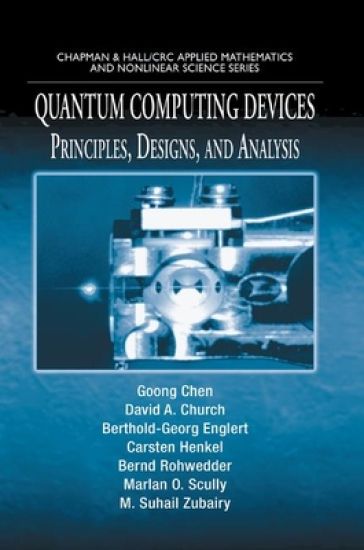
Quantum Computing Devices

Quantum Computing Devices

Goong Chen; David A. Church; Berthold-Georg Englert; Carsten Henkel; Bernd Rohwedder; Marlan O. Scully; M. Suhail Zubairy

Chapman Hall/CRC
2006
sidottu
One of the first books to thoroughly examine the subject, Quantum Computing Devices: Principles, Designs, and Analysis covers the essential components in the design of a "real" quantum computer. It explores contemporary and important aspects of quantum computation, particularly focusing on the role of quantum electronic devices as quantum gates. Largely self-contained and written in a tutorial style, this reference presents the analysis, design, and modeling of the major types of quantum computing devices: ion traps, cavity quantum electrodynamics (QED), linear optics, quantum dots, nuclear magnetic resonance (NMR), superconducting quantum interference devices (SQUID), and neutral atom traps. It begins by explaining the fundamentals and algorithms of quantum computing, followed by the operations and formalisms of quantum systems. For each electronic device, the subsequent chapters discuss physical properties, the setup of qubits, control actions that produce the quantum gates that are universal for quantum computing, relevant measurements, and decoherence properties of the systems. The book also includes tables, diagrams, and figures that illustrate various data, uses, and designs of quantum computing. As nanoelectronics will inevitably replace microelectronics, the development of quantum information science and quantum computing technology is imperative to the future of information science and technology. Quantum Computing Devices: Principles, Designs, and Analysis helps fulfill this need by providing a comprehensive collection of the most promising devices for the future.
Lectures On Quantum Mechanics - Volume 3: Perturbed Evolution

Lectures On Quantum Mechanics - Volume 3: Perturbed Evolution

Berthold-georg Englert

World Scientific Publishing Co Pte Ltd
2006
sidottu
Note: The three volumes are not sequential but rather independent of each other and largely self-contained.Basic Matters is a first introduction to quantum mechanics that does not assume any prior knowledge of the subject. The emphasis is on the general structure as the necessary foundation of any understanding. Starting from the simplest quantum phenomenon, the Stern-Gerlach experiment with its choice between two discrete outcomes, and ending with one-dimensional continuous systems, the physical concepts and notions as well as the mathematical formalism of quantum mechanics are developed in successive, manageable steps. The presentation is modern inasmuch as the natural language of the trade - Dirac's kets and bras and so on - is introduced early, and the temporal evolution is dealt with in a picture-free manner, with Schrödinger's and Heisenberg's equations of motion side by side and on equal footing.The reader of Simple Systems is not expected to be familiar with the material in Basic Matters, but should have the minimal knowledge of a standard brief introduction to quantum mechanics with its typical emphasis on one-dimensional position wave functions. The step to Dirac's more abstract and much more powerful formalism is taken immediately, followed by reviews of quantum kinematics and quantum dynamics. The important standard examples (force-free motion, constant force, harmonic oscillator, hydrogen-like atoms) are then treated in considerable detail, whereby a nonstandard perspective is offered wherever it is deemed feasible and useful. A final chapter is devoted to approximation methods, from the Hellmann-Feynman theorem to the WKB quantization rule.Perturbed Evolution has a closer link to Simple Systems than that volume has to Basic Matters, but any reader familiar with the subject matter of a solid introduction to quantum mechanics - such as Dirac's formalism of kets and bras, Schrödinger's and Heisenberg's equations of motion, and the standard examples that can be treated exactly, with harmonic oscillators and hydrogen-like atoms among them - can cope with the somewhat advanced material of this volume. The basics of kinematics and dynamics are reviewed at the outset, including discussions of Bohr's principle of complementarity and Schwinger's quantum action principle. The Born series, the Lippmann-Schwinger equation, and Fermi's golden rule are recurring themes in the treatment of the central subject matter - the evolution in the presence of perturbing interactions for which there are no exact solutions as one has them for the standard examples in Simple Systems. The scattering by a localized potential is regarded as a perturbed evolution of a particular kind and is dealt with accordingly. The unique features of the scattering of indistinguishable quantum objects illustrate the nonclassical properties of bosons and fermions and prepare the groundwork for a discussion of multi-electron atoms.
Lectures On Quantum Mechanics (In 3 Companion Volumes)

Lectures On Quantum Mechanics (In 3 Companion Volumes)

Berthold-georg Englert

World Scientific Publishing Co Pte Ltd
2006
sidottu
Note: The three volumes are not sequential but rather independent of each other and largely self-contained.Basic Matters is a first introduction to quantum mechanics that does not assume any prior knowledge of the subject. The emphasis is on the general structure as the necessary foundation of any understanding. Starting from the simplest quantum phenomenon, the Stern-Gerlach experiment with its choice between two discrete outcomes, and ending with one-dimensional continuous systems, the physical concepts and notions as well as the mathematical formalism of quantum mechanics are developed in successive, manageable steps. The presentation is modern inasmuch as the natural language of the trade - Dirac's kets and bras and so on - is introduced early, and the temporal evolution is dealt with in a picture-free manner, with Schrödinger's and Heisenberg's equations of motion side by side and on equal footing.The reader of Simple Systems is not expected to be familiar with the material in Basic Matters, but should have the minimal knowledge of a standard brief introduction to quantum mechanics with its typical emphasis on one-dimensional position wave functions. The step to Dirac's more abstract and much more powerful formalism is taken immediately, followed by reviews of quantum kinematics and quantum dynamics. The important standard examples (force-free motion, constant force, harmonic oscillator, hydrogen-like atoms) are then treated in considerable detail, whereby a nonstandard perspective is offered wherever it is deemed feasible and useful. A final chapter is devoted to approximation methods, from the Hellmann-Feynman theorem to the WKB quantization rule.Perturbed Evolution has a closer link to Simple Systems than that volume has to Basic Matters, but any reader familiar with the subject matter of a solid introduction to quantum mechanics - such as Dirac's formalism of kets and bras, Schrödinger's and Heisenberg's equations of motion, and the standard examples that can be treated exactly, with harmonic oscillators and hydrogen-like atoms among them - can cope with the somewhat advanced material of this volume. The basics of kinematics and dynamics are reviewed at the outset, including discussions of Bohr's principle of complementarity and Schwinger's quantum action principle. The Born series, the Lippmann-Schwinger equation, and Fermi's golden rule are recurring themes in the treatment of the central subject matter - the evolution in the presence of perturbing interactions for which there are no exact solutions as one has them for the standard examples in Simple Systems. The scattering by a localized potential is regarded as a perturbed evolution of a particular kind and is dealt with accordingly. The unique features of the scattering of indistinguishable quantum objects illustrate the nonclassical properties of bosons and fermions and prepare the groundwork for a discussion of multi-electron atoms.