Kirjojen hintavertailu. Mukana 12 595 353 kirjaa ja 12 kauppaa.

Kirjailija

Beth E. Lachman

Kirjat ja teokset yhdessä paikassa: 20 kirjaa, julkaisuja vuosilta 1999-2020, suosituimpien joukossa Green Warriors. Vertaile teosten hintoja ja tarkista saatavuus suomalaisista kirjakaupoista.

Mukana myös kirjoitusasut: Beth E Lachman

20 kirjaa

Kirjojen julkaisuhaarukka 1999-2020.

The Army's Local Economic Effects

The Army's Local Economic Effects

Christopher M. Schnaubelt; Craig A. Bond; Frank Camm; Joshua Klimas; Beth E. Lachman; Laurie L. McDonald; Judith D. Mele; Paul Ng; Meagan Smith; Cole Sutera; Christopher Skeels

RAND
2016
pokkari
This report presents findings on the economic activity supported by total Army spending in each of the 435 congressional districts for fiscal years 2012-2014. Using input/output models, researchers estimated that in FY 2014, the Army directly spent approximately $121 million in the median congressional district (in 2012 dollars), translating into about 4,200 jobs and contributing to $375 million of economic output.

Green Warriors

Green Warriors

David E. Mosher; Beth E. Lachman; Michael D. Greenberg; Tiffany Nichols; Brian Rosen; Henry H. Willis

RAND
2008
pokkari
This study assesses whether Army policy, doctrine, and guidance adequately address environmental activities in post-conflict phases of contingencies. A review of policy, doctrine, operational experience, and documentation, as well as interviews with Army personnel, indicates that environmental concerns can have significant impacts.Recommendations are made for improving the Army's approach to environmental issues in contingency operations.It looks at the growing importance of environmental considerations for the Army in contingency operations, and recommendations for ways to better address environmental issues in Army planning, training, policy, guidance, and operations.
Mapping the Risks

Mapping the Risks

John C. Baker; Beth E. Lachman; Dave R. Frelinger; Kevin M. O'Connell; Alexander Hou; Michael S. Tseng; David T. Orletsky; Charles Yost

RAND
2004
pokkari
Assesses the homeland security implications of publicly available geospatial data and information. Following the attacks of September 11, 2001, many agencies within the federal government began restricting some of their publicly available geospatial data and information from such sources as the World Wide Web. As time passes, however, decisionmakers have begun to ask whether and how such information specifically helps potential attackers, including terrorists, to select U.S. homeland sites and prepare for better attacks. The research detailed in this book aims to assist decisionmakers tasked with the responsibility of choosing which geospatial information to make available and which to restrict.
U.S.Commercial Remote Sensing Satellite Industry

U.S.Commercial Remote Sensing Satellite Industry

Kevin M. O'Connell; John C. Baker; Beth E. Lachman; Steven Berner; David R. Frelinger; Kim E. Gavin

RAND
2001
pokkari
Assesses the risks facing U.S. commercial remote sensing satellite firms and explores the U.S. policy and regulatory environment for these firms. American firms have begun to operate their own imaging satellite systems, aiming to become an important part of the U.S. commercial remote sensing industry. To succeed over the long run, these new U.S. commercial remote sensing satellite firms need a combination of reliable technologies, government policies that encourage U.S. industry competitiveness, a strong international presence, and sound business plans to ensure their competitiveness in both the domestic and international marketplaces. The greatest risks for the these firms come from the challenge of transforming themselves from imagery data providers to strong competitors as information age companies; the need to master the technical risks of building and operating sophisticated imaging satellite systems; and the requirement to operate effectively in a complex international business environment.In addition, the government's policymaking process has yet to achieve the degree of predictability, timeliness, and transparency that the firms need if they are expected to operate effectively in a highly competitive and rapidly changing global marketplace. The authors conclude with six recommendations that the U.S. Department of Commerce should adopt to best fulfill its responsibilities for promoting the U.S. commercial remote sensing industry and for encouraging the competitiveness of new private imaging satellite firms. (MP)
Improving the Allocation and Execution of Army Facility Sustainment Funding

Improving the Allocation and Execution of Army Facility Sustainment Funding

Ellen M Pint; Beth E Lachman; Katherine Anania

RAND
2020
nidottu
The U.S. Army has accepted risk in facility sustainment to maintain warfighting readiness, which can result in higher life-cycle costs because it increases the likelihood that facility components break earlier. To identify strategies and make recommendations for improving the allocation and execution of Army installation facility sustainment funding, the authors study practices in the Air Force, Navy, Marine Corps, and public and private sectors.
Assessing the Needs of Soldiers and Their Families at the Garrison Level

Assessing the Needs of Soldiers and Their Families at the Garrison Level

Carra S Sims; Thomas E Trail; Emily K Chen; Erika Meza; Parisa Roshan; Beth E Lachman

RAND
2018
nidottu
In 2014, the RAND Arroyo Center conducted a formal needs assessment survey of active component soldiers and described the broad landscape of needs and resource use. Installations vary in several ways that can affect service delivery. This project analyzed existing survey data at the garrison level and gathered qualitative focus group data to provide unique information, enabling garrisons to see where they do well and where they have challenges.
Army Installation Rail Operations

Army Installation Rail Operations

Ellen M. Pint; Beth E Lachman; Jeremy M Eckhause

RAND
2018
nidottu
The Army relies on commercial rail carriers for off-post rail movements, but it currently has three business models for on-post rail operations: government owned, government operated; government owned, contractor operated; and privatized. In this report, the authors evaluate the three business models and determine whether greater reliance on commercial rail assets could meet Army rail needs at a lower cost.
Water Management, Partnerships, Rights, and Market Trends

Water Management, Partnerships, Rights, and Market Trends

Beth E. Lachman; Susan A. Resetar; Nidhi Kalra; Agnes Gereben Schaefer; Aimee E. Curtright

RAND
2016
pokkari
This report assesses water management, partnerships, rights, and market trends and opportunities, and how Army installations can potentially use them to improve programs and investments in water and wastewater systems. It provides examples from across the United States, along with detailed case studies of two states and two Army installations, and recommends ways to improve installation water security, programs, and infrastructure investments.
The Nevada Test and Training Range (Nttr) and Proposed Wilderness Areas

The Nevada Test and Training Range (Nttr) and Proposed Wilderness Areas

Beth E. Lachman; John A. Ausink; William A. Williams; Katherine Pfrommer; Manuel J. Carrillo

RAND
2016
pokkari
This research seeks to help the U.S. Air Force (USAF) understand the implications for future operations in the Nevada Test and Training Range (NTTR) of Desert National Wildlife Refuge (DNWR) land that overlaps the NTTR. The USAF and the U.S. Fish and Wildlife Service (USFWS) co-manage this land, and some of it is proposed wilderness. The proposed wilderness designation can restrict some desired Air Force activities.
What Should be Classified?

What Should be Classified?

Martin C. Libicki; Brian A. Jackson; David R. Frelinger; Beth E. Lachman; Cesse Ip

RAND
2011
pokkari
The Global Force Management Data Initiative was launched to improve aggregation of unclassified force-structure data. Aggregation, though, raised concerns about classification because the system might be attractive to a potential adversary. The authors develop a framework for evaluating classification decisions to determine that, while overall classification is not indicated, the inclusion of some data will require careful consideration.
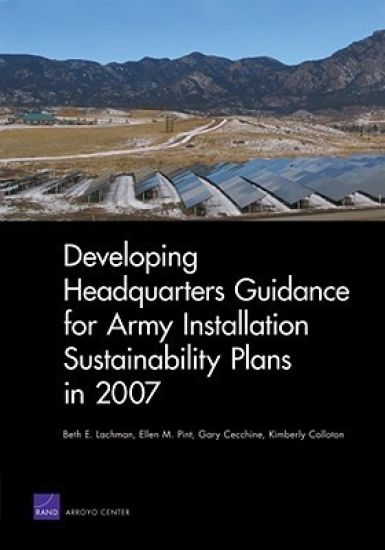
Developing Headquarters Guidance for Army Installation Sustainability Plans in 2007

Developing Headquarters Guidance for Army Installation Sustainability Plans in 2007

Beth E Lachman; Ellen M Pint; Gary Cecchine; Kimberly Colloton

RAND
2010
pokkari
An installation sustainability plan (ISP) documents long-range plans that address mission, community, and environmental issues developed through a strategic planning process. RAND Arroyo Center examined the experiences of Army installations with sustainability planning and made recommendations to help foster the effective development and implementation of ISPs throughout the Army.
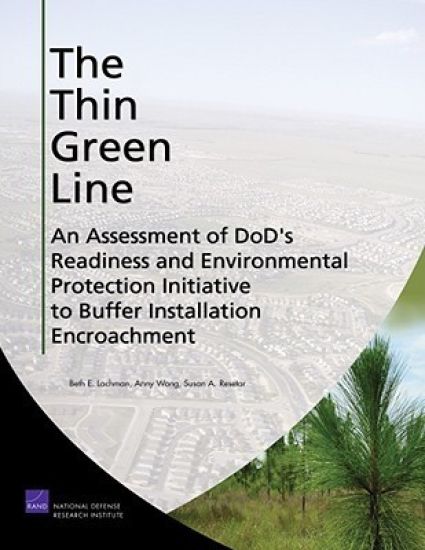
The Thin Green Line

The Thin Green Line

Beth E. Lachman; Anny Wong; Susan A. Resetar

RAND
2008
pokkari
This monograph assesses the effectiveness of DoD's Readiness and Environmental Protection Initiative to help testing and training installations deal with encroachment from sprawl and other sources.The authors identify the main causes of encroachment; detail the benefits, both to the military and local communities, of buffering areas near installations with REPI projects; and provide recommendations for how to improve REPI's effectiveness.It assesses the effectiveness of DoD's Readiness and Environmental Protection Initiative in helping military installations develop partnerships to address encroachment with buffering projects on non-military lands.
Implementing Proactive Environmental Management

Implementing Proactive Environmental Management

Frank Camm; Jeffrey Drezner; Beth E. Lachman; Susan Resetar

RAND
2001
pokkari
Like many large organizations, the Department of Defense (DoD) faces a serious challenge as it attempts to balance its efforts to pursue core military, financial, and environmental goals. Over the last 15 years, DoD and other large, complex, global organizations have turned increasingly to "proactive environmental management" to balance such competing goals more successfully. By looking beyond simple compliance with environmental regulations, proactive approaches give these organizations strategic flexibility. But such approaches are difficult to implement. The authors first summarize analyses of how commercial firms have implemented proactive approaches in areas of environmental management relevant to (1) weapon system design, (2) provision of central logistics, (3) integrated base management, and (4) management of environmental cleanup, then draw implications for DoD's environmental management efforts in these areas.The authors propose an approach to implementation based on total quality management, recommending that DoD use commercially developed TQM templates, which have been customized for application to sophisticated environmental management systems, to define and monitor the details of this implementation effort.
Integrated Facility Environmental Management Approaches

Integrated Facility Environmental Management Approaches

Beth E. Lachman; Frank Camm; Susan Resetar

RAND
2001
pokkari
Commercial facilities have discovered that pursuing integrated, facilitywide approaches to environmental management is good for the environment and makes good business sense. Direct benefits can include cost savings, increased operational flexibility, and improved public image. But despite the benefits, implementation can be difficult, as Department of Defense (DoD) installations have discovered while trying such integrated approaches. Commercial facilities similar to DoD installations offer insights about how to implement integrated approaches successfully. Demonstrated success factors include getting and sustaining high-level leadership support for change until change is complete, which will take time; implementing an effective environmental management system, often based on an international environmental management standard, ISO 14001, throughout the organization; establishing proactive environmental goals and activities with clear relationships to the organization's core values and mission; training and motivating personnel; using creative environmental assessment and priority setting techniques; developing good relationships with all stakeholders.The commercial lessons offered here can help DoD and other organizations implement integrated facilitywide approaches to environmental management. (PG)