

Kirjailija
Beth Gardner
Kirjat ja teokset yhdessä paikassa: 5 kirjaa, julkaisuja vuosilta 2013-2026, suosituimpien joukossa Plastic Inc. Vertaile teosten hintoja ja tarkista saatavuus suomalaisista kirjakaupoista.
5 kirjaa
Kirjojen julkaisuhaarukka 2013-2026.

Plastic is omnipresent in our daily lives. But despite our distress at using it everyday, we often feel powerless to escape it. Because for all the vivid coverage of where plastic ends up, there is remarkably little discussion of where it comes from. Through a shocking investigative deep dive and vivid character-driven storytelling, in Plastic Inc, Beth Gardiner tells the story of a vast, rapacious industry hiding in plain sight. From the Gulf Coast of Texas to the rural towns of Indonesia, from the boardrooms to the rubbish dumps, Gardiner lifts the rug on the petrochemical companies that make plastics, and reveals the disturbing truth of their origins. For decades Big Oil's masterplan has been to grow plastics in the face of diminishing demand for fossil fuels, and - despite public opinion's call to reduce waste - is preparing to double and eventually triple plastic production by 2050.Gardiner's expose gives readers an up-close look at how the plastics industry has bullied its way into our lives and the global economy. We learn that Big Oil invented the idea of recycling in order to produce more plastic. It funded litter campaigns in order to push responsibility for waste onto the consumer, and put huge resources into fighting plastic bag bans across the US. And with microplastics becoming a huge public health crisis, Big Oil has finally not only forced plastic into our lives but into our bodies too.Plastic Inc is an extraordinary exposé of an industry that will stop at nothing to propel its own greed.
Spatial Dynamics and Ecology of Large Ungulate Populations in Tropical Forests of India
N. Samba Kumar; K. Ullas Karanth; James D. Nichols; Srinivas Vaidyanathan; Beth Gardner; Jagdish Krishnaswamy
SPRINGER VERLAG, SINGAPORE
2021
nidottu
Large ungulates in tropical forests are among the most threatened taxa of mammals. Excessive hunting, degradation of and encroachments on their natural habitats by humans have contributed to drastic reductions in wild ungulate populations in recent decades. As such, reliable assessments of ungulate-habitat relationships and the spatial dynamics of their populations are urgently needed to provide a scientific basis for conservation efforts. However, such rigorous assessments are methodologically complex and logistically difficult, and consequently many commonly used ungulate population survey methods do not address key problems. As a result of such deficiencies, key parameters related to population distribution, abundance, habitat ecology and management of tropical forest ungulates remain poorly understood. This book addresses this critical knowledge gap by examining how population abundance patterns in five threatened species of large ungulates vary across spacein the tropical forests of the Nagarahole-Bandipur reserves in southwestern India. It also explains the development and application of an innovative methodology – spatially explicit line transect sampling – based on an advanced hierarchical modelling under the Bayesian inferential framework, which overcomes common methodological deficiencies in current ungulate surveys. The methods and results presented provide valuable reference material for researchers and professionals involved in studying and managing wild ungulate populations around the globe.
Spatial Dynamics and Ecology of Large Ungulate Populations in Tropical Forests of India
N. Samba Kumar; K. Ullas Karanth; James D. Nichols; Srinivas Vaidyanathan; Beth Gardner; Jagdish Krishnaswamy
Springer Verlag, Singapore
2020
sidottu
Large ungulates in tropical forests are among the most threatened taxa of mammals. Excessive hunting, degradation of and encroachments on their natural habitats by humans have contributed to drastic reductions in wild ungulate populations in recent decades. As such, reliable assessments of ungulate-habitat relationships and the spatial dynamics of their populations are urgently needed to provide a scientific basis for conservation efforts. However, such rigorous assessments are methodologically complex and logistically difficult, and consequently many commonly used ungulate population survey methods do not address key problems. As a result of such deficiencies, key parameters related to population distribution, abundance, habitat ecology and management of tropical forest ungulates remain poorly understood. This book addresses this critical knowledge gap by examining how population abundance patterns in five threatened species of large ungulates vary across spacein the tropical forests of the Nagarahole-Bandipur reserves in southwestern India. It also explains the development and application of an innovative methodology – spatially explicit line transect sampling – based on an advanced hierarchical modelling under the Bayesian inferential framework, which overcomes common methodological deficiencies in current ungulate surveys. The methods and results presented provide valuable reference material for researchers and professionals involved in studying and managing wild ungulate populations around the globe.
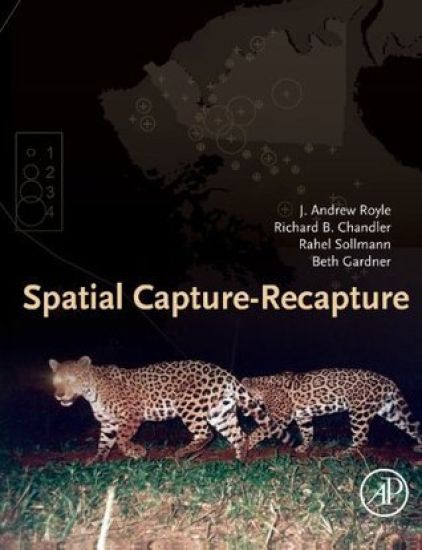
Spatial Capture-Recapture
J. Andrew Royle; Richard B. Chandler; Rahel Sollmann; Beth Gardner
Academic Press Inc
2013
sidottu
Spatial Capture-Recapture provides a comprehensive how-to manual with detailed examples of spatial capture-recapture models based on current technology and knowledge. Spatial Capture-Recapture provides you with an extensive step-by-step analysis of many data sets using different software implementations. The authors' approach is practical – it embraces Bayesian and classical inference strategies to give the reader different options to get the job done. In addition, Spatial Capture-Recapture provides data sets, sample code and computing scripts in an R package.