Kirjojen hintavertailu. Mukana 12 530 829 kirjaa ja 12 kauppaa.
Kirjailija
Bikas K. Sinha
Kirjat ja teokset yhdessä paikassa: 7 kirjaa, julkaisuja vuosilta 1991-2025, suosituimpien joukossa Selected Topics in Statistical Inference. Vertaile teosten hintoja ja tarkista saatavuus suomalaisista kirjakaupoista.
This book focuses exclusively on the domain of parametric inference and that, too, from a reader’s perspective, i.e., covering only point estimation of parameter(s). It covers those topics in parametric inference which need clarity of exposure to students, researchers, and teachers alike; mere statements of theorems and proofs may not always reveal the inner beauty and significance of some aspects of inference. To ensure clarity, the book discusses the following topics at an advanced level—(1) sequential (unbiased) point estimation of ‘p’ and its functions; generalization to trinomial and tetranomial populations; (2) some aspects of the use of additional resources in finite population inference; (3) the concept of sufficiency vis-à-vis the notion of sufficient experiments and comparison of experiments; (4) estimation of the size of a finite population with special features; and (5) unbiased estimation of reliability in exponential samples and other settings. This book provides a platform for thought-provoking, creative, and challenging discussions on a variety of topics in statistical estimation theory, it is also ideal for research methodology course for statistics research scholars, and for clarification of basic ideas in topics discussed at basic/advanced levels.
This book presents various recently developed and traditional statistical techniques, which are increasingly being applied in social science research. The social sciences cover diverse phenomena arising in society, the economy and the environment, some of which are too complex to allow concrete statements; some cannot be defined by direct observations or measurements; some are culture- (or region-) specific, while others are generic and common. Statistics, being a scientific method – as distinct from a ‘science’ related to any one type of phenomena – is used to make inductive inferences regarding various phenomena. The book addresses both qualitative and quantitative research (a combination of which is essential in social science research) and offers valuable supplementary reading at an advanced level for researchers.
This book presents various recently developed and traditional statistical techniques, which are increasingly being applied in social science research. The social sciences cover diverse phenomena arising in society, the economy and the environment, some of which are too complex to allow concrete statements; some cannot be defined by direct observations or measurements; some are culture- (or region-) specific, while others are generic and common. Statistics, being a scientific method – as distinct from a ‘science’ related to any one type of phenomena – is used to make inductive inferences regarding various phenomena. The book addresses both qualitative and quantitative research (a combination of which is essential in social science research) and offers valuable supplementary reading at an advanced level for researchers.
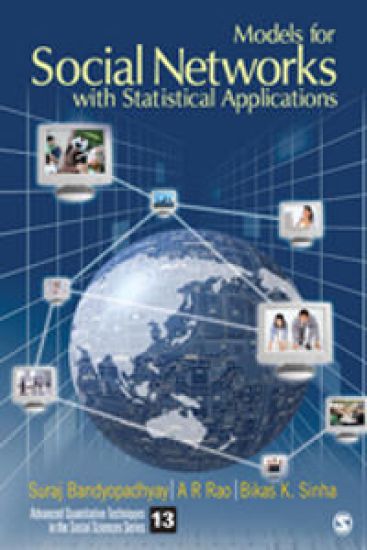
Written by a sociologist, a graph theorist, and a statistician, this title provides social network analysts and students with a solid statistical foundation from which to analyze network data. Clearly demonstrates how graph-theoretic and statistical techniques can be employed to study some important parameters of global social networks. The authors uses real life village-level social networks to illustrate the practicalities, potentials, and constraints of social network analysis ("SNA"). They also offer relevant sampling and inferential aspects of the techniques while dealing with potentially large networks. Intended Audience This supplemental text is ideal for a variety of graduate and doctoral level courses in social network analysis in the social, behavioral, and health sciences
In the early nineties, at the initiative of Sinha and financial support of Shah and Liski (from their respective Research Project Funds), the authors - inspired by their similar research interests - started collaborative research at various institutions mostly in pairs and triplets. It took more time and efforts on the part of MandaI to visit the others at regular intervals and keep track of their common as well as diverse research areas and merge his own. From this collaborative work, the concept of this monograph took a preliminary shape only last year and serious efforts were started to combine diverse avenues into one. Admittedly, it took more time than expected to converge to a common platform regarding the contents and broad coverage of the topics to be included. We were mostly guided by our own common research interests spanning over the last ten years. That covered optimal designs in both discrete and continuous settings. Availability of huge published literature in various statistical journals on the broad theme of optimal designs has made our task quite interesting and stimulating. We hope our readers will be as excited and delighted to read the monograph as we have been in our efforts to write it.
Covers a new but essential development in the field of population sampling, namely inference in finite sampling. Offers some important topics not found in other texts on sampling such as the superpopulation approach and randomized response, nonresponse and resampling techniques.