Kirjojen hintavertailu. Mukana 12 595 353 kirjaa ja 12 kauppaa.

Kirjailija

Bikash Pal

Kirjat ja teokset yhdessä paikassa: 7 kirjaa, julkaisuja vuosilta 2005-2019, suosituimpien joukossa Dynamic Estimation and Control of Power Systems. Vertaile teosten hintoja ja tarkista saatavuus suomalaisista kirjakaupoista.

7 kirjaa

Kirjojen julkaisuhaarukka 2005-2019.

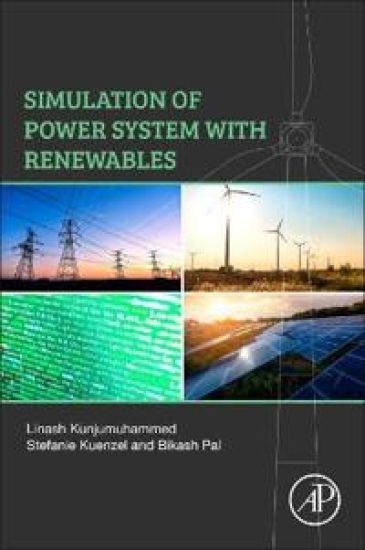
Simulation of Power System with Renewables

Simulation of Power System with Renewables

Linash Kunjumuhammed; Stefanie Kuenzel; Bikash Pal

Academic Press Inc
2019
nidottu
Simulation of Power System with Renewables provides details on the modelling and efficient implementation of MATLAB, particularly with a renewable energy driven power system. The book presents a step-by-step approach to modelling implementation, including all major components used in current power systems operation, giving the reader the opportunity to learn how to gather models for conventional generators, wind farms, solar plants and FACTS control devices. Users will find this to be a central resource for modelling, building and simulating renewable power systems, including discussions on its limitations, assumptions on the model, and the implementation and analysis of the system.
Dynamic Estimation and Control of Power Systems

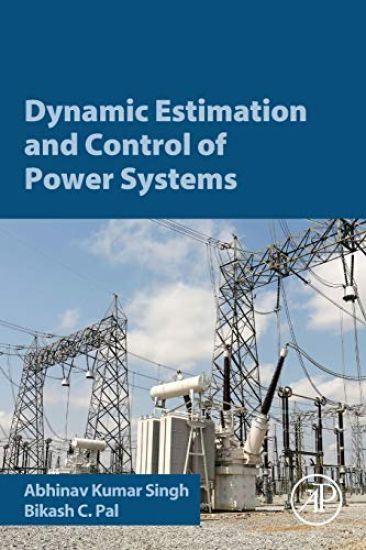
Dynamic Estimation and Control of Power Systems

Abhinav Kumar Singh; Bikash Pal

Academic Press Inc
2018
nidottu
Dynamic estimation and control is a fast growing and widely researched field of study that lays the foundation for a new generation of technologies that can dynamically, adaptively and automatically stabilize power systems. This book provides a comprehensive introduction to research techniques for real-time estimation and control of power systems. Dynamic Estimation and Control of Power Systems coherently and concisely explains key concepts in a step by step manner, beginning with the fundamentals and building up to the latest developments of the field. Each chapter features examples to illustrate the main ideas, and effective research tools are presented for signal processing-based estimation of the dynamic states and subsequent control, both centralized and decentralized, as well as linear and nonlinear. Detailed mathematical proofs are included for readers who desire a deeper technical understanding of the methods. This book is an ideal research reference for engineers and researchers working on monitoring and stability of modern grids, as well as postgraduate students studying these topics. It serves to deliver a clear understanding of the tools needed for estimation and control, while also acting as a basis for readers to further develop new and improved approaches in their own research.
Flexible AC Transmission Systems: Modelling and Control

Flexible AC Transmission Systems: Modelling and Control

Xiao-Ping Zhang; Christian Rehtanz; Bikash Pal

Springer-Verlag Berlin and Heidelberg GmbH Co. K
2014
nidottu
The extended and revised second edition of this successful monograph presents advanced modeling, analysis and control techniques of Flexible AC Transmission Systems (FACTS). The book covers comprehensively a range of power-system control problems: from steady-state voltage and power flow control, to voltage and reactive power control, to voltage stability control, to small signal stability control using FACTS controllers. In the six years since the first edition of the book has been published research on the FACTS has continued to flourish while renewable energy has developed into a mature and booming global green business. The second edition reflects the new developments in converter configuration, smart grid technologies, super power grid developments worldwide, new approaches for FACTS control design, new controllers for distribution system control, and power electronic controllers in wind generation operation and control. The latest trends of VSC-HVDC with multilevel architecture have been included and four completely new chapters have been added devoted to Multi-Agent Systems for Coordinated Control of FACTS-devices, Power System Stability Control using FACTS with Multiple Operating Points, Control of a Looping Device in a Distribution System, and Power Electronic Control for Wind Generation.
Flexible AC Transmission Systems: Modelling and Control

Flexible AC Transmission Systems: Modelling and Control

Xiao-Ping Zhang; Christian Rehtanz; Bikash Pal

Springer-Verlag Berlin and Heidelberg GmbH Co. K
2012
sidottu
The extended and revised second edition of this successful monograph presents advanced modeling, analysis and control techniques of Flexible AC Transmission Systems (FACTS). The book covers comprehensively a range of power-system control problems: from steady-state voltage and power flow control, to voltage and reactive power control, to voltage stability control, to small signal stability control using FACTS controllers. In the six years since the first edition of the book has been published research on the FACTS has continued to flourish while renewable energy has developed into a mature and booming global green business. The second edition reflects the new developments in converter configuration, smart grid technologies, super power grid developments worldwide, new approaches for FACTS control design, new controllers for distribution system control, and power electronic controllers in wind generation operation and control. The latest trends of VSC-HVDC with multilevel architecture have been included and four completely new chapters have been added devoted to Multi-Agent Systems for Coordinated Control of FACTS-devices, Power System Stability Control using FACTS with Multiple Operating Points, Control of a Looping Device in a Distribution System, and Power Electronic Control for Wind Generation.
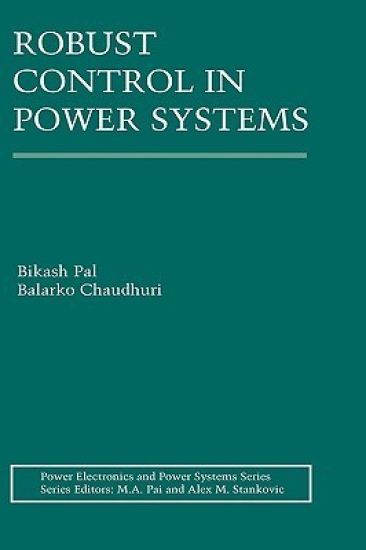
Robust Control in Power Systems

Robust Control in Power Systems

Bikash Pal; Balarko Chaudhuri

Springer-Verlag New York Inc.
2010
nidottu
Robust Control in Power Systems deals with the applications of new techniques in linear system theory to control low frequency oscillations in power systems. The book specifically focuses on the analysis and damping of inter-area oscillations in the systems which are in the range of 0.2-1 Hz. The damping control action is injected through high power electronic devices known as flexible AC transmission system (FACTS) controllers. Three commonly used FACTS controllers: controllable series capacitors (CSCs) controllable phase shifters (CPSs) and static var compensators (SVCs) have been used in this book to control the inter-area oscillations. The overview of linear system theory from the perspective of power system control is explained through examples. The damping control design is formulated as norm optimization problem. The H_infinity, H2 norm of properly defined transfer functions are minimized in linear matrix inequalities (LMI) framework to obtain desired performance and stability robustness. Both centralized and decentralized control structures are used. Usually the transmission of feedback signal from a remote location encounters delays making it difficult to control the system. Smith predictor based approach has been successfully explored in this book as a solution to such a problem. Robust Control in Power Systems will be valuable to academicians in the areas of power, control and system theory, as well as professionals in the power industry.
Flexible AC Transmission Systems: Modelling and Control

Flexible AC Transmission Systems: Modelling and Control

Xiao-Ping Zhang; Christian Rehtanz; Bikash Pal

Springer-Verlag Berlin and Heidelberg GmbH Co. K
2010
nidottu
The electric power industry is undergoing the most profound technical, economic and organisational changes since its inception some one hundred years ago. This paradigm change is the result of the liberalisation process, stipulated by politics andfollowedupbyindustry. Formanyyearstheelectricpowerindustrywasch- acterized by a vertically integrated structure, consisting of power generation, transmission/distributionandtrading. Theliberalisationprocesshasresultedinthe unbundlingofthisorganizationalstructure. Nowgenerationandtradingareorg- ised in separate business entities, subject to competition, while the transm- sion/distribution business remains a natural monopoly. Since the trading of el- tric energy happens on two levels, the physical level and the contractual level, it has to be recognized that these two levels are completely different. However for understanding the electricity market as a network based industry both levels have to be considered and understood. The fundamental properties of electric energy areasfollows: * Electricityalwaysneedsanetworkfortransportationanddistribution. * Electricitycannot be storedin asubstantialamount, hence production andc- sumptionhavetobematchedateachinstantoftime. * The physical transport of electricity has nothing to do with the contracts for tradingwithelectricity The role of the electric network is of prime importance within the electric energy business. Its operation is governed by physical laws. The electric network has a fixed structure consisting of different voltage levels; the higher levels are for transmission purposeswhereasthe lower levelsareused for the distributiontasks. Eachnetworkelementhasafinitecapacity,limitingtheamountofelectricitytobe transported or distributed. As a consequence of the liberalisation process the - eration of the networks has beenpushedcloser towardsitstechnicallimits. Hence thestressonthesystemisconsiderablybiggerthaninthepast. Theefficientuseof all network elements is of prime interest to the network operator because the cost constraints have also become much tighter than in the past.
Robust Control in Power Systems

Robust Control in Power Systems

Bikash Pal; Balarko Chaudhuri

Springer-Verlag New York Inc.
2005
sidottu
Robust Control in Power Systems deals with the applications of new techniques in linear system theory to control low frequency oscillations in power systems. The book specifically focuses on the analysis and damping of inter-area oscillations in the systems which are in the range of 0.2-1 Hz. The damping control action is injected through high power electronic devices known as flexible AC transmission system (FACTS) controllers. Three commonly used FACTS controllers: controllable series capacitors (CSCs) controllable phase shifters (CPSs) and static var compensators (SVCs) have been used in this book to control the inter-area oscillations. The overview of linear system theory from the perspective of power system control is explained through examples. The damping control design is formulated as norm optimization problem. The H_infinity, H2 norm of properly defined transfer functions are minimized in linear matrix inequalities (LMI) framework to obtain desired performance and stability robustness. Both centralized and decentralized control structures are used. Usually the transmission of feedback signal from a remote location encounters delays making it difficult to control the system. Smith predictor based approach has been successfully explored in this book as a solution to such a problem. Robust Control in Power Systems will be valuable to academicians in the areas of power, control and system theory, as well as professionals in the power industry.