
Kirjailija
Bill Johnston
Kirjat ja teokset yhdessä paikassa: 15 kirjaa, julkaisuja vuosilta 2002-2025, suosituimpien joukossa Ennemonde. Vertaile teosten hintoja ja tarkista saatavuus suomalaisista kirjakaupoista.
15 kirjaa
Kirjojen julkaisuhaarukka 2002-2025.

A haunting, allegorical Swiss masterpiece centered around a posse of villagers as they brave dark elements to ascend a mountain, thicketed with lore Teeming with tension, this immersive, rhapsodic story transports readers to the Swiss mountainside, bringing to mind the writing of Thomas Mann while offering character studies as vivid and bracing as Eudora Welty's. Feed is running low in a rural village in Switzerland. The town council meets to decide whether or not to ascend a chimerical mountain in order to access the open pastures that have enough grass to "feed seventy animals all summer long." The elders of the town protest, warning of the dangers and the dreadful lore that enfolds the mountain passageways like thick fog. They've seen it all before, reckoning with the loss of animals and men who have tried to reach the pastures nearly twenty years ago. The younger men don't listen, making plans to set off on their journey despite all warnings. Strange things happen. Spirits wrestle with headstrong young men. As the terror of life on the mountain builds, Ramuz's writing captures the rural dialog and mindsets of the men. One of the most talented translators working today, Bill Johnston captures the careful and sublime twists and turns of the original in his breathtaking translation.


Conceptualising the Digital University
Bill Johnston; Sheila MacNeill; Keith Smyth
Palgrave MacMillan
2020
pokkari

Conceptualising the Digital University
Bill Johnston; Sheila MacNeill; Keith Smyth
Springer International Publishing AG
2019
sidottu
Despite the increasing ubiquity of the term, the concept of the digital university remains diffuse and indeterminate. This book examines what the term 'digital university' should encapsulate and the resulting challenges, possibilities and implications that digital technology and practice brings to higher education. Critiquing the current state of definition of the digital university construct, the authors propose a more holistic, integrated account that acknowledges the inherent diffuseness of the concept. The authors also question the extent to which digital technologies and practices can allow us to re-think the location of universities and curricula; and how they can extend higher education as a public good within the current wider political context. Framed inside a critical pedagogy perspective, this volume debates the role of the university in fostering the learning environments, skills and capabilities needed for critical engagement, active open participation and reflection in the digital age. This pioneering volume will be of interest and value to students and scholars of digital education, as well as policy makers and practitioners.

Debates about the place of mission work in English Language Teaching continue to rage, and yet full-length studies of what really happens at the intersection of ELT and evangelical Christianity are rare. In this book, Johnston conducts a detailed ethnography of an evangelical language school in Poland, looking at its Bible-based curriculum, and analyzing interaction in classes for adults. He also explores the idea of ‘relationship’ in the context of the school and its mission activity, and more broadly the cultural encounter between North American evangelicalism and Polish Catholicism. The book comprises an in-depth examination of a key issue facing TEFL in the 21st century, and will be of interest to all practitioners and scholars in the field, whatever their position on this topic.

Debates about the place of mission work in English Language Teaching continue to rage, and yet full-length studies of what really happens at the intersection of ELT and evangelical Christianity are rare. In this book, Johnston conducts a detailed ethnography of an evangelical language school in Poland, looking at its Bible-based curriculum, and analyzing interaction in classes for adults. He also explores the idea of ‘relationship’ in the context of the school and its mission activity, and more broadly the cultural encounter between North American evangelicalism and Polish Catholicism. The book comprises an in-depth examination of a key issue facing TEFL in the 21st century, and will be of interest to all practitioners and scholars in the field, whatever their position on this topic.
From Information Literacy to Social Epistemology
Anthony Anderson; Bill Johnston
Chandos Publishing (Oxford) Ltd
2016
nidottu
From Information Literacy to Social Epistemology: Insights from Psychology focuses on information and the ways in which information literacy relates to critical thinking in education, the workplace, and in our social life. The broad context for our interest is the development in internet technologies often characterised by terms like the ‘digital age’, leading to questions of digital participation, digital divides, and the role of thinking in the information society. In short, to what extent is the ‘digital age’ engendering changes in learning directed towards the better use of information, and in addition, encouraging or even requiring improvements in critical thinking?


The First Year at University: Teaching Students in Transition
Bill Johnston
Open University Press
2010
sidottu
If academics are genuinely to develop as teachers throughout their careers, if they are to continue to produce innovations, they have to bring a scholarly orientation to teaching. This series will show them how to do that. It will teach them how to make credible cases for different forms of innovation, thus helping them to situate teaching centrally in their careers. It will also show them ways of solving students' problems and methods of helping their students to learn more effectively. THE FIRST YEAR AT UNIVERSITYTeaching Students in TransitionThe first year at university can be a very challenging time for students especially in a mass system of higher education. Many students are ill- equipped to cope with life at university and retention is now a critical metric for all universities. This has resulted in universities having to spend considerable time and attention on ensuring that the 'first year experience' is as positive as possible for all students.This book offers a range of practical strategies, underpinned by relevant research, which lecturers can implement when charged with working with first year students in order to ease their transition to higher education. These strategies affect not only the design of courses, teaching and assessment but also how teams of lecturers provide consistent support, and how this in turn is supported by strategic planning at an institutional level.The First Year at University is a practical resource that can be used by a wide range of lecturers including those undertaking the PGCE (Higher Education) as well as those on CPD courses on teaching and learning in higher education.
Values in English Language Teaching
Bill Johnston
Routledge Member of the Taylor and Francis Group
2002
sidottu
This book offers a new perspective on language teaching by placing moral issues--that is, questions of values--at the core of what it is to be a teacher. The teacher-student relation is central to this view, rather than the concept of language teaching as merely a technical matter of managing students' acquisition of language. The message is that all language teaching involves an interplay of deeply held values, but in each teaching situation these values are played out in different ways. Johnston does not tell readers what to think, but only suggests what to think about.Values in English Language Teaching explores the complex and often contradictory moral landscape of the language classroom, gradually revealing how teaching is not a matter of clear-cut choices but of wrestling with dilemmas and making difficult decisions in situations often riven with conflict. It examines the underlying values that teachers hold as individuals and as members of their profession, and demonstrates how those values are played out in the real world of language classrooms. Matters addressed include connections between the moral and political dimensions in English language teaching, and between values and religious beliefs; relationship(s) between teacher identity and values; the meaning of professionalism and how it is associated with morality and values; the ways in which teacher development is a moral issue; and the marginality of English language teaching. All the examples are taken from real-life teaching situations--the complexity and messiness of these situations is always acknowledged, including both individual influences and broader social, cultural, and political forces at play in English language classrooms. By using actual situations as the starting point for analysis, Johnston offers a philosophy based in practice, and recognizes the primacy of lived experience as a basis for moral analysis. Examples come from teaching contexts around the world, including Brazil, Thailand, Poland, Japan, Central African Republic, Turkey, and Taiwan, as well as various settings in the United States. This book will change the way teachers see language classrooms--their own or those of others. It is a valuable resource for teachers of ESL and EFL and all those who work with them, especially teacher educators, researchers, and administrators.
Values in English Language Teaching
Bill Johnston
Routledge Member of the Taylor and Francis Group
2002
nidottu
This book offers a new perspective on language teaching by placing moral issues--that is, questions of values--at the core of what it is to be a teacher. The teacher-student relation is central to this view, rather than the concept of language teaching as merely a technical matter of managing students' acquisition of language. The message is that all language teaching involves an interplay of deeply held values, but in each teaching situation these values are played out in different ways. Johnston does not tell readers what to think, but only suggests what to think about.Values in English Language Teaching explores the complex and often contradictory moral landscape of the language classroom, gradually revealing how teaching is not a matter of clear-cut choices but of wrestling with dilemmas and making difficult decisions in situations often riven with conflict. It examines the underlying values that teachers hold as individuals and as members of their profession, and demonstrates how those values are played out in the real world of language classrooms. Matters addressed include connections between the moral and political dimensions in English language teaching, and between values and religious beliefs; relationship(s) between teacher identity and values; the meaning of professionalism and how it is associated with morality and values; the ways in which teacher development is a moral issue; and the marginality of English language teaching. All the examples are taken from real-life teaching situations--the complexity and messiness of these situations is always acknowledged, including both individual influences and broader social, cultural, and political forces at play in English language classrooms. By using actual situations as the starting point for analysis, Johnston offers a philosophy based in practice, and recognizes the primacy of lived experience as a basis for moral analysis. Examples come from teaching contexts around the world, including Brazil, Thailand, Poland, Japan, Central African Republic, Turkey, and Taiwan, as well as various settings in the United States. This book will change the way teachers see language classrooms--their own or those of others. It is a valuable resource for teachers of ESL and EFL and all those who work with them, especially teacher educators, researchers, and administrators.
Cary Buzzelli and Bill Johnson reinvigorate the enduring question: What is the place of morality in the classroom? Departing from notions of a morality that can only be abstract and absolute, these authors ground their investigation in analyses of actual teacher-student interactions. This approach illuminates the ways in which language, power and culture impact "the moral" in teaching. Buzzelli and Johnson's study addresses a wide range of moral issues in various classroom contexts. Its practical and diverse examples make it a valuable resource for teachers and teacher development programs.
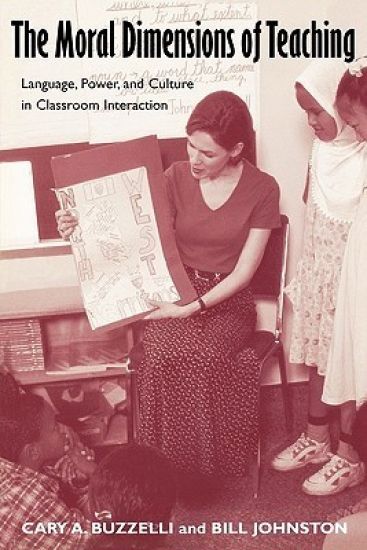
Cary Buzzelli and Bill Johnson reinvigorate the enduring question: What is the place of morality in the classroom? Departing from notions of a morality that can only be abstract and absolute, these authors ground their investigation in analyses of actual teacher-student interactions. This approach illuminates the ways in which language, power and culture impact "the moral" in teaching. Buzzelli and Johnson's study addresses a wide range of moral issues in various classroom contexts. Its practical and diverse examples make it a valuable resource for teachers and teacher development programs.