Kirjojen hintavertailu. Mukana 12 595 353 kirjaa ja 12 kauppaa.

Kirjailija

Bing-Yuan Cao

Kirjat ja teokset yhdessä paikassa: 9 kirjaa, julkaisuja vuosilta 2002-2020, suosituimpien joukossa Optimal Models and Methods with Fuzzy Quantities. Vertaile teosten hintoja ja tarkista saatavuus suomalaisista kirjakaupoista.

9 kirjaa

Kirjojen julkaisuhaarukka 2002-2020.

Fuzzy Sets Theory Preliminary

Fuzzy Sets Theory Preliminary

Hao-Ran Lin; Bing-Yuan Cao; Yun-zhang Liao

Springer International Publishing AG
2019
nidottu
This basic book has been used at the middle schools in Shanghai, China for more than 10 years. The book presents carefully-selected contents in order to achieve the roles of enlightenment and popularization. It mainly includes: Chapter 1: Human Brains, Computers and Fuzzy Mathematics; Chapter 2: Matrix, Fuzzy Relations and Fuzzy Matrix; Chapter 3: Fuzzy Control; Chapter 4: Fuzzy Statistics and Fuzzy Probability and Chapter 5: Fuzzy Linear Programming. It includes at the end of each chapter concise, interesting and profound reading and thinking materials, and a certain amount of exercises so as to make it an informative and interesting textbook. This book can be used not only as a textbook in senior middle schools, and in vocational colleges, but also as a primer for individually learning fuzzy mathematics.
Fuzzy Sets Theory Preliminary

Fuzzy Sets Theory Preliminary

Hao-Ran Lin; Bing-Yuan Cao; Yun-zhang Liao

Springer International Publishing AG
2018
sidottu
This basic book has been used at the middle schools in Shanghai, China for more than 10 years. The book presents carefully-selected contents in order to achieve the roles of enlightenment and popularization. It mainly includes: Chapter 1: Human Brains, Computers and Fuzzy Mathematics; Chapter 2: Matrix, Fuzzy Relations and Fuzzy Matrix; Chapter 3: Fuzzy Control; Chapter 4: Fuzzy Statistics and Fuzzy Probability and Chapter 5: Fuzzy Linear Programming. It includes at the end of each chapter concise, interesting and profound reading and thinking materials, and a certain amount of exercises so as to make it an informative and interesting textbook. This book can be used not only as a textbook in senior middle schools, and in vocational colleges, but also as a primer for individually learning fuzzy mathematics.
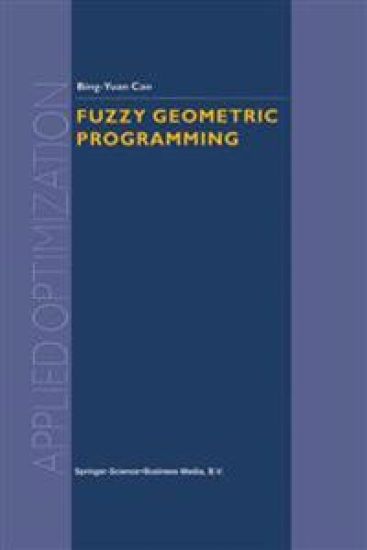
Fuzzy Geometric Programming

Fuzzy Geometric Programming

Bing-Yuan Cao

Springer-Verlag New York Inc.
2013
nidottu
Fuzzy geometric programming was originated by the author in the Proceed­ ing of the second IFSA conferences, 1987(Tokyo) 14 years ago. Later, the paper was invited for formal publication in the International Journal of Fuzzy Sets and Systems. From then on, more and more papers have been written by scholars all over the world who have been interested in its research. So this programming method has been acknowledged by experts and has gradually formed a new branch of fuzzy mathematics. lnspired by Zadeh's fuzzy sets theory, fuzzy geometric programming emerges from the combination of fuzzy sets theory with geometric programming, where models are built in the fuzzy posynomial and the reverse geometric program­ ming. The present book is intended to discuss fuzziness of objective function and constraint conditions, a variety of fuzzy numbers in coefficients and vari­ ables and problems about multi-objective fuzzy geometric programming. It establishes and rounds out an entire theory system, showing that there exist conditions of fuzzy optimal or most satisfactory solutions in fuzzy geometric ptogramming, and it develops some effective algorithms. In order to introduce this new branch, the book aims at the exposition of three points: encompassing ideas and conception, theory and methods, and diffusion and application. lt lays more emphasis on the second point than the first one, and less on the third. Besides, it introduces some knowledge of classical geometric programming and of fuzzy sets theory and application examples of fuzzy geometric programming in electric power systems as weil.
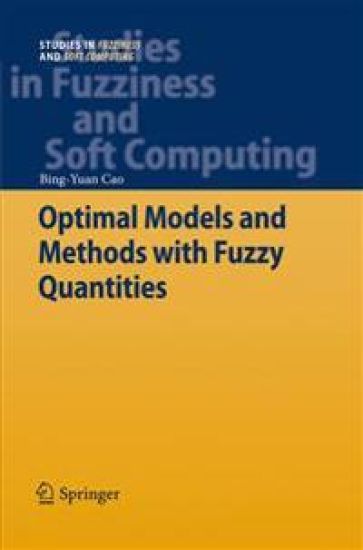
Optimal Models and Methods with Fuzzy Quantities

Optimal Models and Methods with Fuzzy Quantities

Bing-Yuan Cao

Springer-Verlag Berlin and Heidelberg GmbH Co. K
2010
sidottu
I originated a submission titled "Fuzzy Geometric Programming" for the Proceeding of the Second International Fuzzy Systems Association (IFSA) Congress (Tokyo) in 1987, and later published through rigorous selection in Fuzzy Sets and Systems. In 1989, I brought up"Study on non-distinct se- regression forecast model" for discussion by using Zadeh's theory on fuzzy sets. From then on, I have done researches on an optimal model with fuzzy informationquantities. In the book,Iregardthe modelwith fuzzy quantities, including fuzzy coe?cients and fuzzy variables, as a main line, introducing the molding of various problems and their practical examples, completely and clearly, in some ?elds. Many of my papers are indexed in SCI (Science Citation Index), EI (Engineering Index) and ISTP (Index to Scienti?c & Technical Proceedings), commented or extracted in American Mathematical Reviews and Zentralblatt Math. The researching and writing have been funded by the National Na- ral Science Foundation of China for three times (1997, 2003, 2008). At the same time, it is supported by the Science and Technology Project of - nan Province, the Science Research Foundation of Changsha Electric Power University,"211 Project"Foundation of Shantou University and Li Ka-Shing Science Development Foundation of Shantou University, and Scienti?c - search Foundation of Guangzhou University. The research project won the ThirdAwardofGuangdongScienceandTechnologyAwardedbytheGove- ment of Guangdong Province (2005) and Third Award of Excellent Papers in Natural Science by it (2003), successively. The book contains ten chapters as follows: Chapter 1. Prepare Knowledge; Chapter2. RegressionandSelf-regressionModelswith FuzzyCoe?cients; Chapter 3.
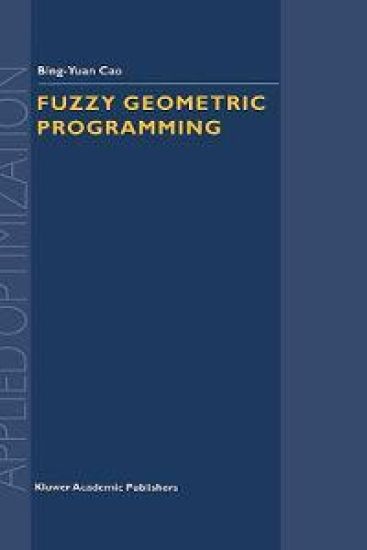
Fuzzy Geometric Programming

Fuzzy Geometric Programming

Bing-Yuan Cao

Springer-Verlag New York Inc.
2002
sidottu
Fuzzy geometric programming was originated by the author in the Proceed­ ing of the second IFSA conferences, 1987(Tokyo) 14 years ago. Later, the paper was invited for formal publication in the International Journal of Fuzzy Sets and Systems. From then on, more and more papers have been written by scholars all over the world who have been interested in its research. So this programming method has been acknowledged by experts and has gradually formed a new branch of fuzzy mathematics. lnspired by Zadeh's fuzzy sets theory, fuzzy geometric programming emerges from the combination of fuzzy sets theory with geometric programming, where models are built in the fuzzy posynomial and the reverse geometric program­ ming. The present book is intended to discuss fuzziness of objective function and constraint conditions, a variety of fuzzy numbers in coefficients and vari­ ables and problems about multi-objective fuzzy geometric programming. It establishes and rounds out an entire theory system, showing that there exist conditions of fuzzy optimal or most satisfactory solutions in fuzzy geometric ptogramming, and it develops some effective algorithms. In order to introduce this new branch, the book aims at the exposition of three points: encompassing ideas and conception, theory and methods, and diffusion and application. lt lays more emphasis on the second point than the first one, and less on the third. Besides, it introduces some knowledge of classical geometric programming and of fuzzy sets theory and application examples of fuzzy geometric programming in electric power systems as weil.
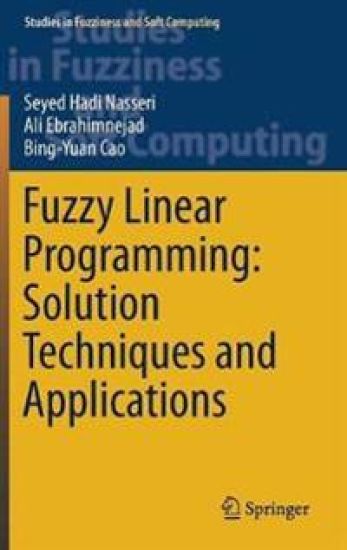
Fuzzy Linear Programming: Solution Techniques and Applications

Fuzzy Linear Programming: Solution Techniques and Applications

Seyed Hadi Nasseri; Ali Ebrahimnejad; Bing-Yuan Cao

Springer Nature Switzerland AG
2020
nidottu
This book presents the necessary and essential backgrounds of fuzzy set theory and linear programming, particularly a broad range of common Fuzzy Linear Programming (FLP) models and related, convenient solution techniques. These models and methods belong to three common classes of fuzzy linear programming, namely: (i) FLP problems in which all coefficients are fuzzy numbers, (ii) FLP problems in which the right-hand-side vectors and the decision variables are fuzzy numbers, and (iii) FLP problems in which the cost coefficients, the right-hand-side vectors and the decision variables are fuzzy numbers. The book essentially generalizes the well-known solution algorithms used in linear programming to the fuzzy environment. Accordingly, it can be used not only as a textbook, teaching material or reference book for undergraduate and graduate students in courses on applied mathematics, computer science, management science, industrial engineering, artificial intelligence, fuzzy information processes, and operations research, but can also serve as a reference book for researchers in these fields, especially those engaged in optimization and soft computing. For textbook purposes, it also includes simple and illustrative examples to help readers who are new to the field.
Fuzzy Relational Mathematical Programming

Fuzzy Relational Mathematical Programming

Bing-Yuan Cao; Ji-Hui Yang; Xue-Gang Zhou; Zeinab Kheiri; Faezeh Zahmatkesh; Xiao-Peng Yang

Springer Nature Switzerland AG
2019
sidottu
This book summarizes years of research in the field of fuzzy relational programming, with a special emphasis on geometric models. It discusses the state-of-the-art in fuzzy relational geometric problems, together with key open issues that must be resolved to achieve a more efficient application of this method. Though chiefly based on research conducted by the authors, who were the first to introduce fuzzy geometric problems, it also covers important findings obtained in the field of linear and non-linear programming. Thanks to its balance of basic and advanced concepts, and its wealth of practical examples, the book offers a valuable guide for both newcomers and experienced researcher in the fields of soft computing and mathematical optimization.
Fuzzy Linear Programming: Solution Techniques and Applications

Fuzzy Linear Programming: Solution Techniques and Applications

Seyed Hadi Nasseri; Ali Ebrahimnejad; Bing-Yuan Cao

Springer Nature Switzerland AG
2019
sidottu
This book presents the necessary and essential backgrounds of fuzzy set theory and linear programming, particularly a broad range of common Fuzzy Linear Programming (FLP) models and related, convenient solution techniques. These models and methods belong to three common classes of fuzzy linear programming, namely: (i) FLP problems in which all coefficients are fuzzy numbers, (ii) FLP problems in which the right-hand-side vectors and the decision variables are fuzzy numbers, and (iii) FLP problems in which the cost coefficients, the right-hand-side vectors and the decision variables are fuzzy numbers. The book essentially generalizes the well-known solution algorithms used in linear programming to the fuzzy environment. Accordingly, it can be used not only as a textbook, teaching material or reference book for undergraduate and graduate students in courses on applied mathematics, computer science, management science, industrial engineering, artificial intelligence, fuzzy information processes, and operations research, but can also serve as a reference book for researchers in these fields, especially those engaged in optimization and soft computing. For textbook purposes, it also includes simple and illustrative examples to help readers who are new to the field.
Optimal Models and Methods with Fuzzy Quantities

Optimal Models and Methods with Fuzzy Quantities

Bing-Yuan Cao

Springer-Verlag Berlin and Heidelberg GmbH Co. K
2012
nidottu
I originated a submission titled "Fuzzy Geometric Programming" for the Proceeding of the Second International Fuzzy Systems Association (IFSA) Congress (Tokyo) in 1987, and later published through rigorous selection in Fuzzy Sets and Systems. In 1989, I brought up"Study on non-distinct se- regression forecast model" for discussion by using Zadeh's theory on fuzzy sets. From then on, I have done researches on an optimal model with fuzzy informationquantities. In the book,Iregardthe modelwith fuzzy quantities, including fuzzy coe?cients and fuzzy variables, as a main line, introducing the molding of various problems and their practical examples, completely and clearly, in some ?elds. Many of my papers are indexed in SCI (Science Citation Index), EI (Engineering Index) and ISTP (Index to Scienti?c & Technical Proceedings), commented or extracted in American Mathematical Reviews and Zentralblatt Math. The researching and writing have been funded by the National Na- ral Science Foundation of China for three times (1997, 2003, 2008). At the same time, it is supported by the Science and Technology Project of - nan Province, the Science Research Foundation of Changsha Electric Power University,"211 Project"Foundation of Shantou University and Li Ka-Shing Science Development Foundation of Shantou University, and Scienti?c - search Foundation of Guangzhou University. The research project won the ThirdAwardofGuangdongScienceandTechnologyAwardedbytheGove- ment of Guangdong Province (2005) and Third Award of Excellent Papers in Natural Science by it (2003), successively. The book contains ten chapters as follows: Chapter 1. Prepare Knowledge; Chapter2. RegressionandSelf-regressionModelswith FuzzyCoe?cients; Chapter 3.