Kirjojen hintavertailu. Mukana 12 200 002 kirjaa ja 12 kauppaa.

Kirjailija

Bob Gluck

Kirjat ja teokset yhdessä paikassa: 7 kirjaa, julkaisuja vuosilta 2012-2025, suosituimpien joukossa The Musical World of Paul Winter. Vertaile teosten hintoja ja tarkista saatavuus suomalaisista kirjakaupoista.

7 kirjaa

Kirjojen julkaisuhaarukka 2012-2025.

The Musical World of Paul Winter

The Musical World of Paul Winter

Bob Gluck

Terra Nova Press
2025
pokkari
Saxophonist and environmentalist Paul Winter has traveled a fascinating path, from a small central Pennsylvania railroad town to touring South America at the invitation of the U.S. State Department and playing at the Kennedy White House. He played in Russia, recorded in the Grand Canyon, discovered the music of Brazil, organized a town party for Charles Ives' birthday. For his group, he adopted an Elizabethan English musical model known as the "Consort," a group of collaborative, talented, and expressive musicians who experimented with diverse musical forms. Bringing wolves, whales, and elephants into his compositions, he is a pioneer of interspecies jazz and musical ecology. This is the first book on his life and work. Bob Gluck is the author of You'll Know When You Get There: Herbie Hancock and the Mwandishi Band (2012), The Miles Davis 'Lost' Quintet and Other Revolutionary Ensembles (2016), and Pat Metheny, Stories beyond Words (2024). He is Professor Emeritus of Music at the University at Albany in Albany, New York. For millions of listeners world-wide, Paul Winter's music provides the wholeness that comes as we recognize our place in the vastness of the world. In The Musical World of Paul Winter, author Bob Gluck has done his homework. The biographical resonance is further burnished by extensive quotes from Winter's gifted colleagues articulating the guiding aesthetic that has, for sixty-five years and counting, radiated throughout his musical collaborations. And this book goes beyond one musician's story directly into your own. It gets you to musing, "Where do I really fit in? Where does anyone?" - W. A. Mathieu
Pat Metheny

Pat Metheny

Bob Gluck

THE UNIVERSITY OF CHICAGO PRESS
2024
sidottu
An in-depth exploration of the style and influence of Pat Metheny, a truly distinctive musical voice of our time. Guitarist and composer Pat Metheny, among the most acclaimed, visionary musicians of our time, has for five decades toured with his many creative musical projects, most prominently the Pat Metheny Group, while collaborating with celebrated artists, including Charlie Haden, Ron Carter, Herbie Hancock, Ornette Coleman, and Steve Reich. Bob Gluck, whose perspective as pianist, composer, and educator has illuminated the music of Herbie Hancock and Miles Davis in his two previous books, now focuses his lens on the music of Metheny. Neither a biography nor chronological record of Metheny’s musical output, Pat Metheny: Stories beyond Words instead captures Metheny’s self-conception as a musician and the threads that unite and distinguish his creative process. Drawing upon a wealth of new interviews and close readings of musical examples, Gluck offers a bird’s-eye view of Metheny’s musical ideas. Among these are the metaphor of storytelling, the complementarity of simplicity and complexity, and the integrated roles of composer, performer, and band leader. Much like Metheny’s signature style, this book is accessible to a wide range of readers, presenting new clarity, musical insight, and historical perspective about the legacy of Metheny’s groundbreaking music.
Pat Metheny

Pat Metheny

Bob Gluck

THE UNIVERSITY OF CHICAGO PRESS
2024
nidottu
An in-depth exploration of the style and influence of Pat Metheny, a truly distinctive musical voice of our time. Guitarist and composer Pat Metheny, among the most acclaimed, visionary musicians of our time, has for five decades toured with his many creative musical projects, most prominently the Pat Metheny Group, while collaborating with celebrated artists, including Charlie Haden, Ron Carter, Herbie Hancock, Ornette Coleman, and Steve Reich. Bob Gluck, whose perspective as pianist, composer, and educator has illuminated the music of Herbie Hancock and Miles Davis in his two previous books, now focuses his lens on the music of Metheny. Neither a biography nor chronological record of Metheny’s musical output, Pat Metheny: Stories beyond Words instead captures Metheny’s self-conception as a musician and the threads that unite and distinguish his creative process. Drawing upon a wealth of new interviews and close readings of musical examples, Gluck offers a bird’s-eye view of Metheny’s musical ideas. Among these are the metaphor of storytelling, the complementarity of simplicity and complexity, and the integrated roles of composer, performer, and band leader. Much like Metheny’s signature style, this book is accessible to a wide range of readers, presenting new clarity, musical insight, and historical perspective about the legacy of Metheny’s groundbreaking music.
The Miles Davis Lost Quintet and Other Revolutionary Ensembles
Miles Davis's Bitches Brew is one of the most iconic albums in American music, the preeminent landmark and fertile seedbed of jazz-fusion. Fans have been fortunate in the past few years to gain access to Davis's live recordings from this time, when he was working with an ensemble that has come to be known as the Lost Quintet. In this book, jazz historian and musician Bob Gluck explores the performances of this revolutionary group Davis's first electric band to illuminate the thinking of one of our rarest geniuses and, by extension, the extraordinary transition in American music that he and his fellow players ushered in. Gluck listens deeply to the uneasy tension between this group's driving rhythmic groove and the sonic and structural openness, surprise, and experimentation they were always pushing toward. There he hears and outlines a fascinating web of musical interconnection that brings Davis's funk-inflected sensibilities into conversation with the avant-garde worlds that players like Ornette Coleman and John Coltrane were developing. Going on to analyze the little-known experimental groups Circle and the Revolutionary Ensemble, Gluck traces deep resonances across a commercial gap between the celebrity Miles Davis and his less famous but profoundly innovative peers. The result is a deeply attuned look at a pivotal moment when once-disparate worlds of American music came together in explosively creative combinations.
The Miles Davis Lost Quintet and Other Revolutionary Ensembles
Miles Davis's Bitches Brew is one of the most iconic albums in American music, the preeminent landmark and fertile seedbed of jazz-fusion. Fans have been fortunate in the past few years to gain access to Davis's live recordings from this time, when he was working with an ensemble that has come to be known as the Lost Quintet. In this book, jazz historian and musician Bob Gluck explores the performances of this revolutionary group-Davis's first electric band-to illuminate the thinking of one of our rarest geniuses and, by extension, the extraordinary transition in American music that he and his fellow players ushered in. Gluck listens deeply to the uneasy tension between this group's driving rhythmic groove and the sonic and structural openness, surprise, and experimentation they were always pushing toward. There he hears-and outlines-a fascinating web of musical interconnection that brings Davis's funk-inflected sensibilities into conversation with the avant-garde worlds that players like Ornette Coleman and John Coltrane were developing. Going on to analyze the little-known experimental groups Circle and the Revolutionary Ensemble, Gluck traces deep resonances across a commercial gap between the celebrity Miles Davis and his less famous but profoundly innovative peers. The result is a deeply attuned look at a pivotal moment when once-disparate worlds of American music came together in explosively creative combinations.
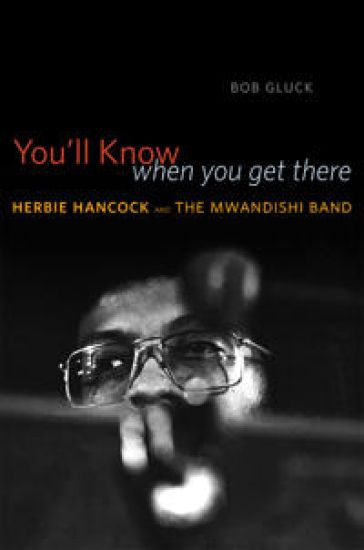
You'll Know When You Get There

You'll Know When You Get There

Bob Gluck

University of Chicago Press
2014
nidottu
As the 1960s ended, Herbie Hancock embarked on a grand creative experiment. Having just left the celebrated Miles Davis Quintet, he set out on the road, playing with his first touring group as a leader until he eventually formed what would become a revolutionary band. Taking the Swahili name Mwandishi, the group would go on to play some of the most innovative music of the 1970s. In You'll Know When You Get There, Bob Gluck offers the first comprehensive study of this seminal group, mapping the musical, technological, political, and cultural changes that they not only lived in but also effected. From protofunk rhythms to synthesizers to the reclamation of African identities, he tells the story of a highly peculiar and thrillingly unpredictable band that became an emblem of American genius.
You'll Know When You Get There

You'll Know When You Get There

Bob Gluck

University of Chicago Press
2012
sidottu
As the 1960s ended, Herbie Hancock embarked on a grand creative experiment. Having just been dismissed from the celebrated Miles Davis Quintet, he brought a new group of musicians together into what would become a revolutionary band. Taking the Swahili name Mwandishi, the group would go on to play some of the most innovative music of the 1970s, fusing an assortment of musical genres, American and African cultures, and acoustic and electronic sounds into groundbreaking experiments that helped shape the American popular music that followed. In "You'll Know When You Get There", Bob Gluck offers the first comprehensive study of this seminal group, mapping the musical, technological, political, and cultural changes that they not only lived in, but effected. Beginning with Hancock's formative years as a sideman in bebop and hard bop ensembles, his work with Miles Davis, and the early recordings under his own name, Gluck uncovers the many ingredients that would come to form the Mwandishi sound. He offers an extensive series of interviews with Hancock, other band members, the producer and engineer who worked with them, and a catalog of well-known musicians who were profoundly influenced by the group. Paying close attention to Mwandishi's compositions, he analyzes a wide array of recordings - many little known - and examines the group's instrumentation, their pioneering use of electronics, and their transformation of the studio into a compositional tool. From protofunk rhythms to synthesizers to the reclamation of African identities, Gluck tells the story of a highly peculiar and thrillingly unpredictable band that became a hallmark of American genius.