Kirjojen hintavertailu. Mukana 12 390 323 kirjaa ja 12 kauppaa.

Kirjailija

Bogumil Kaminski

Kirjat ja teokset yhdessä paikassa: 8 kirjaa, julkaisuja vuosilta 2018-2026, suosituimpien joukossa Mining Complex Networks. Vertaile teosten hintoja ja tarkista saatavuus suomalaisista kirjakaupoista.

8 kirjaa

Kirjojen julkaisuhaarukka 2018-2026.

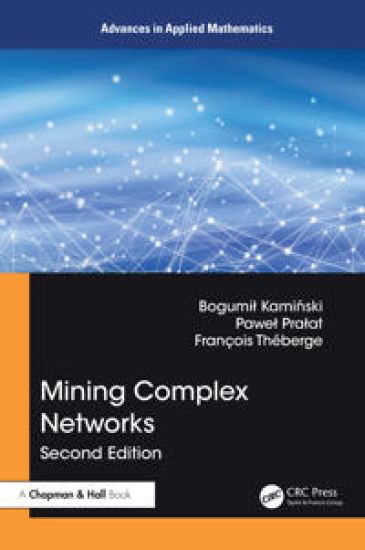
Mining Complex Networks

Mining Complex Networks

Bogumil Kaminski; Pawel Pralat; c Théberge

TAYLOR FRANCIS LTD
2026
nidottu
This book concentrates on mining networks, a subfield within data science. Many data science problems can be viewed as a study of some properties of complex networks in which nodes represent the entities that are being investigated, and edges represent relations between these entities. In these networks (for example, Instagram and Facebook online social networks), nodes not only contain some useful information (such as the user’s profile, photos, tags) but are also internally connected to other nodes (relations based on follower requests, similar users’ behavior, age, geographic location). Such networks are often large-scale, decentralized, and evolve dynamically over time. Mining complex networks to understand the principles governing the organization and the behavior of such networks is crucial for a broad range of fields of study, including information and social sciences, economics, biology, and neuroscience. The field has seen significant advancements since the first edition was published. Changes and updates to this edition include: New material and examples on random geometric graphs The chapter on node embeddings was augmented in several places including a discussion on classical vs. structural embeddings, more details on graph neural networks (GNNs), as well as other directions. Several new tools and techniques are introduced on mining hypergraphs New material on post-processing for overlapping communities A new focus on a framework for embedding graphs codeveloped by the authors. A short chapter on fairness in network mining models. This book is aimed at being suitable for an upper-year undergraduate course or a graduate course.
Mining Complex Networks

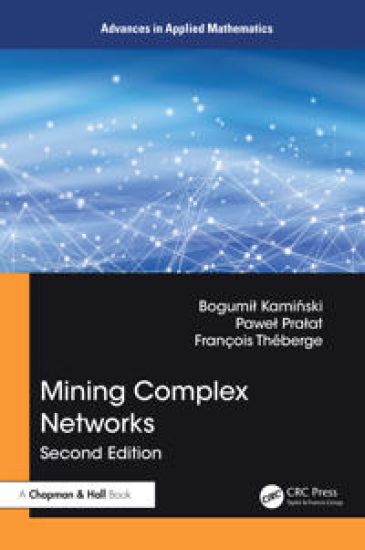
Mining Complex Networks

Bogumil Kaminski; Pawel Pralat; c Théberge

TAYLOR FRANCIS LTD
2026
sidottu
This book concentrates on mining networks, a subfield within data science. Many data science problems can be viewed as a study of some properties of complex networks in which nodes represent the entities that are being investigated, and edges represent relations between these entities. In these networks (for example, Instagram and Facebook online social networks), nodes not only contain some useful information (such as the user’s profile, photos, tags) but are also internally connected to other nodes (relations based on follower requests, similar users’ behavior, age, geographic location). Such networks are often large-scale, decentralized, and evolve dynamically over time. Mining complex networks to understand the principles governing the organization and the behavior of such networks is crucial for a broad range of fields of study, including information and social sciences, economics, biology, and neuroscience. The field has seen significant advancements since the first edition was published. Changes and updates to this edition include: New material and examples on random geometric graphs The chapter on node embeddings was augmented in several places including a discussion on classical vs. structural embeddings, more details on graph neural networks (GNNs), as well as other directions. Several new tools and techniques are introduced on mining hypergraphs New material on post-processing for overlapping communities A new focus on a framework for embedding graphs codeveloped by the authors. A short chapter on fairness in network mining models. This book is aimed at being suitable for an upper-year undergraduate course or a graduate course.
Mining Complex Networks

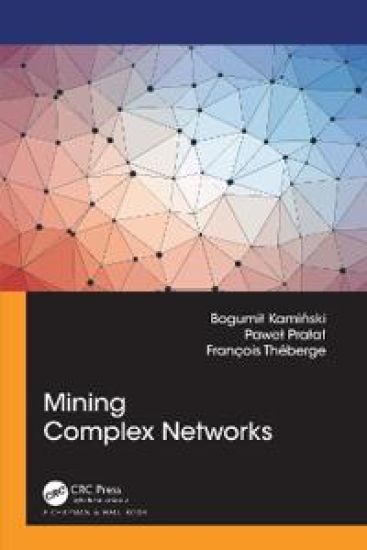
Mining Complex Networks

Bogumil Kaminski; Pawel Pralat; Francois Theberge

TAYLOR FRANCIS LTD
2024
nidottu
This book concentrates on mining networks, a subfield within data science. Data science uses scientific and computational tools to extract valuable knowledge from large data sets. Once data is processed and cleaned, it is analyzed and presented to support decision-making processes. Data science and machine learning tools have become widely used in companies of all sizes. Networks are often large-scale, decentralized, and evolve dynamically over time. Mining complex networks aim to understand the principles governing the organization and the behavior of such networks is crucial for a broad range of fields of study. Here are a few selected typical applications of mining networks: Community detection (which users on some social media platforms are close friends). Link prediction (who is likely to connect to whom on such platforms). Node attribute prediction (what advertisement should be shown to a given user of a particular platform to match their interests). Influential node detection (which social media users would be the best ambassadors of a specific product).This textbook is suitable for an upper-year undergraduate course or a graduate course in programs such as data science, mathematics, computer science, business, engineering, physics, statistics, and social science. This book can be successfully used by all enthusiasts of data science at various levels of sophistication to expand their knowledge or consider changing their career path. Jupiter notebooks (in Python and Julia) accompany the book and can be accessed on https://www.ryerson.ca/mining-complex-networks/. These not only contain all the experiments presented in the book, but also include additional material. Bogumil Kaminski is the Chairman of the Scientific Council for the Discipline of Economics and Finance at SGH Warsaw School of Economics. He is also an Adjunct Professor at the Data Science Laboratory at Ryerson University. Bogumil is an expert in applications of mathematical modeling to solving complex real-life problems. He is also a substantial open-source contributor to the development of the Julia language and its package ecosystem.Pawel Pralat is a Professor of Mathematics in Ryerson University, whose main research interests are in random graph theory, especially in modeling and mining complex networks. He is the Director of Fields-CQAM Lab on Computational Methods in Industrial Mathematics in The Fields Institute for Research in Mathematical Sciences and has pursued collaborations with various industry partners as well as the Government of Canada. He has written over 170 papers and three books with 130 plus collaborators.François Théberge holds a B.Sc. degree in applied mathematics from the University of Ottawa, a M.Sc. in telecommunications from INRS and a PhD in electrical engineering from McGill University. He has been employed by the Government of Canada since 1996 where he was involved in the creation of the data science team as well as the research group now known as the Tutte Institute for Mathematics and Computing. He also holds an adjunct professorial position in the Department of Mathematics and Statistics at the University of Ottawa. His current interests include relational-data mining and deep learning.
Julia for Data Analysis

Julia for Data Analysis

Bogumil Kaminski

Manning Publications
2023
nidottu
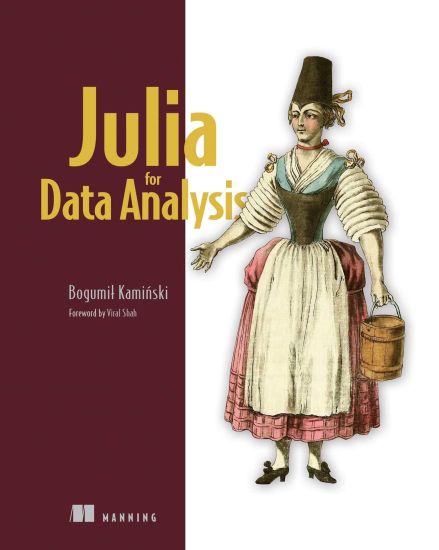
Master core data analysis skills using Julia. Julia for Data Analysis is a fascinating, hands-on projects guide you through time series data, predictive models, popularity ranking, and more. With this book, you will learn how to: Read and write data in various formatsWork with tabular data, including subsetting, grouping, and transformingVisualise your data using plotsPerform statistical analysisBuild predictive modelsCreate complex data processing pipelines Julia was designed for the unique needs of data scientists: it's expressive and easy-to-use whilst also delivering super fast code execution. Julia for Data Analysis teaches you how to perform core data science tasks with this amazing language. It is written by Bogumil Kaminski, a top contributor to Julia, #1 Julia answerer on StackOverflow, and a lead developer of Julia's core data package DataFrames.jl. You will learn how to write production-quality code in Julia, and utilize Julia's core features for data gathering, visualisation, and working with data frames. Plus, the engaging hands-on projects get you into the action quickly. About the technology Julia is a huge step forward for data science and scientific computing. It is a powerful high-performance programming language with many developer-friendly features like garbage collection, dynamic typing, just-in-time compilation, and a flexible approach to concurrent, parallel, and distributed computing. Although Julia's strong numerical programming features make it a favorite of data scientists, it is also an awesome general purpose programming language. About the reader For data scientists familiar with Python or R. No experience with Julia required.
Mining Complex Networks

Mining Complex Networks

Bogumil Kaminski; Pawel Pralat; Francois Theberge

TAYLOR FRANCIS LTD
2021
sidottu
This book concentrates on mining networks, a subfield within data science. Data science uses scientific and computational tools to extract valuable knowledge from large data sets. Once data is processed and cleaned, it is analyzed and presented to support decision-making processes. Data science and machine learning tools have become widely used in companies of all sizes. Networks are often large-scale, decentralized, and evolve dynamically over time. Mining complex networks aim to understand the principles governing the organization and the behavior of such networks is crucial for a broad range of fields of study. Here are a few selected typical applications of mining networks: Community detection (which users on some social media platforms are close friends). Link prediction (who is likely to connect to whom on such platforms). Node attribute prediction (what advertisement should be shown to a given user of a particular platform to match their interests). Influential node detection (which social media users would be the best ambassadors of a specific product).This textbook is suitable for an upper-year undergraduate course or a graduate course in programs such as data science, mathematics, computer science, business, engineering, physics, statistics, and social science. This book can be successfully used by all enthusiasts of data science at various levels of sophistication to expand their knowledge or consider changing their career path. Jupiter notebooks (in Python and Julia) accompany the book and can be accessed on https://www.ryerson.ca/mining-complex-networks/. These not only contain all the experiments presented in the book, but also include additional material. Bogumil Kaminski is the Chairman of the Scientific Council for the Discipline of Economics and Finance at SGH Warsaw School of Economics. He is also an Adjunct Professor at the Data Science Laboratory at Ryerson University. Bogumil is an expert in applications of mathematical modeling to solving complex real-life problems. He is also a substantial open-source contributor to the development of the Julia language and its package ecosystem.Pawel Pralat is a Professor of Mathematics in Ryerson University, whose main research interests are in random graph theory, especially in modeling and mining complex networks. He is the Director of Fields-CQAM Lab on Computational Methods in Industrial Mathematics in The Fields Institute for Research in Mathematical Sciences and has pursued collaborations with various industry partners as well as the Government of Canada. He has written over 170 papers and three books with 130 plus collaborators.François Théberge holds a B.Sc. degree in applied mathematics from the University of Ottawa, a M.Sc. in telecommunications from INRS and a PhD in electrical engineering from McGill University. He has been employed by the Government of Canada since 1996 where he was involved in the creation of the data science team as well as the research group now known as the Tutte Institute for Mathematics and Computing. He also holds an adjunct professorial position in the Department of Mathematics and Statistics at the University of Ottawa. His current interests include relational-data mining and deep learning.
Train Your Brain

Train Your Brain

Bogumil Kaminski; Pawel Pralat

CRC Press
2020
sidottu
This accessible book helps readers to see the bigger picture of advanced mathematics. The book contains carefully selected, challenging problems in an easy-to-follow, step-by-step process. Neither prior preparation nor any mathematical sophistication is required. The authors guide the reader to “train their brain” to think and express themselves in a rigorous, mathematical way, and to extract facts, analyze the problem, and identify main challenges. A firm foundation in a diverse range of topics is presented. Moreover, the authors show how to draw appropriate, true conclusions. Computer support is used to better intuition into discussed problems. The book is designed for self-study. It can be used to bridge the gap between introductory calculus/linear algebra courses and more advanced courses offered at universities. It improves the ability to read, write, and think in a rigorous, mature mathematical fashion. The reader will develop a deeper understanding in preparation to succeed in more advanced course work. Features•The authors employ a six-step process: 1.SOURCE2.PROBLEM3.THEORY4.SOLUTION5.REMARK6.EXERCISES •An Appendix introduces programming in Julia This book is also suitable for high school students that are interested in competing in math competitions or simply for people of all ages and backgrounds who want to expand their knowledge and to challenge themselves with interesting questions.
Train Your Brain

Train Your Brain

Bogumil Kaminski; Pawel Pralat

CRC Press
2020
nidottu
This accessible book helps readers to see the bigger picture of advanced mathematics. The book contains carefully selected, challenging problems in an easy-to-follow, step-by-step process. Neither prior preparation nor any mathematical sophistication is required. The authors guide the reader to “train their brain” to think and express themselves in a rigorous, mathematical way, and to extract facts, analyze the problem, and identify main challenges. A firm foundation in a diverse range of topics is presented. Moreover, the authors show how to draw appropriate, true conclusions. Computer support is used to better intuition into discussed problems. The book is designed for self-study. It can be used to bridge the gap between introductory calculus/linear algebra courses and more advanced courses offered at universities. It improves the ability to read, write, and think in a rigorous, mature mathematical fashion. The reader will develop a deeper understanding in preparation to succeed in more advanced course work.Features•The authors employ a six-step process: 1.SOURCE2.PROBLEM3.THEORY4.SOLUTION5.REMARK6.EXERCISES•An Appendix introduces programming in JuliaThis book is also suitable for high school students that are interested in competing in math competitions or simply for people of all ages and backgrounds who want to expand their knowledge and to challenge themselves with interesting questions.
Julia 1.0 Programming Cookbook

Julia 1.0 Programming Cookbook

Bogumil Kaminski; Przemyslaw Szufel

Packt Publishing Limited
2018
nidottu
Discover the new features and widely used packages in Julia to solve complex computational problems in your statistical applications.Key FeaturesAddress the core problems of programming in Julia with the most popular packages for common tasksTackle issues while working with Databases and Parallel data processing with JuliaExplore advanced features such as metaprogramming, functional programming, and user defined typesBook DescriptionJulia, with its dynamic nature and high-performance, provides comparatively minimal time for the development of computational models with easy-to-maintain computational code. This book will be your solution-based guide as it will take you through different programming aspects with Julia.Starting with the new features of Julia 1.0, each recipe addresses a specific problem, providing a solution and explaining how it works. You will work with the powerful Julia tools and data structures along with the most popular Julia packages. You will learn to create vectors, handle variables, and work with functions. You will be introduced to various recipes for numerical computing, distributed computing, and achieving high performance. You will see how to optimize data science programs with parallel computing and memory allocation. We will look into more advanced concepts such as metaprogramming and functional programming. Finally, you will learn how to tackle issues while working with databases and data processing, and will learn about on data science problems, data modeling, data analysis, data manipulation, parallel processing, and cloud computing with Julia.By the end of the book, you will have acquired the skills to work more effectively with your dataWhat you will learnBoost your code’s performance using Julia’s unique featuresOrganize data in to fundamental types of collections: arrays and dictionariesOrganize data science processes within Julia and solve related problemsScale Julia computations with cloud computingWrite data to IO streams with Julia and handle web transferDefine your own immutable and mutable typesSpeed up the development process using metaprogrammingWho this book is forThis book is for developers who would like to enhance their Julia programming skills and would like to get some quick solutions to their common programming problems. Basic Julia programming knowledge is assumed.