Kirjojen hintavertailu. Mukana 12 390 323 kirjaa ja 12 kauppaa.

Kirjailija

Bonnie Honig

Kirjat ja teokset yhdessä paikassa: 19 kirjaa, julkaisuja vuosilta 1993-2023, suosituimpien joukossa Toward a Feminist Ethics of Nonviolence. Vertaile teosten hintoja ja tarkista saatavuus suomalaisista kirjakaupoista.

19 kirjaa

Kirjojen julkaisuhaarukka 1993-2023.

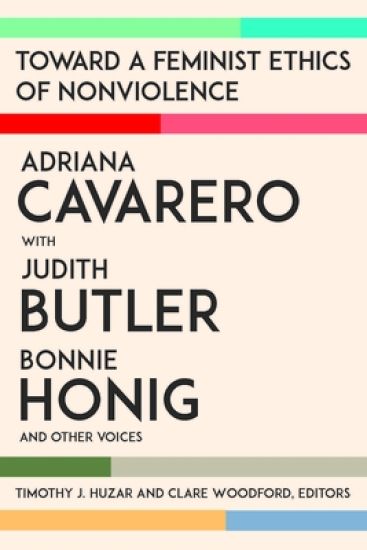
Toward a Feminist Ethics of Nonviolence

Toward a Feminist Ethics of Nonviolence

Adriana Cavarero; Judith Butler; Bonnie Honig

FORDHAM UNIVERSITY PRESS
2021
sidottu
Toward a Feminist Ethics of Nonviolence brings together major feminist thinkers to debate Cavarero's call for a postural ethics of nonviolence and a sociality rooted in bodily interdependence. Toward a Feminist Ethics of Nonviolence brings together three major feminist thinkers—Adriana Cavarero, Judith Butler, and Bonnie Honig—to debate Cavarero's call for a postural ethics of nonviolence. The book consists of three longer essays by Cavarero, Butler, and Honig, followed by shorter responses by a range of scholars that widen the dialogue, drawing on post-Marxism, Italian feminism, queer theory, and lesbian and gay politics. Together, the authors contest the boundaries of their common project for a pluralistic, heterogeneous, but urgent feminist ethics of nonviolence.
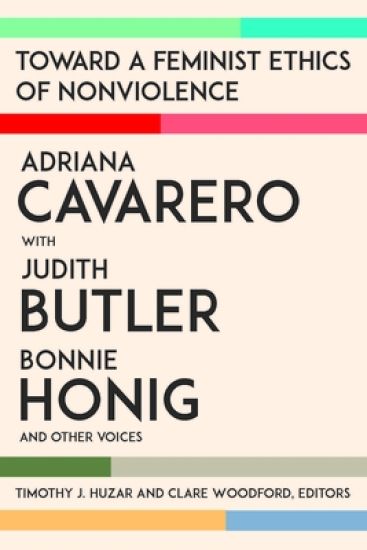
Toward a Feminist Ethics of Nonviolence

Toward a Feminist Ethics of Nonviolence

Adriana Cavarero; Judith Butler; Bonnie Honig

Fordham University Press
2021
pokkari
Toward a Feminist Ethics of Nonviolence brings together major feminist thinkers to debate Cavarero’s call for a postural ethics of nonviolence and a sociality rooted in bodily interdependence. Toward a Feminist Ethics of Nonviolence brings together three major feminist thinkers—Adriana Cavarero, Judith Butler, and Bonnie Honig—to debate Cavarero’s call for a postural ethics of nonviolence. The book consists of three longer essays by Cavarero, Butler, and Honig, followed by shorter responses by a range of scholars that widen the dialogue, drawing on post-Marxism, Italian feminism, queer theory, and lesbian and gay politics. Together, the authors contest the boundaries of their common project for a pluralistic, heterogeneous, but urgent feminist ethics of nonviolence.
Political Theory and the Displacement of Politics

Political Theory and the Displacement of Politics

Bonnie Honig

CORNELL UNIVERSITY PRESS
2023
pokkari
Political Theory and the Displacement of Politics, originally published in 1993, has been called a founding text of agonism, which treats political contestation not as a regrettably necessary way to correct political imperfections but as a necessary, sometimes joyful feature of democratic life. As Bonnie Honig writes in the preface to this thirtieth anniversary edition, "the agonism that informs this book is democratic: it is committed to shared spaces and relational practices in which diverse groups and individuals set and reset the terms of living together as equals." By rethinking the established relation between politics and political theory, Honig argues that political theorists of opposing positions often treat political theory less as an exploration of politics than as a series of devices for its displacement. She characterizes Kant, Rawls, and Sandel as virtue theorists of politics, arguing that they rely on principles of right, rationality, community, and law to protect their political theories from the conflict and uncertainty of political reality. Drawing on Nietzsche and Arendt as well as Machiavelli and Derrida, Honig instead explores an alternative politics of virtú, which treats the disruptions of political order as valued sites of democratic freedom and individuality.
Political Theory and the Displacement of Politics

Political Theory and the Displacement of Politics

Bonnie Honig

CORNELL UNIVERSITY PRESS
2023
sidottu
Political Theory and the Displacement of Politics, originally published in 1993, has been called a founding text of agonism, which treats political contestation not as a regrettably necessary way to correct political imperfections but as a necessary, sometimes joyful feature of democratic life. As Bonnie Honig writes in the preface to this thirtieth anniversary edition, "the agonism that informs this book is democratic: it is committed to shared spaces and relational practices in which diverse groups and individuals set and reset the terms of living together as equals." By rethinking the established relation between politics and political theory, Honig argues that political theorists of opposing positions often treat political theory less as an exploration of politics than as a series of devices for its displacement. She characterizes Kant, Rawls, and Sandel as virtue theorists of politics, arguing that they rely on principles of right, rationality, community, and law to protect their political theories from the conflict and uncertainty of political reality. Drawing on Nietzsche and Arendt as well as Machiavelli and Derrida, Honig instead explores an alternative politics of virtú, which treats the disruptions of political order as valued sites of democratic freedom and individuality.
A Feminist Theory of Refusal

A Feminist Theory of Refusal

Bonnie Honig

Harvard University Press
2021
sidottu
An acclaimed political theorist offers a fresh, interdisciplinary analysis of the politics of refusal, highlighting the promise of a feminist politics that does not simply withdraw from the status quo but also transforms it.The Bacchae, Euripides’s fifth-century tragedy, famously depicts the wine god Dionysus and the women who follow him as indolent, drunken, mad. But Bonnie Honig sees the women differently. They reject work, not out of laziness, but because they have had enough of women’s routine obedience. Later they escape prison, leave the city of Thebes, explore alternative lifestyles, kill the king, and then return to claim the city. Their “arc of refusal,” Honig argues, can inspire a new feminist politics of refusal.Refusal, the withdrawal from unjust political and economic systems, is a key theme in political philosophy. Its best-known literary avatar is Herman Melville’s Bartleby, whose response to every request is, “I prefer not to.” A feminist politics of refusal, by contrast, cannot simply decline to participate in the machinations of power. Honig argues that a feminist refusal aims at transformation and, ultimately, self-governance. Withdrawal is a first step, not the end game.Rethinking the concepts of refusal in the work of Giorgio Agamben, Adriana Cavarero, and Saidiya Hartman, Honig places collective efforts toward self-governance at refusal’s core and, in doing so, invigorates discourse on civil and uncivil disobedience. She seeks new protagonists in film, art, and in historical and fictional figures including Sophocles’s Antigone, Ovid’s Procne, Charlie Chaplin’s Tramp, Leonardo da Vinci’s Madonna, and Muhammad Ali. Rather than decline the corruptions of politics, these agents of refusal join the women of Thebes first in saying no and then in risking to undertake transformative action.
Shell-Shocked

Shell-Shocked

Bonnie Honig

Fordham University Press
2021
pokkari
A biting, funny, up-to-the-minute collection of essays by a major political thinker that gets to the heart of what feminist criticism can do in the face of everyday politics. Stormy Daniels offered a #metoo moment, and Anderson Cooper missed it. Conservatives don't believe that gender is fluid, except when they're feminizing James Comey. "Gaslighting" is our word for male domination but a gaslight also lights the way for a woman's survival. Across two dozen trenchant, witty reflections, Bonnie Honig offers a biting feminist account of politics since Trump. In today's shock politics, Honig traces the continuing work of patriarchy, as powerful, mediocre men gaslight their way across the landscape of democratic institutions. But amid the plundering and patriarchy, feminist criticism finds ways to demand justice. Shell-Shocked shows how women have talked back, acted out, and built anew, exposing the practices and policies of feminization that have historically been aimed not just at women but also at racial and ethnic minorities. The task of feminist criticism—and this is what makes it particularly well-suited to this moment—is to respond to shock politics by resensitizing us to its injustices and honing the empathy needed for living with others in the world as equals. Feminist criticism's penchant for the particular and the idiosyncratic is part of its power. It is drawn to the loose threads of psychological and collective life, not to the well-worn fabrics with which communities and nations hide their shortcomings and deflect critical scrutiny of their injustices. Taking literary models such as Homer's Penelope and Toni Morrison's Cee, Honig draws out the loose threads from the fabric of shock politics' domination and begins unraveling them. Honig's damning, funny, and razor sharp essays take on popular culture, national politics, and political theory alike as texts for resensitizing through a feminist lens. Here are insightful readings of film and television, from Gaslight to Bombshell, Unbelievable to Stranger Things, Rambo to the Kavanaugh hearings. In seeking out the details that might break the spell of shock, this groundbreaking book illustrates alternative ways of living and writing in a time of public violence, plunder, and—hopefully—democratic renewal.
Shell-Shocked

Shell-Shocked

Bonnie Honig

Fordham University Press
2021
sidottu
A biting, funny, up-to-the-minute collection of essays by a major political thinker that gets to the heart of what feminist criticism can do in the face of everyday politics. Stormy Daniels offered a #metoo moment, and Anderson Cooper missed it. Conservatives don't believe that gender is fluid, except when they're feminizing James Comey. "Gaslighting" is our word for male domination but a gaslight also lights the way for a woman's survival. Across two dozen trenchant, witty reflections, Bonnie Honig offers a biting feminist account of politics since Trump. In today's shock politics, Honig traces the continuing work of patriarchy, as powerful, mediocre men gaslight their way across the landscape of democratic institutions. But amid the plundering and patriarchy, feminist criticism finds ways to demand justice. Shell-Shocked shows how women have talked back, acted out, and built anew, exposing the practices and policies of feminization that have historically been aimed not just at women but also at racial and ethnic minorities. The task of feminist criticism—and this is what makes it particularly well-suited to this moment—is to respond to shock politics by resensitizing us to its injustices and honing the empathy needed for living with others in the world as equals. Feminist criticism's penchant for the particular and the idiosyncratic is part of its power. It is drawn to the loose threads of psychological and collective life, not to the well-worn fabrics with which communities and nations hide their shortcomings and deflect critical scrutiny of their injustices. Taking literary models such as Homer's Penelope and Toni Morrison's Cee, Honig draws out the loose threads from the fabric of shock politics' domination and begins unraveling them. Honig's damning, funny, and razor sharp essays take on popular culture, national politics, and political theory alike as texts for resensitizing through a feminist lens. Here are insightful readings of film and television, from Gaslight to Bombshell, Unbelievable to Stranger Things, Rambo to the Kavanaugh hearings. In seeking out the details that might break the spell of shock, this groundbreaking book illustrates alternative ways of living and writing in a time of public violence, plunder, and—hopefully—democratic renewal.
The President's House Is Empty

The President's House Is Empty

Michael Hardt; Bonnie Honig; Elaine Kamarck; Tracey Meares; K. Sabeel Rahman; Marshall Steinbaum

Boston Review/Boston Critic Inc.
2017
pokkari
The President's House is Empty: Losing and Gaining Public Goods explores the question of what we--the public--owe each other as free and equal members of a democratic society. With essays by writers and thinkers like Bonnie Honig, this collection attempts to make sense of the current administration's disdain for public things like the White House, public education, and clean water.
Att läsa Arendt

Att läsa Arendt

Étienne Balibar; Judith Butler; Julia Kristeva; Bonnie Honig; Jürgen Habermas; Seyla Benhabib; Paul Ricoeur

Tankekraft Förlag
2017
nidottu
Hannah Arendt framstår med allt större tydlighet som en av det förra århundradets mest egensinniga och användbara teoretiker. Föreliggande antologi samlar nio essäer och artiklar om hennes politiska tänkande. Ett par av texterna är skrivna av författare som primärt kan karakteriseras som Arendtforskare medan de övriga är skrivna av mer namnkunniga politiska tänkare och filosofer för vilka Arendt blir en dialogpartner i det kontinuerliga utvecklandet av deras egna teorier. Genomgående handlar det om författare som tänker med Arendt mot Arendt och som visar att det med utgångspunkt i hennes verk fortfarande är möjligt att ställa de riktigt stora frågorna om politikens mening, våld och makt, mänskliga rättigheter och människans villkor. Parallellt med den här boken publiceras Rätten till rättigheter: Politiska texter i urval som innehåller essäer, fragment och intervjuer av och med Hannah Arendt. Redaktör för båda volymerna är Anders Burman, idéhistoriker verksam vid Södertörns högskola som på TankeKraft förlag tidigare gett ut Att läsa Hegel (tillsammans med Anders Bartonek) och Flykten från Hegel.
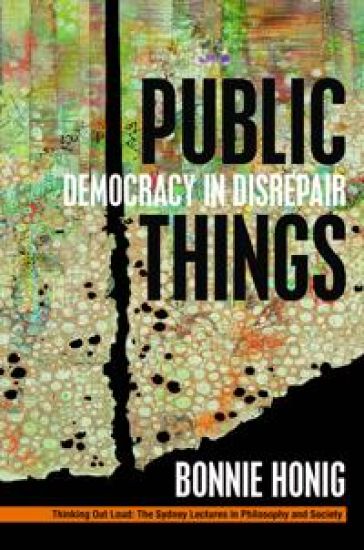
Public Things

Public Things

Bonnie Honig

Fordham University Press
2017
sidottu
In the contemporary world of neoliberalism, efficiency is treated as the vehicle of political and economic health. State bureaucracy, but not corporate bureaucracy, is seen as inefficient, and privatization is seen as a magic cure for social ills. In Public Things: Democracy in Disrepair, Bonnie Honig asks whether democracy is possible in the absence of public services, spaces, and utilities. In other words, if neoliberalism leaves to democracy merely electoral majoritarianism and procedures of deliberation while divesting democratic states of their ownership of public things, what will the impact be? Following Tocqueville, who extolled the virtues of "pursuing in common the objects of common desires," Honig focuses not on the demos but on the objects of democratic life. Democracy, as she points out, postulates public things—infrastructure, monuments, libraries—that citizens use, care for, repair, and are gathered up by. To be "gathered up" refers to the work of D. W. Winnicott, the object relations psychoanalyst who popularized the idea of "transitional objects"—the toys, teddy bears, or favorite blankets by way of which infants come to understand themselves as unified selves with an inside and an outside in relation to others. The wager of Public Things is that the work transitional objects do for infants is analogously performed for democratic citizens by public things, which press us into object relations with others and with ourselves. Public Things attends also to the historically racial character of public things: public lands taken from indigenous peoples, access to public goods restricted to white majorities. Drawing on Hannah Arendt, who saw how things fabricated by humans lend stability to the human world, Honig shows how Arendt and Winnicott—both theorists of livenesss—underline the material and psychological conditions necessary for object permanence and the reparative work needed for a more egalitarian democracy.
Public Things

Public Things

Bonnie Honig

Fordham University Press
2017
pokkari
In the contemporary world of neoliberalism, efficiency is treated as the vehicle of political and economic health. State bureaucracy, but not corporate bureaucracy, is seen as inefficient, and privatization is seen as a magic cure for social ills. In Public Things: Democracy in Disrepair, Bonnie Honig asks whether democracy is possible in the absence of public services, spaces, and utilities. In other words, if neoliberalism leaves to democracy merely electoral majoritarianism and procedures of deliberation while divesting democratic states of their ownership of public things, what will the impact be? Following Tocqueville, who extolled the virtues of "pursuing in common the objects of common desires," Honig focuses not on the demos but on the objects of democratic life. Democracy, as she points out, postulates public things—infrastructure, monuments, libraries—that citizens use, care for, repair, and are gathered up by. To be "gathered up" refers to the work of D. W. Winnicott, the object relations psychoanalyst who popularized the idea of "transitional objects"—the toys, teddy bears, or favorite blankets by way of which infants come to understand themselves as unified selves with an inside and an outside in relation to others. The wager of Public Things is that the work transitional objects do for infants is analogously performed for democratic citizens by public things, which press us into object relations with others and with ourselves. Public Things attends also to the historically racial character of public things: public lands taken from indigenous peoples, access to public goods restricted to white majorities. Drawing on Hannah Arendt, who saw how things fabricated by humans lend stability to the human world, Honig shows how Arendt and Winnicott—both theorists of livenesss—underline the material and psychological conditions necessary for object permanence and the reparative work needed for a more egalitarian democracy.
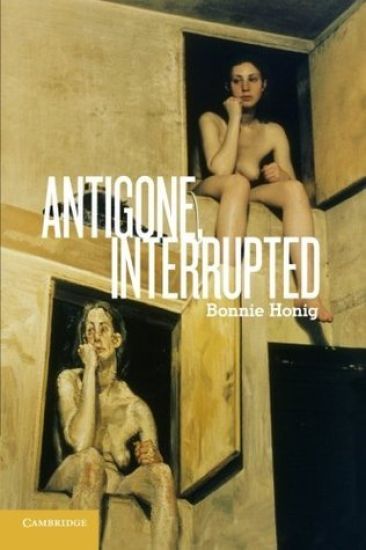
Antigone, Interrupted

Antigone, Interrupted

Bonnie Honig

Cambridge University Press
2013
pokkari
Sophocles' Antigone is a touchstone in democratic, feminist and legal theory, and possibly the most commented upon play in the history of philosophy and political theory. Bonnie Honig's rereading of it therefore involves intervening in a host of literatures and unsettling many of their governing assumptions. Exploring the power of Antigone in a variety of political, cultural, and theoretical settings, Honig identifies the 'Antigone-effect' - which moves those who enlist Antigone for their politics from activism into lamentation. She argues that Antigone's own lamentations can be seen not just as signs of dissidence but rather as markers of a rival world view with its own sovereignty and vitality. Honig argues that the play does not offer simply a model for resistance politics or 'equal dignity in death', but a more positive politics of counter-sovereignty and solidarity which emphasizes equality in life.
Antigone, Interrupted

Antigone, Interrupted

Bonnie Honig

Cambridge University Press
2013
sidottu
Sophocles' Antigone is a touchstone in democratic, feminist and legal theory, and possibly the most commented upon play in the history of philosophy and political theory. Bonnie Honig's rereading of it therefore involves intervening in a host of literatures and unsettling many of their governing assumptions. Exploring the power of Antigone in a variety of political, cultural, and theoretical settings, Honig identifies the 'Antigone-effect' - which moves those who enlist Antigone for their politics from activism into lamentation. She argues that Antigone's own lamentations can be seen not just as signs of dissidence but rather as markers of a rival world view with its own sovereignty and vitality. Honig argues that the play does not offer simply a model for resistance politics or 'equal dignity in death', but a more positive politics of counter-sovereignty and solidarity which emphasizes equality in life.
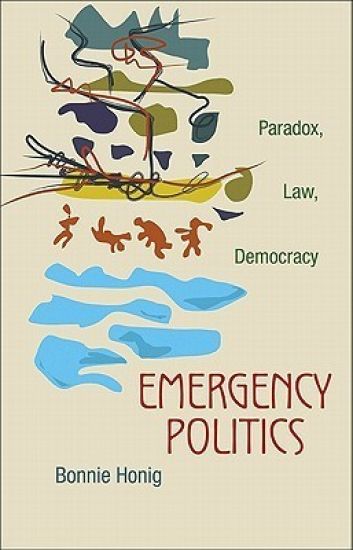
Emergency Politics

Emergency Politics

Bonnie Honig

Princeton University Press
2011
pokkari
This book intervenes in contemporary debates about the threat posed to democratic life by political emergencies. Must emergency necessarily enhance and centralize top-down forms of sovereignty? Those who oppose executive branch enhancement often turn instead to law, insisting on the sovereignty of the rule of law or demanding that law rather than force be used to resolve conflicts with enemies. But are these the only options? Or are there more democratic ways to respond to invocations of emergency politics? Looking at how emergencies in the past and present have shaped the development of democracy, Bonnie Honig argues that democracies must resist emergency's pull to focus on life's necessities (food, security, and bare essentials) because these tend to privatize and isolate citizens rather than bring us together on behalf of hopeful futures. Emphasizing the connections between mere life and more life, emergence and emergency, Honig argues that emergencies call us to attend anew to a neglected paradox of democratic politics: that we need good citizens with aspirational ideals to make good politics while we need good politics to infuse citizens with idealism. Honig takes a broad approach to emergency, considering immigration politics, new rights claims, contemporary food politics and the infrastructure of consumption, and the limits of law during the Red Scare of the early twentieth century. Taking its bearings from Moses Mendelssohn, Franz Rosenzweig, and other Jewish thinkers, this is a major contribution to modern thought about the challenges and risks of democratic orientation and action in response to emergency.
The Oxford Handbook of Political Theory

The Oxford Handbook of Political Theory

John S Dryzek; Bonnie Honig; Anne Phillips

Oxford University Press
2008
nidottu
Long recognized as one of the main branches of political science, political theory has in recent years burgeoned in many different directions. Close textual analysis of historical texts sits alongside more analytical work on the nature and normative grounds of political values. Continental and post-modern influences jostle with ones from economics, history, sociology, and the law. Feminist concerns with embodiment make us look at old problems in new ways, and challenges of new technologies open whole new vistas for political theory. This Handbook provides comprehensive and critical coverage of the lively and contested field of political theory, and will help set the agenda for the field for years to come. Forty-five chapters by distinguished political theorists look at the state of the field, where it has been in the recent past, and where it is likely to go in future. They examine political theory's edges as well as its core, the globalizing context of the field, and the challenges presented by social, economic, and technological changes.
Democracy and the Foreigner

Democracy and the Foreigner

Bonnie Honig

Princeton University Press
2003
pokkari
What should we do about foreigners? Should we try to make them more like us or keep them at bay to protect our democracy, our culture, our well-being? This dilemma underlies age-old debates about immigration, citizenship, and national identity that are strikingly relevant today. In Democracy and the Foreigner, Bonnie Honig reverses the question: What problems might foreigners solve for us? Hers is not a conventional approach. Instead of lauding the achievements of individual foreigners, she probes a much larger issue--the symbolic politics of foreignness. In doing so she shows not only how our debates over foreignness help shore up our national or democratic identities, but how anxieties endemic to liberal democracy themselves animate ambivalence toward foreignness. Central to Honig's arguments are stories featuring "foreign-founders," in which the origins or revitalization of a people depend upon a foreigner's energy, virtue, insight, or law. From such popular movies as The Wizard of Oz, Shane, and Strictly Ballroom to the biblical stories of Moses and Ruth to the myth of an immigrant America, from Rousseau to Freud, foreignness is represented not just as a threat but as a supplement for communities periodically requiring renewal. Why? Why do people tell stories in which their societies are dependent on strangers? One of Honig's most surprising conclusions is that an appreciation of the role of foreigners in (re)founding peoples works neither solely as a cosmopolitan nor a nationalist resource. For example, in America, nationalists see one archetypal foreign-founder--the naturalized immigrant--as reconfirming the allure of deeply held American values, whereas to cosmopolitans this immigrant represents the deeply transnational character of American democracy. Scholars and students of political theory, and all those concerned with the dilemmas democracy faces in accommodating difference, will find this book rich with valuable and stimulating insights.
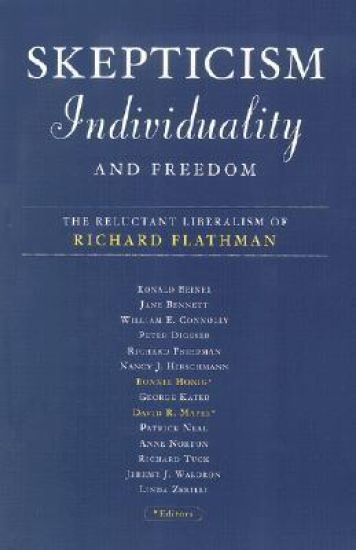
Skepticism, Individuality, and Freedom

Skepticism, Individuality, and Freedom

Bonnie Honig

University of Minnesota Press
2002
nidottu
Major thinkers grapple with the challenge of this renowned liberal thinker.As one of liberal theory’s most important gadflies, Richard Flathman has during the past four decades produced a significant body of work that is iconoclastic, idiosyncratic, and increasingly influential. Flathman criticizes liberal theory’s role in justifying a politics of governance that has drifted substantially from liberalism’s central commitments to individuality and freedom. It is this challenge, and its implications for the future of liberal theory, that brings together the diverse and distinguished authors of this volume. Topics include the relationships between theory and practice, skepticism and knowledge, individuality and egoism, negative and positive freedom, Hobbes and liberalism, as well as the uneasy connections among liberalism, feminism, and democratic politics. Contributors: Ronald Beiner, U of Toronto; Jane Bennett, Goucher; William E. Connolly, Johns Hopkins; Peter Digeser, U of California, Santa Barbara; Richard Friedman, SUNY, Buffalo; Nancy J. Hirschmann, Cornell; George Kateb, Princeton; Patrick Neal, U of Vermont; Anne Norton, U of Pennsylvania; Richard Tuck, Harvard; Jeremy J. Waldron, Columbia; Linda Zerilli, Northwestern.
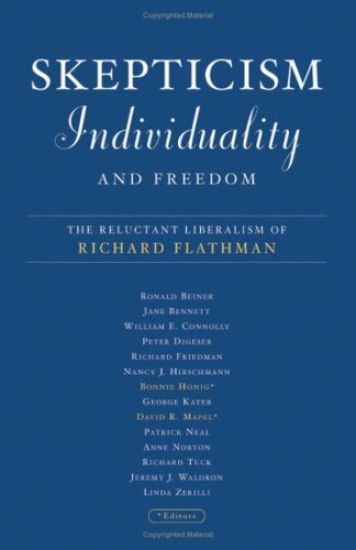
Skepticism, Individuality, and Freedom

Skepticism, Individuality, and Freedom

Bonnie Honig

University of Minnesota Press
2002
sidottu
As one of liberal theory's most important gadflies, Richard Flathman has during the past four decades produced a significant body of work that is iconoclastic, idiosyncratic, and increasingly influential. Flathman criticizes liberal theory's role in justifying a politics of governance that has drifted substantially from liberalism's central commitments to individuality and freedom. It is this challenge, and its implications for the future of liberal theory, that brings together the diverse and distinguished authors of this volume. Topics include the relationships between theory and practice, skepticism and knowledge, individuality and egoism, negative and positive freedom, Hobbes and liberalism, as well as the uneasy connections among liberalism, feminism, and democratic politics.
Political Theory and the Displacement of Politics

Political Theory and the Displacement of Politics

Bonnie Honig

Cornell University Press
1993
pokkari
In this book, Bonnie Honig rethinks that established relation between politics and political theory. From liberal to communitarian to republican, political theorists of opposing positions often treat political theory less as an exploration of politics than as a series of devices of its displacement. Honig characterizes Kant, Rawls, and Sandel as virtue theorists of politics, arguing that they rely on principles of right, rationality, community, and law to protect their political theories from the conflict and uncertainty of political reality. Drawing on Nietzsche and Arendt, as well as Machiavelli and Derrida, Honig explores an alternative politics of virtù, which treats the disruptions of political order as valued sites of democratic freedom and individuality.