Kirjojen hintavertailu. Mukana 12 595 353 kirjaa ja 12 kauppaa.

Kirjailija

Boris Vormann

Kirjat ja teokset yhdessä paikassa: 5 kirjaa, julkaisuja vuosilta 2014-2025, suosituimpien joukossa Global Port Cities in North America. Vertaile teosten hintoja ja tarkista saatavuus suomalaisista kirjakaupoista.

5 kirjaa

Kirjojen julkaisuhaarukka 2014-2025.

Global Port Cities in North America
As the material anchors of globalization, North America’s global port cities channel flows of commodities, capital, and tourists. This book explores how economic globalization processes have shaped these cities' political institutions, social structures, and urban identities since the mid-1970s. Although the impacts of financialization on global cities have been widely discussed, it is curious that how the global integration of commodity chains actually happens spatially — creating a quantitatively new, global organization of production, distribution, and consumption processes — remains understudied. The book uses New York City, Los Angeles, Vancouver, and Montreal as case studies of how once-redundant spaces have been reorganized, and crucially, reinterpreted, so as to accommodate new flows of goods and people — and how, in these processes, social, environmental, and security costs of global production networks have been shifted to the public.
Global Port Cities in North America
As the material anchors of globalization, North America’s global port cities channel flows of commodities, capital, and tourists. This book explores how economic globalization processes have shaped these cities' political institutions, social structures, and urban identities since the mid-1970s. Although the impacts of financialization on global cities have been widely discussed, it is curious that how the global integration of commodity chains actually happens spatially — creating a quantitatively new, global organization of production, distribution, and consumption processes — remains understudied. The book uses New York City, Los Angeles, Vancouver, and Montreal as case studies of how once-redundant spaces have been reorganized, and crucially, reinterpreted, so as to accommodate new flows of goods and people — and how, in these processes, social, environmental, and security costs of global production networks have been shifted to the public.
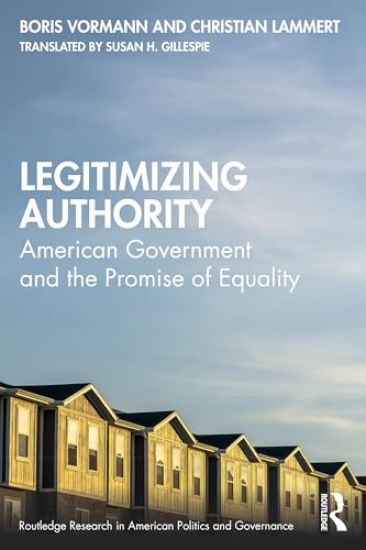
Legitimizing Authority

Legitimizing Authority

Boris Vormann; Christian Lammert

TAYLOR FRANCIS LTD
2025
nidottu
Legitimizing Authority places the American state apparatus back in the foreground to rethink the development of the country’s government in the context of its unfulfilled promise of equality.The book argues that the tensions between calls for equality and the simultaneous tolerance of inequality have accompanied the rise of modern mass society and, with it, of liberal democracy. Vormann and Lammert emphasize that government has played and continues to play a decisive role in calibrating the relationship between the interior and the exterior of the nation, moving between an extractive state, a taxation state, and a welfare state over time in order to expand social access and political participation inside the national community – while tolerating conditions that continue to belie the historical promise of equality. The authors draw on a range of literatures that transcend disciplinary boundaries to reveal how exploitative practices have been accepted. They conclude that the democratic crises of the present must be comprehended through understanding how legitimation was always maintained by a state apparatus active at multiple scales and in multiple policy fields.This interdisciplinary book is addressed to a broad audience across disciplines, including political science, political economy, political history, comparative politics, international politics, international relations, American Political Development (APD), and cultural studies.
Legitimizing Authority

Legitimizing Authority

Boris Vormann; Christian Lammert

TAYLOR FRANCIS LTD
2023
sidottu
Legitimizing Authority places the American state apparatus back in the foreground to rethink the development of the country’s government in the context of its unfulfilled promise of equality.The book argues that the tensions between calls for equality and the simultaneous tolerance of inequality have accompanied the rise of modern mass society and, with it, of liberal democracy. Vormann and Lammert emphasize that government has played and continues to play a decisive role in calibrating the relationship between the interior and the exterior of the nation, moving between an extractive state, a taxation state, and a welfare state over time in order to expand social access and political participation inside the national community – while tolerating conditions that continue to belie the historical promise of equality. The authors draw on a range of literatures that transcend disciplinary boundaries to reveal how exploitative practices have been accepted. They conclude that the democratic crises of the present must be comprehended through understanding how legitimation was always maintained by a state apparatus active at multiple scales and in multiple policy fields.This interdisciplinary book is addressed to a broad audience across disciplines, including political science, political economy, political history, comparative politics, international politics, international relations, American Political Development (APD), and cultural studies.
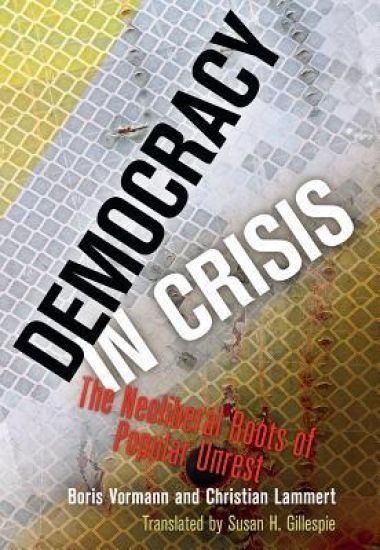
Democracy in Crisis

Democracy in Crisis

Boris Vormann; Christian Lammert

University of Pennsylvania Press
2019
sidottu
Liberal democracies on both sides of the Atlantic find themselves approaching a state of emergency, beset by potent populist challenges of the right and left. But what exactly lies at the core of widespread dissatisfaction with the status quo? And how can the challenge be overcome? In Democracy in Crisis, Christian Lammert and Boris Vormann argue that the rise of populism in North Atlantic states is not the cause of a crisis of governance but its result. This crisis has been many decades in the making and is intricately linked to the rise of a certain type of political philosophy and practice in which economic rationality has hollowed out political values and led to an impoverishment of the political sphere more broadly. The process began in the 1980s, when the United States and Great Britain decided to unleash markets in the name of economic growth and democracy. After the fall of the Berlin Wall, several countries in Europe followed suit and marketized their educational, social, and healthcare systems, which in turn increased inequality and fragmentation. The result has been a collapse of social cohesion and trust that the populists promise to address but only make worse. Looking to the future, Lammert and Vormann conclude their analysis with concrete suggestions for ways politics can once again be placed in the foreground, with markets serving social relations rather than the reverse.