Kirjailija
Brad Jersak
Kirjat ja teokset yhdessä paikassa: 11 kirjaa, julkaisuja vuosilta 2010-2020, suosituimpien joukossa Nothing but the Blood of Jesus. Vertaile teosten hintoja ja tarkista saatavuus suomalaisista kirjakaupoista.
11 kirjaa
Kirjojen julkaisuhaarukka 2010-2020.

George P. Grant - Canada's Lone Wolf: Essays in Political Philosophy
Brad Jersak; Ron S. Dart
Createspace Independent Publishing Platform
2013
nidottu
This collection of essays by George Grant scholars, Ron Dart and Brad Jersak, explores issues of political philosophy, including comparisons with Manning, Strauss, Voegelin and Weil.Part 1 Essays by Ron S. Dart1. Reversing the Reversal / 72. Review of Lament for a Nation / 153. George Grant and Ernest Manning: Who is the RealConservative? / 274. Biblical Judaism, Western Christianity andLiberalism / 375. Matrix of Liberalism: a Seven Act Drama / 45Part 2 Essays by Brad Jersak6. Grant, Weil and Nietzsche: The Darkness of Modernity / 737. Grant, Strauss and Voegelin: Modernist Embodiments / 10
Grace is amazing. About this all Christians agree. Yet nearly all forms of Christianity put significant limits on grace. Those forms of Christianity which proclaim grace alone actually saves typically don't believe God gives grace to everyone; while those forms of Christianity which proclaim God gives grace to everyone typically don't believe grace alone actually saves. Must grace either be that which saves alone but doesn't go to all, or that which goes to all but doesn't save alone? In Grace Saves All, David Artman argues that grace saves alone and goes to all. This inclusive approach to Christianity is variously called universal reconciliation, universal salvation, or perhaps most accurately, Christian universalism. He contends that the inclusive/Christian universalist approach is necessary because it offers the only Christian theology which successfully defends the goodness of God. For it logically follows that if God is all-good, all-knowing, and all-powerful, then God must also be all-saving. Often dismissed as a modern feel-good theology, Christian universalism is an ancient, orthodox, and biblical theology which was expounded by early Christians and early church fathers. Artman brings much deserved attention to this wonderful spirituality.
Grace is amazing. About this all Christians agree. Yet nearly all forms of Christianity put significant limits on grace. Those forms of Christianity which proclaim grace alone actually saves typically don't believe God gives grace to everyone; while those forms of Christianity which proclaim God gives grace to everyone typically don't believe grace alone actually saves. Must grace either be that which saves alone but doesn't go to all, or that which goes to all but doesn't save alone? In Grace Saves All, David Artman argues that grace saves alone and goes to all. This inclusive approach to Christianity is variously called universal reconciliation, universal salvation, or perhaps most accurately, Christian universalism. He contends that the inclusive/Christian universalist approach is necessary because it offers the only Christian theology which successfully defends the goodness of God. For it logically follows that if God is all-good, all-knowing, and all-powerful, then God must also be all-saving. Often dismissed as a modern feel-good theology, Christian universalism is an ancient, orthodox, and biblical theology which was expounded by early Christians and early church fathers. Artman brings much deserved attention to this wonderful spirituality.


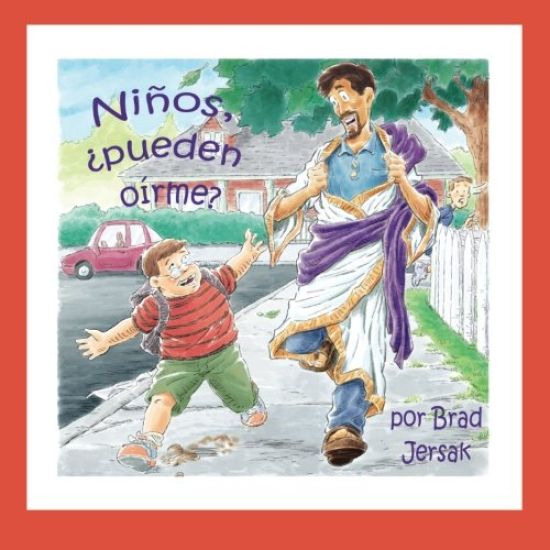
Niños, ¿pueden oírme?: Como oir y ver a Dios
Brad Jersak
Createspace Independent Publishing Platform
2014
nidottu
Puedes usar este libro con ni os de varias maneras. Para empezar, puedes leerlo junto con ellos f cilmente en una sentada. Tambi n te dar s cuenta que cada p gina puede actuar independiente como un devocional para ni os, acompa ado por una porci n de Escritura parafraseada. Despu s de haber le do todo el libro varias veces, tal vez quieras leerlo otra vez, pausando en cada p gina para hablar del punto que se plantea. Anima a los ni os a que te hagan preguntas acerca de ti y de Dios.La mayor a de las p ginas tambi n pueden servir como ejercicios de "oraci n de solo escuchar". Por ejemplo, una de las p ginas trata con encontrar a Dios en tu mejor recuerdo. Usa esto como un ejercicio para escuchar, dile a los ni os que cierren sus ojos y digan todo lo que puedan de su recuerdo favorito, incluyendo lugares, sonidos, olores, y sabores. Una vez que hayan descrito todo el cuadro, p deles que busquen a Jes s dentro de ese cuadro y que te digan que es lo que est haciendo o diciendo. Inv talos a que se le acerquen e interact en con l como un amigo. Y para terminar, tambi n he escrito este libro para el ni o o ni a dentro de ti - el que necesita escuchar lo que Jes s esta diciendo a sus ni os. No importa tu edad, si tu puedes escuchar este mensaje como un ni o ansioso y dispuesto, nimo Podr a ser que est s entrando en el reino de los cielos
Red Tory, Red Virgin: Essays on Simone Weil and George P. Grant
Brad Jersak
Fresh Wind Press
2013
nidottu
Simone Weil and George P. Grant were among the 20th century's top political theologians. Weil, a philosopher-activist-mystic from France, was the Christian mystic who refused to join the Church but nevertheless, influenced the Vatican II popes with her radical openness.George Grant, one of Canada's top three thinkers, once said that next to the four Gospels, Weil was his highest authority.This book is a series of essays in political theology, exploring some of their key themes and how their work inter-relates. This book explores in depth, for the first time, how their 'theology of consent' informs their political philosophy and a public ethic of the Cross.Table of ContentsPreface / 1Part 1 - SIMONE WEIL: RED VIRGIN1. Simone Weil: George Grant's Diotima / 52. Stages of Weil's Mystical Ascent / 193. Competing Conceptions of God in Biblical Religion / 49Part 2 - GEORGE GRANT: RED TORY4. Grant and the Matrix: Complex of Ideologies / 715. Grant and the Matrix: Dialogue Partners / 756. Finding His Voice: Conversion to Lament / 83Part 3 - DIVINE CONSENT7. Wrath and Love as Divine Consent / 109Abbreviations / 123Bibliography of Sources Consulted / 127
George P. Grant - Minerva's Snowy Owl: Essays in Political Theology
Brad Jersak
Createspace Independent Publishing Platform
2013
nidottu
George P. Grant (1918-88) was one of Canada's premier political philosophers and stands as the benchmark for the Red Tory Tradition. He can also be credited with introducing the thought of Nietzsche, Heidegger and Simone Weil to Canada, critically analyzing their work seriously for the first time. Grant's Red Toryism has been revived and modified in the UK, but for a look at the essential thought of its chief architect, this book is a must read. Included in this work are essays in political theology, along with previously unpublished letters and classnotes that are critical to an understanding of Grant's 'primacy of the Good' vis-a-vis the 'primacy of freedom-as-mastery.' Especially important is the analysis of his theological relationship to Simone Weil and an appropriation of his work to rise above the culture wars of left and right.Table of ContentsPreface / 1Part 1 - CONVERSION1. George Grant's Conversion Accounts / 52. Simone Weil's Encounter with Christ in Marseilles / 133. Grant's McMaster Sermon / 17Part 2 - THE RISE OF MODERNITY4. Sprouts of Modernity in Medieval Theology / 235. Blooms of Modernity in the Reformation and Calvinist Puritanism / 376. The Autonomous Subject: Knowing as Willing in Descartes, Bacon and Kant / 49Part 3 - MYSTICAL EPISTEMOLOGY7. Etymology of Nous / 658. Heidegger's Eckart / 819. Weil's Mystical Ascent / 85Part 4 - GRANTEAN THEOLOGY10. God the All-Powerful, All-Powerless / 11111. Consent as Coercion / 123Part 5 - GRANTEAN JUSTICE12. Grant's Rhetorical Method / 13113. Christ at the Checkpoint / 141Part 6 - PRIMARY SOURCES14. Previously Unpublished Letters and Journal Entries / 15115. Reading Simone Weil: Unpublished Excerpt / 19916. Dalhousie Classnotes on Plato / 20117. Robin Mathews: The Wave of the Future / 21118. Grant's References to Martin Luther's Thesis 21 / 213APPENDICES19. Grant's Readings in Weil: French and English / 21920. Beyond Dualism: Correspondence with Radical Orthodoxy / 221Abbreviations / 227Bibliography of Sources Consulted / 231