Kirjojen hintavertailu. Mukana 12 383 395 kirjaa ja 12 kauppaa.

Kirjailija

Branko Grünbaum

Kirjat ja teokset yhdessä paikassa: 7 kirjaa, julkaisuja vuosilta 2003-2025, suosituimpien joukossa Convex Polytopes. Vertaile teosten hintoja ja tarkista saatavuus suomalaisista kirjakaupoista.

Mukana myös kirjoitusasut: Branko Grunbaum

7 kirjaa

Kirjojen julkaisuhaarukka 2003-2025.

Convex Polytopes

Convex Polytopes

Branko Grünbaum

Springer-Verlag New York Inc.
2003
nidottu
"The appearance of Grünbaum's book Convex Polytopes in 1967 was a moment of grace to geometers and combinatorialists. The special spirit of the book is very much alive even in those chapters where the book's immense influence made them quickly obsolete. Some other chapters promise beautiful unexplored land for future research. The appearance of the new edition is going to be another moment of grace. Kaibel, Klee and Ziegler were able to update the convex polytope saga in a clear, accurate, lively, and inspired way." (Gil Kalai, The Hebrew University of Jerusalem) "The original book of Grünbaum has provided the central reference for work in this active area of mathematics for the past 35 years...I first consulted this book as a graduate student in 1967; yet, even today, I am surprised again and again by what I find there. It is an amazingly complete reference for work on this subject up to that time and continues to be a major influence on research to this day." (Louis J. Billera, Cornell University) "The original edition of Convex Polytopes inspired a whole generation of grateful workers in polytope theory. Without it, it is doubtful whether many of the subsequent advances in the subject would have been made. The many seeds it sowed have since grown into healthy trees, with vigorous branches and luxuriant foliage. It is good to see it in print once again." (Peter McMullen, University College London)
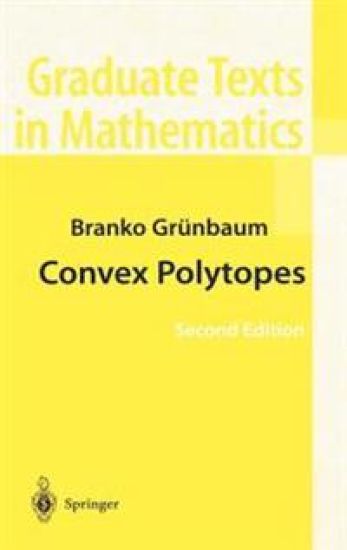
Convex Polytopes

Convex Polytopes

Branko Grünbaum

Springer-Verlag New York Inc.
2003
sidottu
"The appearance of Grünbaum's book Convex Polytopes in 1967 was a moment of grace to geometers and combinatorialists. The special spirit of the book is very much alive even in those chapters where the book's immense influence made them quickly obsolete. Some other chapters promise beautiful unexplored land for future research. The appearance of the new edition is going to be another moment of grace. Kaibel, Klee and Ziegler were able to update the convex polytope saga in a clear, accurate, lively, and inspired way." (Gil Kalai, The Hebrew University of Jerusalem) "The original book of Grünbaum has provided the central reference for work in this active area of mathematics for the past 35 years...I first consulted this book as a graduate student in 1967; yet, even today, I am surprised again and again by what I find there. It is an amazingly complete reference for work on this subject up to that time and continues to be a major influence on research to this day." (Louis J. Billera, Cornell University) "The original edition of Convex Polytopes inspired a whole generation of grateful workers in polytope theory. Without it, it is doubtful whether many of the subsequent advances in the subject would have been made. The many seeds it sowed have since grown into healthy trees, with vigorous branches and luxuriant foliage. It is good to see it in print once again." (Peter McMullen, University College London)
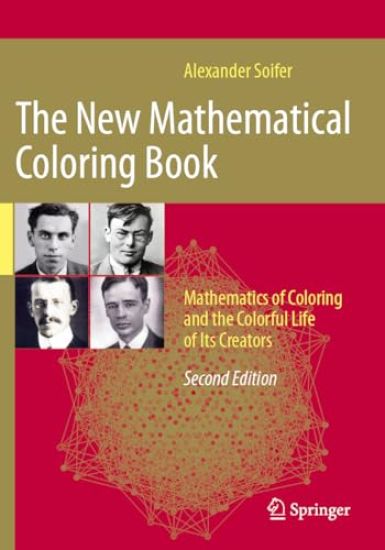
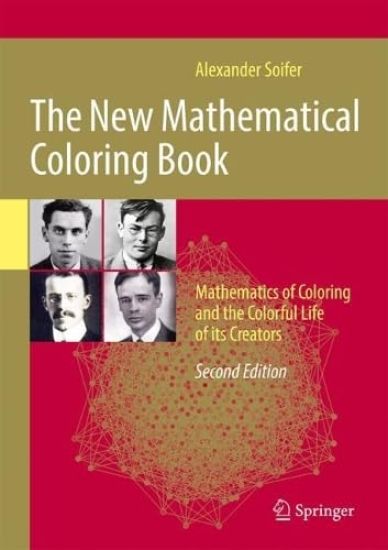
The New Mathematical Coloring Book

The New Mathematical Coloring Book

Alexander Soifer; Branko Grünbaum; Peter Johnson; Cecil Rousseau

SPRINGER-VERLAG NEW YORK INC.
2025
nidottu
The New Mathematical Coloring Book (TNMCB) includes striking results of the past 15-year renaissance that produced new approaches, advances, and solutions to problems from the first edition. A large part of the new edition “Ask what your computer can do for you,” presents the recent breakthrough by Aubrey de Grey and works by Marijn Heule, Jaan Parts, Geoffrey Exoo, and Dan Ismailescu. TNMCB introduces new open problems and conjectures that will pave the way to the future keeping the book in the center of the field. TNMCB presents mathematics of coloring as an evolution of ideas, with biographies of their creators and historical setting of the world around them, and the world around us.A new thing in the world at the time, TMCB I is now joined by a colossal sibling containing more than twice as much of what only Alexander Soifer can deliver: an interweaving of mathematics with history and biography, well-seasoned with controversy and opinion. –Peter D. Johnson, Jr.Auburn UniversityLike TMCB I, TMCB II is a unique combination of Mathematics, History, and Biography written by a skilled journalist who has been intimately involved with the story for the last half-century. …The nature of the subject makes much of the material accessible to students, but also of interest to working Mathematicians. … In addition to learning some wonderful Mathematics, students will learn to appreciate the influences of Paul Erdos, Ron Graham, and others.–Geoffrey ExooIndiana State UniversityThe beautiful and unique Mathematical coloring book of Alexander Soifer is another case of “good mathematics”, containing a lot of similar examples (it is not by chance that Szemerédi’s Theorem story is included as well) and presenting mathematics as both a science and an art…–Peter MihókMathematical Reviews, MathSciNetA postman came to the door with a copy of the masterpiece of the century. I thank you and the mathematics community should thank you for years to come. You have set a standard for writing about mathematics and mathematicians that will be hard to match.– Harold W. KuhnPrinceton UniversityI have never encountered a book of this kind. The best description of it I can give is that it is a mystery novel… I found it hard to stop reading before I finished (in two days) the whole text. Soifer engages the reader's attention not only mathematically, but emotionally and esthetically. May you enjoy the book as much as I did!– Branko GrünbaumUniversity of WashingtonI am in absolute awe of your 2008 book.–Aubrey D.N.J. de GreyLEV Foundation
The New Mathematical Coloring Book

The New Mathematical Coloring Book

Alexander Soifer; Branko Grünbaum; Peter Johnson; Cecil Rousseau

SPRINGER-VERLAG NEW YORK INC.
2024
sidottu
The New Mathematical Coloring Book (TNMCB) includes striking results of the past 15-year renaissance that produced new approaches, advances, and solutions to problems from the first edition. A large part of the new edition “Ask what your computer can do for you,” presents the recent breakthrough by Aubrey de Grey and works by Marijn Heule, Jaan Parts, Geoffrey Exoo, and Dan Ismailescu. TNMCB introduces new open problems and conjectures that will pave the way to the future keeping the book in the center of the field. TNMCB presents mathematics of coloring as an evolution of ideas, with biographies of their creators and historical setting of the world around them, and the world around us.A new thing in the world at the time, TMCB I is now joined by a colossal sibling containing more than twice as much of what only Alexander Soifer can deliver: an interweaving of mathematics with history and biography, well-seasoned with controversy and opinion. –Peter D. Johnson, Jr.Auburn UniversityLike TMCB I, TMCB II is a unique combination of Mathematics, History, and Biography written by a skilled journalist who has been intimately involved with the story for the last half-century. …The nature of the subject makes much of the material accessible to students, but also of interest to working Mathematicians. … In addition to learning some wonderful Mathematics, students will learn to appreciate the influences of Paul Erdos, Ron Graham, and others.–Geoffrey ExooIndiana State UniversityThe beautiful and unique Mathematical coloring book of Alexander Soifer is another case of “good mathematics”, containing a lot of similar examples (it is not by chance that Szemerédi’s Theorem story is included as well) and presenting mathematics as both a science and an art…–Peter MihókMathematical Reviews, MathSciNetA postman came to the door with a copy of the masterpiece of the century. I thank you and the mathematics community should thank you for years to come. You have set a standard for writing about mathematics and mathematicians that will be hard to match.– Harold W. KuhnPrinceton UniversityI have never encountered a book of this kind. The best description of it I can give is that it is a mystery novel… I found it hard to stop reading before I finished (in two days) the whole text. Soifer engages the reader's attention not only mathematically, but emotionally and esthetically. May you enjoy the book as much as I did!– Branko GrünbaumUniversity of WashingtonI am in absolute awe of your 2008 book.–Aubrey D.N.J. de GreyLEV Foundation
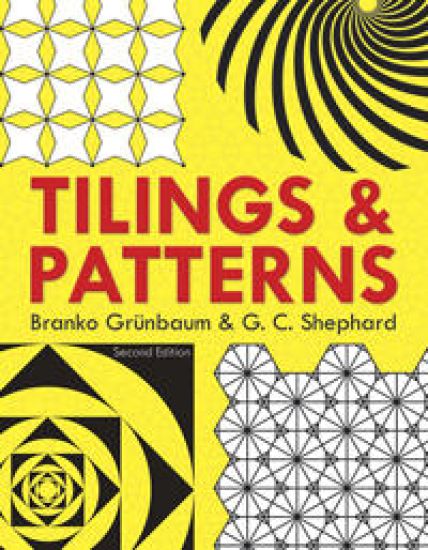
Tilings and Patterns

Tilings and Patterns

Branko Grunbaum

Dover Publications Inc.
2016
nidottu
The definitive book on tiling and geometric patterns, this magnificently illustrated volume features 520 figures and more than 100 tables. Accessible to anyone with a grasp of geometry, it offers numerous graphic examples of two-dimensional spaces covered with interlocking figures, in addition to related problems and references. Suitable for geometry courses as well as independent study, this inspiring book is geared toward students, professional mathematicians, and readers interested in patterns and shapes—artists, architects, and crystallographers, among others. Along with helpful examples from mathematics and geometry, it draws upon models from fields as diverse as crystallography, virology, art, philosophy, and quilting. The self-contained chapters need not be read in sequence, and each concludes with an excellent selection of notes and references. The first seven chapters can be used as a classroom text, and the final four contain fascinating browsing material, including detailed surveys of color patterns, groups of color symmetry, and tilings by polygons.
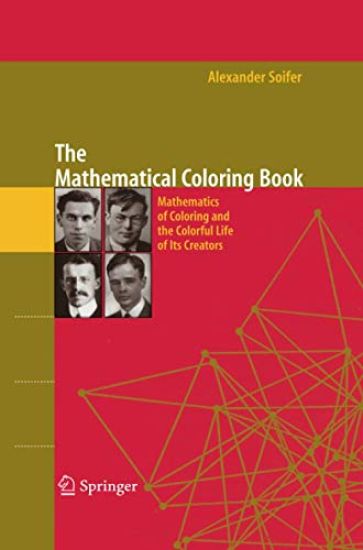
The Mathematical Coloring Book

The Mathematical Coloring Book

Alexander Soifer; Branko Grünbaum; Peter Johnson; Cecil Rousseau

Springer-Verlag New York Inc.
2014
nidottu
This is a unique type of book; at least, I have never encountered a book of this kind. The best description of it I can give is that it is a mystery novel, developing on three levels, and imbued with both educational and philosophical/moral issues. If this summary description does not help understanding the particular character and allure of the book, possibly a more detailed explanation will be found useful. One of the primary goals of the author is to interest readers—in particular, young mathematiciansorpossiblypre-mathematicians—inthefascinatingworldofelegant and easily understandable problems, for which no particular mathematical kno- edge is necessary, but which are very far from being easily solved. In fact, the prototype of such problems is the following: If each point of the plane is to be given a color, how many colors do we need if every two points at unit distance are to receive distinct colors? More than half a century ago it was established that the least number of colorsneeded for such a coloring is either 4, or 5, or 6 or 7. Well, which is it? Despite efforts by a legion of very bright people—many of whom developed whole branches of mathematics and solved problems that seemed much harder—not a single advance towards the answer has been made. This mystery, and scores of other similarly simple questions, form one level of mysteries explored. In doing this, the author presents a whole lot of attractive results in an engaging way, and with increasing level of depth.