Kirjojen hintavertailu. Mukana 12 390 323 kirjaa ja 12 kauppaa.

Kirjailija

Brenda Vale

Kirjat ja teokset yhdessä paikassa: 14 kirjaa, julkaisuja vuosilta 2007-2025, suosituimpien joukossa Collapsing Gracefully: Making a Built Environment that is Fit for the Future. Vertaile teosten hintoja ja tarkista saatavuus suomalaisista kirjakaupoista.

14 kirjaa

Kirjojen julkaisuhaarukka 2007-2025.

Wealth and the Built Environment

Wealth and the Built Environment

Emilio José García; Brenda Vale

Springer International Publishing AG
2025
sidottu
The need to address global environmental problems is urgent. The United Nations 17 Sustainable Development Goals (SDGs) cover a wide range of global concerns, from poverty, hunger, and gender equity to justice and climate action. Concerningly, the SDGs still have faith in economic growth and technological innovation as the means of fixing all global concerns, including climate change. What is not questioned is whether solving development and sustainability problems through economic growth for the accumulation of wealth for the few has led to many of the current unequal development and environmental problems. If unfair growth and wealth accumulation have been part of the problem, how can they be part of the solution? The problem with the SDGs is that their fulfilment relies on wealth creation without the fundamental concomitant of wealth redistribution. The one common driver of change affecting both sustainability and development that has not been included in the SDGs is wealth, the central focus of this book. SDG 11 – sustainable cities and communities – presents a further paradox unless the issue of wealth and its fair distribution is grasped. Cities are the places where wealth is generated but are also places where only a minority are wealthy. The wealth generated in cities leads to higher consumption of resources, higher emissions, and higher disparities and inequalities. However, any version of a sustainable future will happen in the built environment made according to current ideals, like the present belief in overcoming all humanity's problems by becoming wealthier. A fundamental assumption of this book is that the first step toward a fairer habitat that can maintained with the resources available is only possible if we stop designing cities and buildings as if everyone were wealthy or had to become wealthy. To achieve this goal, it is essential to identify and raise awareness of the impact of wealth, to question how the myths about the advantages of wealth were built, where they come from, what shape they take in the built environment and who benefits from them.
Prefabs

Prefabs

Brenda Vale

TAYLOR FRANCIS LTD
2024
nidottu
Originally published in 1995, this book unravels the history of the ‘temporary bungalow’ and shows that perhaps it was more a question of providing a new peace-time product for factories than a means of providing accommodation for the homeless. Built in a period of housing history which remains fascinating for architects and planners and admired by some of their first occupants but berated by others, those prefabs remaining today are subject to preservation orders but also perhaps offer a solution to the ongoing housing crisis in the UK. The book includes chapters on the development of the prefab house in the UK; comparisons with temporary housing programmes in the USA, Sweden and Germany; political and economic considerations to the UK Temporary Housing Programme and a discussion of the design of the Arcon, Uni-Seco, Tarran and Aluminium Temporary Bungalows.
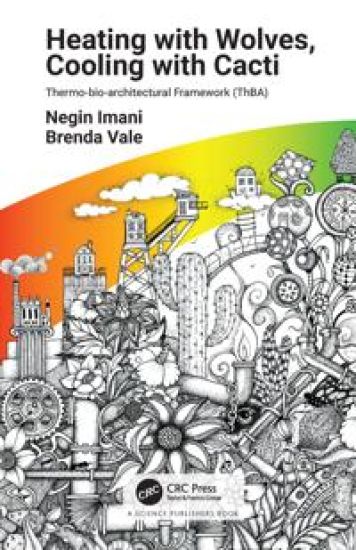
Heating with Wolves, Cooling with Cacti

Heating with Wolves, Cooling with Cacti

Negin Imani; Brenda Vale

TAYLOR FRANCIS LTD
2024
nidottu
This book describes the detailed process behind the development of a comprehensive thermo-bio-architectural framework (the ThBA). This framework systematically connects the thermal performance requirements of a building to relevant solutions found in the natural world. This is the first time that architecture has been connected to biology in this manner. The book provides an in-depth understanding of thermoregulatory strategies in animals and plants and links these to equivalent solutions in architectural design. The inclusion of this fundamental knowledge, along with the systematic process of accessing it, should open up new avenues for the generation of energy efficient and sustainable buildings.
The Environmental Impact of Cities

The Environmental Impact of Cities

Fabricio Chicca; Brenda Vale; Robert Vale

TAYLOR FRANCIS LTD
2022
sidottu
The Environmental Impact of Cities assesses the environmental impact that comes from cities and their inhabitants, demonstrating that our current political and economic systems are not environmentally sustainable because they are designed for endless growth in a system which is finite. It is already well documented that political, economic and social forces are capable of shaping cities and their expansion, retraction, gentrification, re-population, industrialisation or de-industrialisation. However, the links between these political and economic forces and the environmental impact they have on urban areas have yet to be numerically presented. As a result, it is not clear how our cities are affecting the environment, meaning it is currently impossible to relate their economic, political and social systems to their environmental performance. This book examines a broad selection of cities covering a wide range of political systems, geography, cultural backgrounds and population size. The environmental impact of the selected cities is calculated using both ecological footprint and carbon emissions, two of the most extensively available indices for measuring environmental impact. The results are then considered in terms of political, economic and social factors to ascertain the degree to which these factors are helping or hindering the reduction of the environmental impact of humans. This book will be of great interest to students and scholars of sustainability, urban planning, urban design, environmental sciences, geography and sociology.
The Environmental Impact of Cities

The Environmental Impact of Cities

Fabricio Chicca; Brenda Vale; Robert Vale

TAYLOR FRANCIS LTD
2022
nidottu
The Environmental Impact of Cities assesses the environmental impact that comes from cities and their inhabitants, demonstrating that our current political and economic systems are not environmentally sustainable because they are designed for endless growth in a system which is finite. It is already well documented that political, economic and social forces are capable of shaping cities and their expansion, retraction, gentrification, re-population, industrialisation or de-industrialisation. However, the links between these political and economic forces and the environmental impact they have on urban areas have yet to be numerically presented. As a result, it is not clear how our cities are affecting the environment, meaning it is currently impossible to relate their economic, political and social systems to their environmental performance. This book examines a broad selection of cities covering a wide range of political systems, geography, cultural backgrounds and population size. The environmental impact of the selected cities is calculated using both ecological footprint and carbon emissions, two of the most extensively available indices for measuring environmental impact. The results are then considered in terms of political, economic and social factors to ascertain the degree to which these factors are helping or hindering the reduction of the environmental impact of humans. This book will be of great interest to students and scholars of sustainability, urban planning, urban design, environmental sciences, geography and sociology.
Collapsing Gracefully: Making a Built Environment that is Fit for the Future

Collapsing Gracefully: Making a Built Environment that is Fit for the Future

Emilio Garcia; Brenda Vale; Robert Vale

Springer Nature Switzerland AG
2022
nidottu
This innovative book investigates the concept of collapse in terms of our built environment, exploring the future transition of modern cities towards scenarios very different from the current promises of progress and development. This is not a book about the end of the world and hopeless apocalyptic scenarios. It is about understanding change in how and where we live. Collapse is inevitable, but in the built environment collapse could imply a manageable situation, an opportunity for change or a devastating reality. Collapsing gracefully means that there might be better ways to coexist with collapse if we learn more about it and commit to rebuild our civilisations in ways that avoid its worst effects. This book uses a wide range of practical examples to study critical changes in the built environment, to contextualise and visualise what collapse looks like, to see if it is possible to buffer its effects in places already collapsing and to propose ways to develop greater resilience.The book challenges all agents and institutions in modern cities, their designers and planners as well as their residents and users to think differently about built environment so as to ease our coexistence with collapse and not contribute to its causes. .
Prefabs

Prefabs

Brenda Vale

TAYLOR FRANCIS LTD
2022
sidottu
Originally published in 1995, this book unravels the history of the ‘temporary bungalow’ and shows that perhaps it was more a question of providing a new peace-time product for factories than a means of providing accommodation for the homeless. Built in a period of housing history which remains fascinating for architects and planners and admired by some of their first occupants but berated by others, those prefabs remaining today are subject to preservation orders but also perhaps offer a solution to the ongoing housing crisis in the UK. The book includes chapters on the development of the prefab house in the UK; comparisons with temporary housing programmes in the USA, Sweden and Germany; political and economic considerations to the UK Temporary Housing Programme and a discussion of the design of the Arcon, Uni-Seco, Tarran and Aluminium Temporary Bungalows.
Heating with Wolves, Cooling with Cacti

Heating with Wolves, Cooling with Cacti

Negin Imani; Brenda Vale

TAYLOR FRANCIS LTD
2021
sidottu
This book describes the detailed process behind the development of a comprehensive thermo-bio-architectural framework (the ThBA). This framework systematically connects the thermal performance requirements of a building to relevant solutions found in the natural world. This is the first time that architecture has been connected to biology in this manner. The book provides an in-depth understanding of thermoregulatory strategies in animals and plants and links these to equivalent solutions in architectural design. The inclusion of this fundamental knowledge, along with the systematic process of accessing it, should open up new avenues for the generation of energy efficient and sustainable buildings.
Collapsing Gracefully: Making a Built Environment that is Fit for the Future

Collapsing Gracefully: Making a Built Environment that is Fit for the Future

Emilio Garcia; Brenda Vale; Robert Vale

Springer Nature Switzerland AG
2021
sidottu
This innovative book investigates the concept of collapse in terms of our built environment, exploring the future transition of modern cities towards scenarios very different from the current promises of progress and development. This is not a book about the end of the world and hopeless apocalyptic scenarios. It is about understanding change in how and where we live. Collapse is inevitable, but in the built environment collapse could imply a manageable situation, an opportunity for change or a devastating reality. Collapsing gracefully means that there might be better ways to coexist with collapse if we learn more about it and commit to rebuild our civilisations in ways that avoid its worst effects. This book uses a wide range of practical examples to study critical changes in the built environment, to contextualise and visualise what collapse looks like, to see if it is possible to buffer its effects in places already collapsing and to propose ways to develop greater resilience.The book challenges all agents and institutions in modern cities, their designers and planners as well as their residents and users to think differently about built environment so as to ease our coexistence with collapse and not contribute to its causes. .
Unravelling Sustainability and Resilience in the Built Environment
In this timely book, Emilio Jose Garcia and Brenda Vale explore what sustainability and resilience might mean when applied to the built environment. Conceived as a primer for students and professionals, it defines what the terms sustainability and resilience mean and how they are related to each other and to the design of the built environment. After discussion of the origins of the terms, these definitions are then compared and applied to case studies, including Whitehill and Bordon, UK, Tianjin Eco-city, China, and San Miguel de Tucuman, Argentina, which highlight the principles of both concepts. Essentially, the authors champion the case that sustainability in the built environment would benefit from a proper understanding of resilience.
Materials for a Healthy, Ecological and Sustainable Built Environment

Materials for a Healthy, Ecological and Sustainable Built Environment

Emina K. Petrovic; Brenda Vale; Maibritt Pedersen Zari

Woodhead Publishing Ltd
2017
sidottu
Principles for Evaluating Building Materials in Sustainable Construction: Healthy and Sustainable Materials for the Built Environment provides a comprehensive overview of the issues associated with the selection of materials for sustainable construction, proposing a holistic and integrated approach. The book evaluates the issues involved in choosing materials from an ecosystem services perspective, from the design stage to the impact of materials on the health of building users. The three main sections of the book discuss building materials in relation to ecosystem services, the implications of materials choice at the design stage, and the impact of materials on building users and their health. The final section focuses on specific case studies that illustrate the richness of solutions that existed before the rise of contemporary construction and that are consistent with a sustainable approach to creating built environments. These are followed by modern examples which apply some, if not all, of the principles discussed in the first three sections of the book.
Unravelling Sustainability and Resilience in the Built Environment
In this timely book, Emilio Jose Garcia and Brenda Vale explore what sustainability and resilience might mean when applied to the built environment. Conceived as a primer for students and professionals, it defines what the terms sustainability and resilience mean and how they are related to each other and to the design of the built environment. After discussion of the origins of the terms, these definitions are then compared and applied to case studies, including Whitehill and Bordon, UK, Tianjin Eco-city, China, and San Miguel de Tucuman, Argentina, which highlight the principles of both concepts. Essentially, the authors champion the case that sustainability in the built environment would benefit from a proper understanding of resilience.
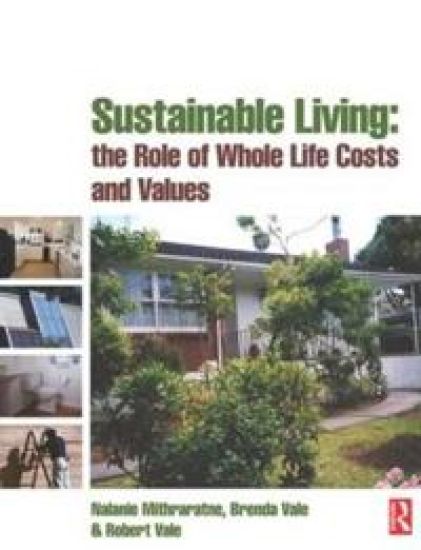
Sustainable Living: the Role of Whole Life Costs and Values

Sustainable Living: the Role of Whole Life Costs and Values

Nalanie Mithraratne; Brenda Vale; Robert Vale

Routledge
2017
sidottu
Achieving a sustainable building is not just a matter of design and construction: what happens once the building is occupied is absolutely critical. This book shows how the choices designers, developers and building users make impact on sustainability over the life span of the building. The authors show how a holistic approach considering costs, energy use, environmental impact, global warming potential as well as items which a usually disregarded such as finishes, furniture and appliances is needed to achieve best practice.
Sustainable Living: the Role of Whole Life Costs and Values

Sustainable Living: the Role of Whole Life Costs and Values

Nalanie Mithraratne; Brenda Vale; Robert Vale

Butterworth-Heinemann Ltd
2007
nidottu
Achieving a sustainable building is not just a matter of design and construction: what happens once the building is occupied is absolutely critical. This book shows how the choices designers, developers and building users make impact on sustainability over the life span of the building. The authors show how a holistic approach considering costs, energy use, environmental impact, global warming potential as well as items which a usually disregarded such as finishes, furniture and appliances is needed to achieve best practice.