Kirjojen hintavertailu. Mukana 12 156 625 kirjaa ja 12 kauppaa.

Kirjailija

Brett J. Pearson

Kirjat ja teokset yhdessä paikassa: 6 kirjaa, julkaisuja vuosilta 2019-2024, suosituimpien joukossa Workshop Physics Activity Guide Module 3. Vertaile teosten hintoja ja tarkista saatavuus suomalaisista kirjakaupoista.

6 kirjaa

Kirjojen julkaisuhaarukka 2019-2024.

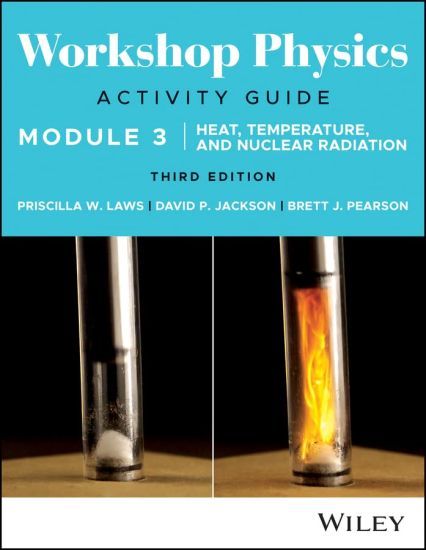
Workshop Physics Activity Guide Module 3

Workshop Physics Activity Guide Module 3

Priscilla W. Laws; David P. Jackson; Brett J. Pearson

JOHN WILEY SONS INC
2024
nidottu
The Workshop Physics Activity Guide is a set of student workbooks designed to serve as the foundation for a two-semester calculus-based introductory physics course. It consists of four Modules, with a total of 28 units, that interweave text materials with activities that include prediction, qualitative observation, explanation, equation derivation, mathematical modeling, quantitative experiments, and problem solving. The modules help students understand the basis of knowledge in physics as interplay between observations, experiments, definitions, and mathematical theory. The inquiry-based activities in the modules give students the opportunity to work collaboratively to solve problems, while thinking critically to make predictions and observations. Students use a powerful set of computer tools to record, display, and analyze data, as well as to develop mathematical models of physical phenomena. The design of many of the activities is based on the outcomes of physics education research. Module 3 Unit 16 Heat and TemperatureUnit 17 Principles of ThermodynamicsUnit 18 Thermodynamics Processes and Heat EnginesUnit 28 Radioactivity and Radon
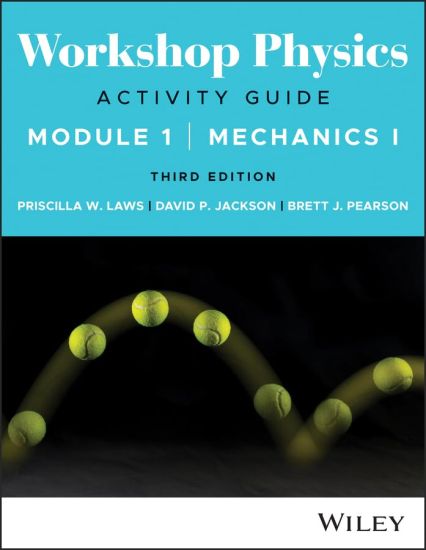
Workshop Physics Activity Guide Module 1

Workshop Physics Activity Guide Module 1

Priscilla W. Laws; David P. Jackson; Brett J. Pearson

JOHN WILEY SONS INC
2024
nidottu
The Workshop Physics Activity Guide is a set of student workbooks designed to serve as the foundation for a two-semester calculus-based introductory physics course. It consists of four Modules, with a total of 28 units, that interweave text materials with activities that include prediction, qualitative observation, explanation, equation derivation, mathematical modeling, quantitative experiments, and problem solving. The modules help students understand the basis of knowledge in physics as interplay between observations, experiments, definitions, and mathematical theory. The inquiry-based activities in the modules give students the opportunity to work collaboratively to solve problems, while thinking critically to make predictions and observations. Students use a powerful set of computer tools to record, display, and analyze data, as well as to develop mathematical models of physical phenomena. The design of many of the activities is based on the outcomes of physics education research. Module 1 Unit 1 Our Place in the UniverseUnit 2 Measurement and UncertaintyUnit 3 Introduction to One-Dimensional MotionUnit 4 Motion with Constant AccelerationUnit 5 Force, Mass, and Motion in One DimensionUnit 6 Gravity and Projectile MotionUnit 7 Applications of Newton's Laws
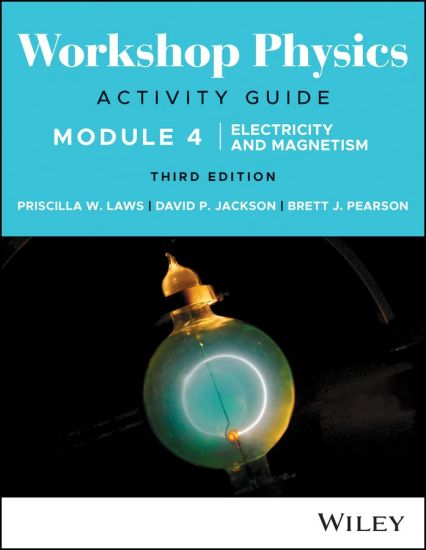
Workshop Physics Activity Guide Module 4

Workshop Physics Activity Guide Module 4

Priscilla W. Laws; David P. Jackson; Brett J. Pearson

JOHN WILEY SONS INC
2024
nidottu
The Workshop Physics Activity Guide is a set of student workbooks designed to serve as the foundation for a two-semester calculus-based introductory physics course. It consists of four Modules, with a total of 28 units, that interweave text materials with activities that include prediction, qualitative observation, explanation, equation derivation, mathematical modeling, quantitative experiments, and problem solving. The modules help students understand the basis of knowledge in physics as interplay between observations, experiments, definitions, and mathematical theory. The inquiry-based activities in the modules give students the opportunity to work collaboratively to solve problems, while thinking critically to make predictions and observations. Students use a powerful set of computer tools to record, display, and analyze data, as well as to develop mathematical models of physical phenomena. The design of many of the activities is based on the outcomes of physics education research. Module 4 Unit 19 Electric Forces and FieldsUnit 20 Electric Flux and Gauss' LawUnit 21 Electric PotentialUnit 22 Introduction to Electric CircuitsUnit 23 Circuit AnalysisUnit 24 Capacitors and RC CircuitsUnit 25 ElectronicsUnit 26 Magnets and Magnetic FieldsUnit 27 Electricity and Magnetism
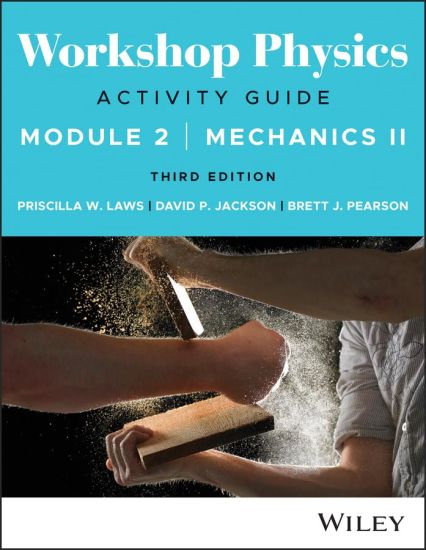
Workshop Physics Activity Guide Module 2

Workshop Physics Activity Guide Module 2

Priscilla W. Laws; David P. Jackson; Brett J. Pearson

JOHN WILEY SONS INC
2024
nidottu
The Workshop Physics Activity Guide is a set of student workbooks designed to serve as the foundation for a two-semester calculus-based introductory physics course. It consists of four Modules, with a total of 28 units, that interweave text materials with activities that include prediction, qualitative observation, explanation, equation derivation, mathematical modeling, quantitative experiments, and problem solving. The modules help students understand the basis of knowledge in physics as interplay between observations, experiments, definitions, and mathematical theory. The inquiry-based activities in the modules give students the opportunity to work collaboratively to solve problems, while thinking critically to make predictions and observations. Students use a powerful set of computer tools to record, display, and analyze data, as well as to develop mathematical models of physical phenomena. The design of many of the activities is based on the outcomes of physics education research. Module 2 Unit 8 Momentum and Collisions in One DimensionUnit 9 Momentum and Collisions in Two DimensionsUnit 10 Work and EnergyUnit 11 Energy ConservationUnit 12 Rotational MotionUnit 13 Rotational Momentum and its Relation to TorqueUnit 14 Simple Harmonic MotionUnit 15 Oscillations, Determinism, and Chaos
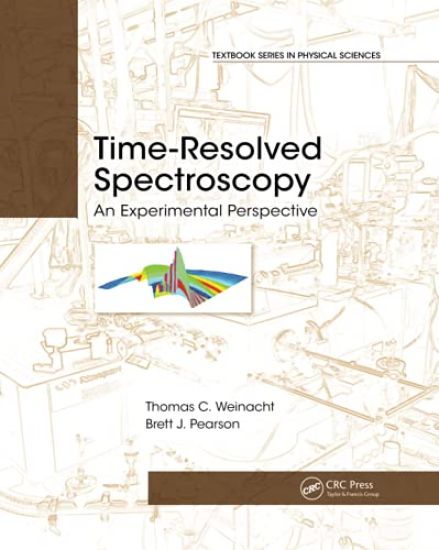
Time-Resolved Spectroscopy

Time-Resolved Spectroscopy

Brett J. Pearson; Thomas Weinacht

CRC Press
2021
nidottu
This concise and carefully developed text offers a reader friendly guide to the basics of time-resolved spectroscopy with an emphasis on experimental implementation. The authors carefully explain and relate for the reader how measurements are connected to the core physical principles. They use the time-dependent wave packet as a building block for understanding quantum dynamics, progressively advancing to more complex topics. The topics are discussed in paired sections, one discussing the theory and the next presenting the related experimental methods.A wide range of readers including students and newcomers to the field will gain a clear and practical understanding of how to measure aspects of molecular dynamics such as wave packet motion, intramolecular vibrational relaxation, and electron-electron coupling, and how to describe such measurements mathematically.
Time-Resolved Spectroscopy

Time-Resolved Spectroscopy

Thomas Weinacht; Brett J. Pearson

Productivity Press
2019
sidottu
This concise and carefully developed text offers a reader friendly guide to the basics of time-resolved spectroscopy with an emphasis on experimental implementation. The authors carefully explain and relate for the reader how measurements are connected to the core physical principles. They use the time-dependent wave packet as a building block for understanding quantum dynamics, progressively advancing to more complex topics. The topics are discussed in paired sections, one discussing the theory and the next presenting the related experimental methods.A wide range of readers including students and newcomers to the field will gain a clear and practical understanding of how to measure aspects of molecular dynamics such as wave packet motion, intramolecular vibrational relaxation, and electron-electron coupling, and how to describe such measurements mathematically.