Kirjojen hintavertailu. Mukana 12 657 676 kirjaa ja 12 kauppaa.

Kirjailija

Brian Clegg

Kirjat ja teokset yhdessä paikassa: 83 kirjaa, julkaisuja vuosilta 1998-2027, suosituimpien joukossa Ten Days in Physics that Shook the World. Vertaile teosten hintoja ja tarkista saatavuus suomalaisista kirjakaupoista.

83 kirjaa

Kirjojen julkaisuhaarukka 1998-2027.

How it All Works

How it All Works

Adam Dant; Brian Clegg

The Ivy Press
2021
sidottu
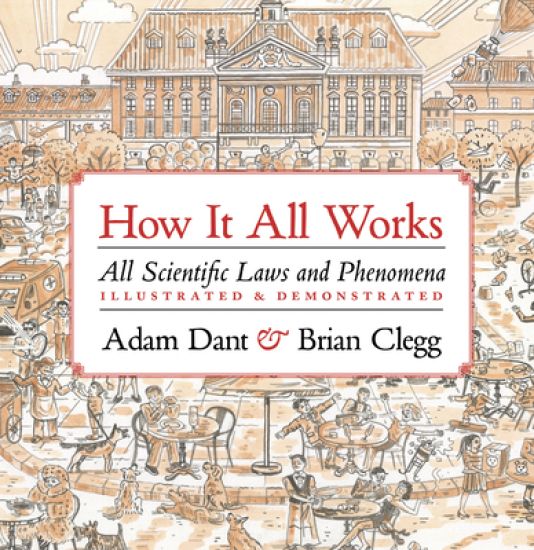
In this beautiful and unique combination of art and science, this stunningly detailed book examines how the rules of science govern the the world around us, from the rooms in our houses to the planet, the solar system and the universe itself! The Universe is inconceivably complex. Its component parts though follow a set of unbreakable laws that have somehow been coded into their very fabric since the beginning of time. These laws play out in different ways at different scales, giving rise to the familiar phenomena of everyday life – as well as the unfamiliar abstract goings-on outside our experience and awareness. Understanding these laws may seem a daunting task, until now.How it All Works illustrates simply how the most interesting and complex named scientific laws and phenomena affect everyone’s daily lives. Using hyper-detailed scene illustrations from the incredible award-winning artist Adam Dant, we start small, with the illustrated science inside your kitchen, before expanding outwards to encompass your garden, street, city, continent, planet, solar system, galaxy and eventually the whole universe.With tiny details pulled out from visually stunning and intricate scene, learn how:Kirchhoff’s Law affects how you charge your phone, Newton’s Law of Cooling helps you make your coffee just the right temperature to drink, How the rules of antimatter are used in hospitals for medical imaging, How Cassie's law keeps ducks dry,How glaciation shapes the ladscapes around us, How thermohaline circulation dictates our weather, and How quantum tunnelling influences the nuclear fusion in our sun, and Wien’s Law determines its colour. This book will astound and inform in equal measure, with each principle drawn into the scene and explained with clarity by leading science writer Brian Clegg. With a reference section at the back as well as profiles of the key figures who have helped shape our understanding of these key principles, from Lynn Margulis and Richard Feynman to Marie Curie, Michael Faraday,Isaac Newton and Albert Einstein, this beautiful and unique visual examination of the rules of science is an must-have book for anyone who wants to understand the physics, chemistry and biology of the world around us!
Ten Days in Physics that Shook the World
'[A]n engaging exploration, ending with interesting speculation on the nature of a future 11th day.' Peet Morris, Times Higher Education Developments in physics and physics-based engineering have led to some of the biggest transformations in the way we live out lives. Here, we journey back to ten separate days in history for a closer look at the breakthroughs that have shaped the modern world. From Isaac Newton's law of motion, to Michael Faraday's electrical field theory, as well as Maxwell's equations that make TV, radio and cellphones possible. Comprising perfectly pitched science writing enlivened with a wealth of fascinating biographical detail, this eye-opening book is a celebration of power of physicists to bring about far-reaching, life-transforming change.
Time Travel: Ten Short Lessons

Time Travel: Ten Short Lessons

Brian Clegg

Johns Hopkins University Press
2021
nidottu
During times like these, who hasn't daydreamed about traveling forward or backward in time? In Time Travel: Ten Short Lessons, popular-science master Brian Clegg gives a grand tour of the essential lessons in this game-changing area of physics, from the imagination of novelists to current research.Einstein's special theory of relativity told us that time travel to the future was possible, and later his general theory of relativity showed us that loops in spacetime could exist, meaning that we might be able to bend time backward, too. But what are the practicalities of making time travel possible? What do we still need to know? How do we deal with paradoxical twists in time--and could quantum physics hold the answer? Packed full of easy-to-understand diagrams and fact boxes, these ten lessons cover all the basics, as well as the latest understanding and developments, to enlighten the nonscientist.About the series: The Pocket Einstein series is a collection of essential pocket-sized guides for anyone looking to understand a little more about some of the most important and fascinating areas of science in the twenty-first century. Broken down into ten simple lessons and written by leading experts in their field, discover the ten most important takeaways from those areas of science you've always wanted to know more about.
Quantum Computing

Quantum Computing

Brian Clegg

Icon Books Ltd
2021
pokkari
The ultimate non-technical guide to the fast-developing world of quantum computing Computer technology has improved exponentially over the last 50 years. But the headroom for bigger and better electronic solutions is running out. Our best hope is to engage the power of quantum physics. 'Quantum algorithms' had already been written long before hardware was built. These would enable, for example, a quantum computer to exponentially speed up an information search, or to crack the mathematical trick behind internet security. However, making a quantum computer is incredibly difficult. Despite hundreds of laboratories around the world working on them, we are only just seeing them come close to 'supremacy' where they can outperform a traditional computer. In this approachable introduction, Brian Clegg explains algorithms and their quantum counterparts, explores the physical building blocks and quantum weirdness necessary to make a quantum computer, and uncovers the capabilities of the current generation of machines.
10 Short Lessons in Time Travel

10 Short Lessons in Time Travel

Brian Clegg

MICHAEL O'MARA BOOKS LTD
2021
sidottu
'10 Short Lessons in Time Travel lucidly sums up the essential parts of this fascinating subject.' John Gribbin________________________In Ten Short Lessons in Time Travel, Brian Clegg takes us on a fascinating and up-to-date tour of the workings of the universe that suggest the possibility of journeying back and forth through time.Einstein’s special theory of relativity told us that time travel to the future was possible, and later his general theory of relativity showed us that loops in spacetime could exist, meaning that we might be able to bend time backwards, too. But what are the practicalities of making time travel possible? What do we still need to know? How do we deal with paradoxical twists in time – and could quantum physics hold the answer? From the imagination of novelists to current research, 10 Short Lessons in Time Travel is a grand tour of the essential lessons in this game-changing area of physics.About the series: The Pocket Einstein series is a collection of essential pocket-sized guides for anyone looking to understand a little more about some of the most important and fascinating areas of science in the twenty-first century. Broken down into ten simple lessons and written by leading experts in their field, discover the ten most important takeaways from those areas of science you’ve always wanted to know more about.
What Do You Think You Are?

What Do You Think You Are?

Brian Clegg

Icon Books Ltd
2021
pokkari
'Gets right to the heart of what makes us what we are. Read it!' Angela Saini, author of Inferior and Superior: The Return of Race ScienceThe popular science equivalent of Who Do You Think You Are? Popular science master Brian Clegg's new book is an entertaining tour through the science of what makes you you.From the atomic level, through life and energy to genetics and personality, it explores how the billions of particles which make up you - your DNA, your skin, your memories - have come to be.It starts with the present-day reader and follows a number of trails to discover their origins: how the atoms in your body were created and how they got to you in space and time, the sources of things you consume, how the living cells of your body developed, where your massive brain and consciousness originated, how human beings evolved and, ultimately, what your personal genetic history reveals.
Essential Science

Essential Science

Brian Clegg

Welbeck Publishing Group
2020
sidottu
Essential Science aims to be the most detailed, accessible and authoritative book of its kind. Each of the 34 discoveries is broken down into seven essential elements to aid comprehension and inform the reader about what really matters: THE ESSENTIAL IDEA: a concise summary of the idea or discovery that makes complex ideas as simple as possible. ORIGINS: where does the discovery come from, who made it and how does it fit in the wider scientific context? KEY THEORIES AND EVIDENCE: even our most familiar ideas and discoveries are far from 'common sense'. How do we know what we know? What is the evidence? What are the dominant theories? CRITICS: science is a constant process of criticism and revision. How have various ideas survived attempts to discredit them? How secure is our knowledge and is it complete? WHY IT MATTERS: how important is the discovery in the wider scientific context? How much has it reshaped our perception of reality? FUTURE DEVELOPMENTS: what remains to be discovered? Might even dominant ideas and discoveries be superseded by better ones? THE ESSENTIAL SUMMARY: a visual outline of all the key insights from the above analytical headings. The consistent structure not only breaks down complex topics into simple, easy to understand chunks, but also helps readers to think for themselves about the process of scientific discovery, testing and progress, showing that science is not just a set of ideas to be learned, but a never-ending process that is constantly reshaping our perception of reality.
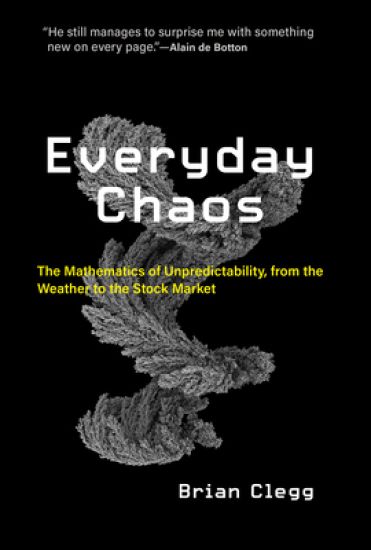
Everyday Chaos

Everyday Chaos

Brian Clegg

MIT PRESS LTD
2020
pokkari
Chaos and complexity explained, with illuminating examples ranging from unpredictable pendulums to London's wobbly Millennium Bridge.The math we are taught in school is precise and only deals with simple situations. Reality is far more complex. Trying to understand a system with multiple interacting components--the weather, for example, or the human body, or the stock market--means dealing with two factors: chaos and complexity. If we don't understand these two essential subjects, we can't understand the real world. In Everyday Chaos, Brian Clegg explains chaos and complexity for the general reader, with an accessible, engaging text and striking full-color illustrations.By chaos, Clegg means a system where complex interactions make predicting long-term outcomes nearly impossible; complexity means complex interacting systems that have new emergent properties that make them more than the sum of their parts. Clegg illustrates these phenomena with discussions of predictable randomness, the power of probability, and the behavior of pendulums. He describes what Newton got wrong about gravity; how feedback kept steam engines from exploding; and why weather produces chaos. He considers the stock market, politics, bestseller lists, big data, and London's wobbling Millennium Bridge as examples of chaotic systems, and he explains how a better understanding of chaos helps scientists predict more accurately the risk of catastrophic Earth-asteroid collisions. We learn that our brains are complex, self-organizing systems; that the structure of snowflakes exemplifies emergence; and that life itself has been shown to be an emergent property of a complex system.
Biográfico Tesla

Biográfico Tesla

Brian Clegg

Cinco Tintas
2020
sidottu
Many people know that Nikola Tesla (1856-1943) was an engineer and inventor, instrumental in developing the alternating-current (AC) electrical system and wireless radio communications we still use today. What, perhaps, they don't know is that he was born during a lightning storm; that when he first arrived in the USA he owned 4 cents, his own poems, and a design for a flying machine; that he spoke 8 languages; that he held 300 patents for his inventions; and that he claimed to have invented a death ray that could destroy 10,000 planes at a distance of 250 miles. Biographic: Tesla presents an electrifying exploration of his life, work and fame, with an array of irresistible facts and figures converted into infographics to reveal the scientist behind the science.
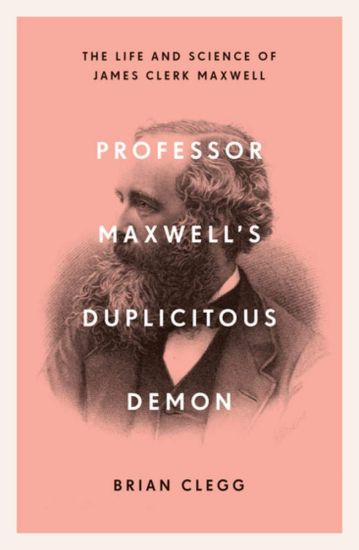
Professor Maxwell’s Duplicitous Demon
Asked to name a great physicist, most people would mention Newton or Einstein, Feynman or Hawking. But ask a physicist and there's no doubt that James Clerk Maxwell will be near the top of the list. Maxwell, an unassuming Victorian Scotsman, explained how we perceive colour. He uncovered the way gases behave. And, most significantly, he transformed the way physics was undertaken in his explanation of the interaction of electricity and magnetism, revealing the nature of light and laying the groundwork for everything from Einstein's special relativity to modern electronics. Along the way, he set up one of the most enduring challenges in physics, one that has taxed the best minds ever since. 'Maxwell's demon' is a tiny but thoroughly disruptive thought experiment that suggests the second law of thermodynamics, the law that governs the flow of time itself, can be broken. This is the story of a groundbreaking scientist, a great contributor to our understanding of the way the world works, and his duplicitous demon.
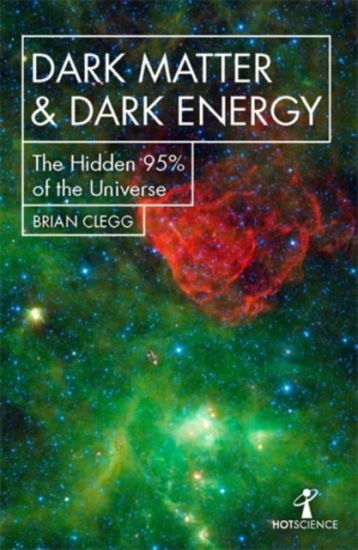
Dark Matter and Dark Energy

Dark Matter and Dark Energy

Brian Clegg

Icon Books Ltd
2019
pokkari
'Clear and compact ... It's hard to fault as a brief, easily digestible introduction to some of the biggest questions in the Universe' Giles Sparrow, BBC Four's The Sky at Night, Best astronomy and space books of 2019: 5/5All the matter and light we can see in the universe makes up a trivial 5 per cent of everything. The rest is hidden. This could be the biggest puzzle that science has ever faced.Since the 1970s, astronomers have been aware that galaxies have far too little matter in them to account for the way they spin around: they should fly apart, but something concealed holds them together. That 'something' is dark matter - invisible material in five times the quantity of the familiar stuff of stars and planets.By the 1990s we also knew that the expansion of the universe was accelerating. Something, named dark energy, is pushing it to expand faster and faster. Across the universe, this requires enough energy that the equivalent mass would be nearly fourteen times greater than all the visible material in existence.Brian Clegg explains this major conundrum in modern science and looks at how scientists are beginning to find solutions to it.
Conundrum

Conundrum

Brian Clegg

Icon Books Ltd
2019
pokkari
**'Title of Most Fiendish Book goes to Conundrum: Crack the Ultimate Cipher Challenge by the ever-excellent science writer Brian Clegg.' Daily Mail, Books of the Year**The ultimate trial of knowledge and cunning, Conundrum features 200 cryptic puzzles and ciphers. The solutions link throughout the book - so you need to solve them all to get to the final round. With a focus on ciphers and codebreaking, Conundrum contains twenty sections, each built around a specific subject from music to literature, physics to politics. To take on Conundrum you need good general knowledge and the ability to think laterally. But if you need help, there are plenty of hints to point you in the right direction. Whether you attempt to crack it alone or work in a team, Conundrum will challenge you to the extreme.Can you take on Conundrum and win? There's only one way to find out.
Professor Maxwell’s Duplicitous Demon
Asked to name a great physicist, most people would mention Newton or Einstein, Feynman or Hawking. But ask a physicist and there's no doubt that James Clerk Maxwell will be near the top of the list. Maxwell, an unassuming Victorian Scotsman, explained how we perceive colour. He uncovered the way gases behave. And, most significantly, he transformed the way physics was undertaken in his explanation of the interaction of electricity and magnetism, revealing the nature of light and laying the groundwork for everything from Einstein's special relativity to modern electronics. Along the way, he set up one of the most enduring challenges in physics, one that has taxed the best minds ever since. 'Maxwell's demon' is a tiny but thoroughly disruptive thought experiment that suggests the second law of thermodynamics, the law that governs the flow of time itself, can be broken. This is the story of a groundbreaking scientist, a great contributor to our understanding of the way the world works, and his duplicitous demon.
Biographic: Tesla

Biographic: Tesla

Brian Clegg

Ammonite Press
2018
sidottu
Many people know that Tesla was a scientific genius, instrumental in developing modern electricity and communications. What, perhaps, they don’t know is that he was born during a lightning storm; spoke eight languages; and claimed to have invented a death ray that could destroy 10,000 planes from 250 miles away. This book presents an electrifying exploration of his life, work and fame, with 50 irresistible facts converted into infographics to reveal the scientist behind the science.
Biographic: Einstein

Biographic: Einstein

Brian Clegg

Ammonite Press
2018
sidottu
Many people know that Albert Einstein was a brilliant theoretical physicist who revolutionised modern science. What they may not know is that he only learnt to speak at four years old; that he was asked to become the President of Israel in 1952, but refused; or that he was under FBI surveillance for 22 years. This book presents an instant impression of his life with 50 irresistible facts converted into infographics to reveal the scientist behind the science.
The Graphene Revolution

The Graphene Revolution

Brian Clegg

Icon Books Ltd
2018
pokkari
In 2003, Russian physicists Andre Geim and Konstantin Novoselov found a way to produce graphene - the thinnest substance in the world - by using sticky tape to separate an atom-thick layer from a block of graphite.Their efforts would win the 2010 Nobel Prize for Physics, and now the applications of graphene and other 'two-dimensional' substances form a worldwide industry. Graphene is far stronger than steel, a far better conductor than any metal, and able to act as a molecular sieve to purify water. Electronic components made from graphene are a fraction of the size of silicon microchips and can be both flexible and transparent, making it possible to build electronics into clothing, produce solar cells to fit any surface, or even create invisible temporary tattoos that monitor your health.Ultra-thin materials give us the next big step forward since the transistor revolutionised electronics. Get ready for the graphene revolution.
Gravitational Waves

Gravitational Waves

Brian Clegg

Icon Books Ltd
2018
pokkari
On 14 September 2015, after 50 years of searching, gravitational waves were detected for the first time and astronomy changed for ever.Until then, investigation of the universe had depended on electromagnetic radiation: visible light, radio, X-rays and the rest. But gravitational waves - ripples in the fabric of space and time - are unrelenting, passing through barriers that stop light dead.At the two 4-kilometre long LIGO observatories in the US, scientists developed incredibly sensitive detectors, capable of spotting a movement 100 times smaller than the nucleus of an atom. In 2015 they spotted the ripples produced by two black holes spiralling into each other, setting spacetime quivering.This was the first time black holes had ever been directly detected - and it promises far more for the future of astronomy. Brian Clegg presents a compelling story of human technical endeavour and a new, powerful path to understand the workings of the universe.
The Reality Frame

The Reality Frame

Brian Clegg

Icon Books Ltd
2017
pokkari
Weaving together the great ideas of science, in this, his magnum opus, Brian Clegg builds up reality piece by piece, from space, to time, to matter, movement, the fundamental forces, life, and the massive transformation that life itself has wrought on the natural world. He reveals that underlying it all is not, as we might believe, a system of immovable absolutes, but the ever-shifting, amorphous world of relativity. From religion to philosophy, humanity has traditionally sought out absolutes to explain the world around us, but as science has developed, relativity has swept away many of these certainties, leaving only a handful of unchangeable essentials - such as absolute zero, nothingness, light - leading to better science and a new understanding of the essence of being human. This is an Ascent of Man for the 21st century, the gripping story of modern science that will fill you with wonder and give you a new insight into our place in the universe.