Kirjailija
Brian Cox
Kirjat ja teokset yhdessä paikassa: 45 kirjaa, julkaisuja vuosilta 1995-2026, suosituimpien joukossa Black Holes: The Key to Understanding the Universe. Vertaile teosten hintoja ja tarkista saatavuus suomalaisista kirjakaupoista.
45 kirjaa
Kirjojen julkaisuhaarukka 1995-2026.

"Some people say, 'How can you live without knowing?' I do not know what they mean. I always live without knowing. That is easy. How you get to know is what I want to know."--Richard P. Feynman Nobel Prize-winning physicist Richard P. Feynman (1918-88) was that rarest of creatures--a towering scientific genius who could make himself understood by anyone and who became as famous for the wit and wisdom of his popular lectures and writings as for his fundamental contributions to science. The Quotable Feynman is a treasure-trove of this revered and beloved scientist's most profound, provocative, humorous, and memorable quotations on a wide range of subjects. Carefully selected by Richard Feynman's daughter, Michelle Feynman, from his spoken and written legacy, including interviews, lectures, letters, articles, and books, the quotations are arranged under two dozen topics--from art, childhood, discovery, family, imagination, and humor to mathematics, politics, science, religion, and uncertainty. These brief passages--about 500 in all--vividly demonstrate Feynman's astonishing yet playful intelligence, and his almost constitutional inability to be anything other than unconventional, engaging, and inspiring. The result is a unique, illuminating, and enjoyable portrait of Feynman's life and thought that will be cherished by his fans at the same time that it provides an ideal introduction to Feynman for readers new to this intriguing and important thinker. The book features a foreword in which physicist Brian Cox pays tribute to Feynman and describes how his words reveal his particular genius, a piece in which cellist Yo-Yo Ma shares his memories of Feynman and reflects on his enduring appeal, and a personal preface by Michelle Feynman. It also includes some previously unpublished quotations, a chronology of Richard Feynman's life, some twenty photos of Feynman, and a section of memorable quotations about Feynman from other notable figures. Features: * Approximately 500 quotations, some of them previously unpublished, arranged by topic* A foreword by Brian Cox, reflections by Yo-Yo Ma, and a preface by Michelle Feynman* A chronology of Feynman's life* Some twenty photos of Feynman* A section of quotations about Feynman from other notable figures Some notable quotations of Richard P. Feynman: *"The thing that doesn't fit is the most interesting."*"Thinking is nothing but talking to yourself inside."*"It is wonderful if you can find something you love to do in your youth which is big enough to sustain your interest through all your adult life. Because, whatever it is, if you do it well enough (and you will, if you truly love it), people will pay you to do what you want to do anyway."*"I'd hate to die twice. It's so boring."
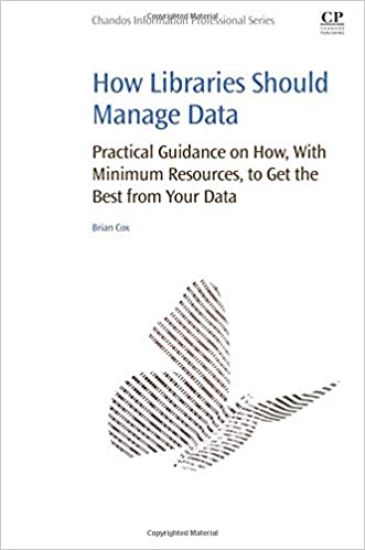
Have you ever looked at your Library’s key performance indicators and said to yourself "so what!"? Have you found yourself making decisions in a void due to the lack of useful and easily accessible operational data? Have you ever worried that you are being left behind with the emergence of data analytics? Do you feel there are important stories in your operational data that need to be told, but you have no idea how to find these stories? If you answered yes to any of these questions, then this book is for you. How Libraries Should Manage Data provides detailed instructions on how to transform your operational data from a fog of disconnected, unreliable, and inaccessible information - into an exemplar of best practice data management. Like the human brain, most people are only using a very small fraction of the true potential of Excel. Learn how to tap into a greater proportion of Excel’s hidden power, and in the process transform your operational data into actionable business intelligence.



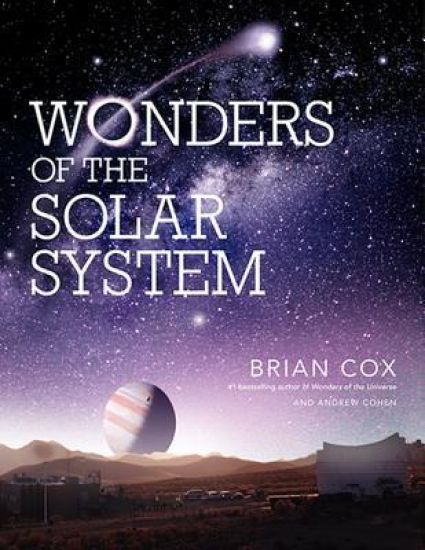
Taking readers on a breathtaking visual and scientific adventure, renowned physicist Brian Cox reveals the Solar System as you have never seen it before: from Saturn's moons, where giant ice fountains spout into space and oceans are made of liquid methane, to Jupiter, where storms rage that are twice the size of Earth and giant super-volcanoes dominate its tortured moon of Io.Professor Cox takes you on a journey of discovery where alien worlds become places you can see and explore. He introduces you to the planets and moons beyond our world, finding the biggest and most bizarre and powerful natural phenomena. He visits some of the most spectacular and extreme locations here on Earth to unveil what our planet can reveal about the wonders of the Solar System.Employing his trademark authoritative yet down-to-earth approach, Brian explores how these previously unseen phenomena have dramatically expanded our horizons with new discoveries about the planets, their moons, and how they came to be the way they are.Includes 500 diagrams and full-color photographs
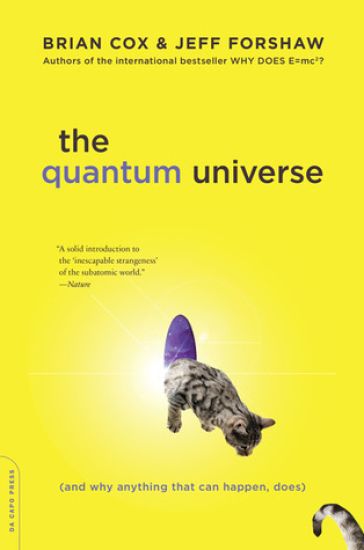
In The Quantum Universe , Brian Cox and Jeff Forshaw approach the world of quantum mechanics in the same way they did in Why Does E=mc2? and make fundamental scientific principles accessible,and fascinating,to everyone. The subatomic realm has a reputation for weirdness, spawning any number of profound misunderstandings, journeys into Eastern mysticism, and woolly pronouncements on the interconnectedness of all things. Cox and Forshaw's contention? There is no need for quantum mechanics to be viewed this way. There is a lot of mileage in the weirdness" of the quantum world, and it often leads to confusion and, frankly, bad science. The Quantum Universe cuts through the Wu Li and asks what observations of the natural world made it necessary, how it was constructed, and why we are confident that, for all its apparent strangeness, it is a good theory. The quantum mechanics of The Quantum Universe provide a concrete model of nature that is comparable in its essence to Newton's laws of motion, Maxwell's theory of electricity and magnetism, and Einstein's theory of relativity.

Wonders of Life: Exploring the Most Extraordinary Force in the Universe
Brian Cox
Harper
2013
sidottu
In Wonders of Life: Exploring the Most Extraordinary Force in the Universe, the definitive companion to the Discovery Science Channel series, Professor Brian Cox takes us on an incredible journey to discover the most complex, diverse, and unique force in the universe: life itself.Through his voyage of discovery, international bestselling author Brian Cox explains how the astonishing inventiveness of nature came about and uncovers the milestones in the epic journey from the origin of life to our own lives, with beautiful full-color illustrations throughout. From spectacular fountains of superheated water at the bottom of the Atlantic to the deepest rainforest, Cox seeks out the places where the biggest questions about life may be answered: What is life? Why do we need water? Why does life end?Physicist and professor Brian Cox uncovers the secrets of life in the most unexpected locations and in the most stunning detail in this beautiful full-color volume.
What is quantum physics? How does it help us understand our amazing world? Where does it leave Newton and Einstein? And why, above all, can we be sure that the theory is good? This title gives us the real science behind the bizarre behaviour of the atoms and energy that make up the universe, and reveal how everything that can happen, does happen.


What does E=mc2 actually mean? Dr. Brian Cox and Professor Jeff Forshaw go on a journey to the frontier of twenty-first century science to unpack Einstein's famous equation. Explaining and simplifying notions of energy, mass, and light,while exploding commonly held misconceptions,they demonstrate how the structure of nature itself is contained within this equation. Along the way, we visit the site of one of the largest scientific experiments ever conducted: the now-famous Large Hadron Collider, a gigantic particle accelerator capable of re-creating conditions that existed fractions of a second after the Big Bang. A collaboration between one of the youngest professors in the United Kingdom and a distinguished popular physicist, Why Does E=mc2? is one of the most exciting and accessible explanations of the theory of relativity.
The international bestseller: an introduction to the theory of relativity by the eminent physicists Brian Cox and Jeff Forshaw