Kirjojen hintavertailu. Mukana 12 390 323 kirjaa ja 12 kauppaa.

Kirjailija

Brian D. Fath

Kirjat ja teokset yhdessä paikassa: 8 kirjaa, julkaisuja vuosilta 2007-2026, suosituimpien joukossa Explaining Technology. Vertaile teosten hintoja ja tarkista saatavuus suomalaisista kirjakaupoista.

8 kirjaa

Kirjojen julkaisuhaarukka 2007-2026.

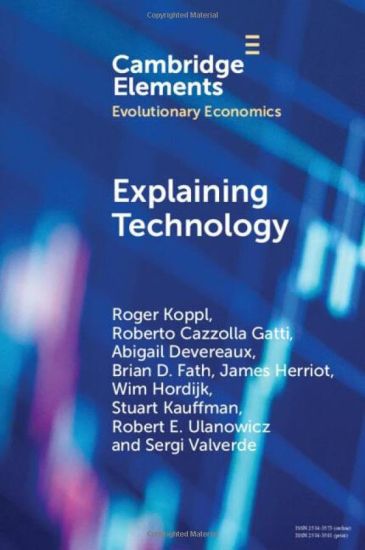
Explaining Technology

Explaining Technology

Roger Koppl; Roberto Cazzolla Gatti; Abigail Devereaux; Brian D. Fath; James Herriot; Wim Hordijk; Stuart Kauffman; Robert E. Ulanowicz; Sergi Valverde

Cambridge University Press
2023
pokkari
A long tradition explains technological change as recombination. Within this tradition, this Element develops an innovative combinatorial model of technological change and tests it with 2,000 years of global GDP data and with data from US patents filed between 1835 and 2010. The model explains 1) the pace of technological change for a least the past two millennia, 2) patent citations and 3) the increasing complexity of tools over time. It shows that combining and modifying pre-existing goods to produce new goods generates the observed historical pattern of technological change. A long period of stasis was followed by sudden super-exponential growth in the number of goods. In this model, the sudden explosion of about 250 years ago is a combinatorial explosion that was a long time in coming, but inevitable once the process began at least two thousand years ago. This Element models the Industrial Revolution as a combinatorial explosion.

Encyclopedia of Ecology

Encyclopedia of Ecology

Brian D. Fath

Elsevier - Health Sciences Division
2026
muu
Encyclopedia of Ecology, Third Edition, Four Volume Set - with over 300 chapters - once again provides a comprehensive reference work covering the current ideas and practices in ecology. Ecology is the ideal field for studying complex, adaptive, and self-organizing systems and by observing and understanding ecosystems, it provides valuable insights into creating sustainable systems. This knowledge is essential for addressing challenges in areas such as land management, environmental policy development, urban metabolism, industrial symbiosis, the global commons, and renewable energy. Ecology traditionally focused on measuring species abundance and distribution through field observations to establish a baseline understanding of nature. More recently, it emphasizes the relationships within populations, among species, and with their environment—networks of life central to this encyclopedia. Understanding these ecological connections is key to sustainability science and human-nature interactions. Current research spans biodiversity loss, soil conservation, sustainable agriculture, emerging diseases, eco-mimicry, and climate change. Ecological education and environmental literacy are increasingly integrated into curricula. Written and edited by an international team of experts and with special focus on interdisciplinary work in socio-ecological systems, this 3rd edition again links theory with application, and helps allow students needing entry-level summaries of specific ecology topics to create connections and find relevant, more in-depth resources in this exciting field.
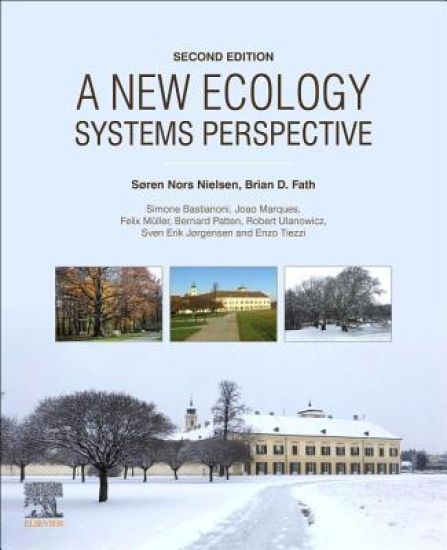
A New Ecology

A New Ecology

Soeren Nors Nielsen; Brian D. Fath; Simone Bastianoni; Joao C. Marques; Felix Muller; Bernard D. Patten; Robert E. Ulanowicz; Enzo Tiezzi

Elsevier Science Ltd
2019
nidottu
A New Ecology: Systems Perspective, Second Edition, gives an overview of the commonalities of all ecosystems from a variety of properties, including physical openness, ontic openness, directionality, connectivity, a complex dynamic for growth and development, and a complex dynamic response to disturbances. Each chapter details basic and characteristic properties that help the reader understand how they can be applied to explain a wide spectrum of current ecological research and environmental management applications.
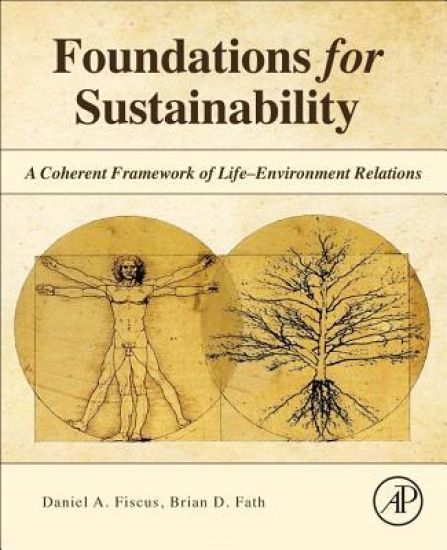
Foundations for Sustainability

Foundations for Sustainability

Daniel A. Fiscus; Brian D. Fath

Academic Press Inc
2018
nidottu
Foundations for Sustainability: A Coherent Framework of Life-Environment Relations challenges existing assumptions on environmental issues and lays the groundwork for a new paradigm, bringing a greater understanding of what is needed to help create an environmentally and economically sustainable future, which to date has been an uphill battle and not an obvious choice. The book presents the case for a paradigm based on a multi-model of life as organism, life as ecosystem, and life as biosphere, as opposed to the singular assumption that life can be viewed solely as an organism. All backed with well-cited research from top investigators from around the world, this book is a must-have resource for anyone working in ecology, environmental science or sustainability.
Encyclopedia of Ecology

Encyclopedia of Ecology

Brian D. Fath

Elsevier Science Ltd
2018
muu
Encyclopedia of Ecology, Second Edition, Four Volume Set continues the acclaimed work of the previous edition published in 2008. It covers all scales of biological organization, from organisms, to populations, to communities and ecosystems. Laboratory, field, simulation modelling, and theoretical approaches are presented to show how living systems sustain structure and function in space and time. New areas of focus include micro- and macro scales, molecular and genetic ecology, and global ecology (e.g., climate change, earth transformations, ecosystem services, and the food-water-energy nexus) are included. In addition, new, international experts in ecology contribute on a variety of topics.
Flourishing Within Limits to Growth

Flourishing Within Limits to Growth

Sven Erik Jørgensen; Brian D. Fath; Søren Nors Nielsen; Federico M. Pulselli; Daniel A. Fiscus; Simone Bastianoni

Routledge
2015
sidottu
Decades of research and discussion have shown that the human population growth and our increased consumption of natural resources cannot continue – there are limits to growth. This volume demonstrates how we might modify and revise our economic systems using nature as a model. The book describes how nature uses three growth forms: biomass, information, and networks, resulting in improved overall ecosystem functioning and co-development. As biomass growth is limited by available resources, nature uses the two other growth forms to achieve higher resource use efficiency. Through a universal application of the three ‘R’s: reduce, reuse, and recycle, nature thus shows us a way forward towards better solutions. However, our current approach, dominated by short-term economic thinking, inhibits full utilization of the three ‘R’s and other successful approaches from nature. Building on ecological principles, the authors present a global model and futures scenario analyses which show that implementation of the proposed changes will lead to a win-win situation. In other words, we can learn from nature how to develop a society that can flourish within the limits to growth with better conditions for prosperity and well-being.
Flourishing Within Limits to Growth

Flourishing Within Limits to Growth

Sven Erik Jørgensen; Brian D. Fath; Søren Nors Nielsen; Federico M. Pulselli; Daniel A. Fiscus; Simone Bastianoni

Routledge
2015
nidottu
Decades of research and discussion have shown that the human population growth and our increased consumption of natural resources cannot continue – there are limits to growth. This volume demonstrates how we might modify and revise our economic systems using nature as a model. The book describes how nature uses three growth forms: biomass, information, and networks, resulting in improved overall ecosystem functioning and co-development. As biomass growth is limited by available resources, nature uses the two other growth forms to achieve higher resource use efficiency. Through a universal application of the three ‘R’s: reduce, reuse, and recycle, nature thus shows us a way forward towards better solutions. However, our current approach, dominated by short-term economic thinking, inhibits full utilization of the three ‘R’s and other successful approaches from nature. Building on ecological principles, the authors present a global model and futures scenario analyses which show that implementation of the proposed changes will lead to a win-win situation. In other words, we can learn from nature how to develop a society that can flourish within the limits to growth with better conditions for prosperity and well-being.
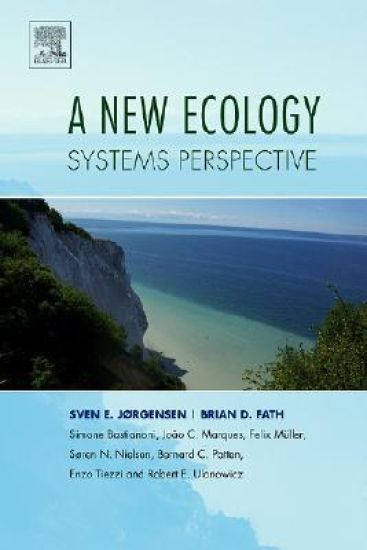
A New Ecology

A New Ecology

Sven Erik Jørgensen; Brian D. Fath; Simone Bastianoni; Joao C. Marques; Felix Muller; S. Nors Nielsen; Bernard D. Patten; Enzo Tiezzi; Robert E. Ulanowicz

Elsevier Science Ltd
2007
sidottu
A New Ecology presents an ecosystem theory based on the following ecosystem properties: physical openness, ontic openness, directionality, connectivity, a complex dynamic for growth and development, and a complex dynamic response to disturbances. Each of these properties is developed in detail to show that these basic and characteristic properties can be applied to explain a wide spectrum of ecological obsevations and convections. It is also shown that the properties have application for environmental management and for assessment of ecosystem health.