
Kirjailija
Brian Harrison
Kirjat ja teokset yhdessä paikassa: 19 kirjaa, julkaisuja vuosilta 1987-2026, suosituimpien joukossa The Dyslexic Writings Of An Eclectic Mind. Vertaile teosten hintoja ja tarkista saatavuus suomalaisista kirjakaupoista.
19 kirjaa
Kirjojen julkaisuhaarukka 1987-2026.
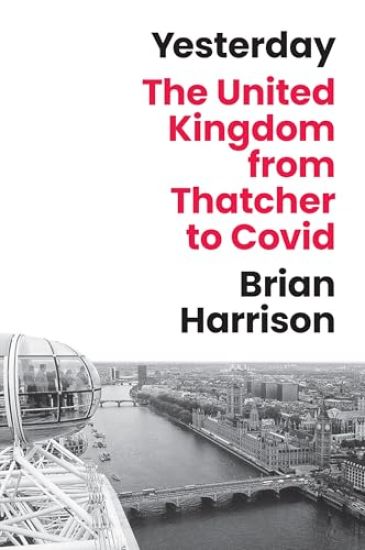
The first major account of this transformative period in the history of Great BritainBetween 1990 and 2020, the United Kingdom experienced the tension between unparalleled social change and a pragmatic political culture which sought continuity, compromise and gradualism. Thatcher’s legacy was slowly digested, Blair’s ‘New Labour’ thoroughly scrutinized, and the decision was made after forty-seven years to leave the European Union. The UK’s long-established major institutions—monarchy, parliament, and the union between England, Scotland, Wales and Northern Ireland—were sorely tested. Yesterday provides the first fully documented history of this pivotal time in Great Britain.Was the UK in decline? Brian Harrison points to Britain’s unsuccessful adventures in Iraq and Afghanistan and its relative economic decline, underfunded hospitals, sink schools, over-filled prisons, and terrorism of both Irish and Islamic varieties. Yet there were successes. Harrison shows how the UK’s participatory institutions outmanoeuvred terrorism and precariously surmounted regional, intergenerational, ethnic and social-class tensions. This vibrant, creative society saw major improvements in time, place and recruitment for work, as well as growth and innovation in conservation, digitization, tourism, consumerism, sport and the arts. Some changes were revolutionary: in family life and relations between the generations, and in the ever-changing electronic media. And if religious observance was in decline, immigrants were introducing new faiths and even a revived religious fervour while attitudes to health and death were changing fast.A panoramic and wide-ranging analysis by a scholar at the height of his powers, Yesterday paints an evocative, richly textured portrait of a people who were shedding their complacency and insularity and bracing themselves to face a very different but promising future.

Togg returns to Earth for a visit only to discover that it's Halloween, and the world has transformed into a spooky and festive place. Togg, curious and bewildered, embarks on an adventure to understand this strange and delightful holiday, encountering costumes, pumpkins, and trick-or-treating along the way. It's a whimsical tale of an alien's unexpected Halloween adventure on our planet.

One snowy Christmas Eve, a friendly alien's spaceship crash-lands on Earth. While fixing his spaceship, the alien meets Santa Claus and becomes fast friends. Together, they set off to help Santa deliver presents to all the boys and girls. Along the way, the alien discovers the joy of giving and learns all about the wonderful holiday of Christmas. It's a fun and heartwarming adventure for kids of all ages

Togg returns to Earth for a vacation, expecting a peaceful holiday season. However, upon arrival, he finds chaos in Santa's workshop, with unfinished toys and Christmas approaching. Using his advanced alien spaceship technology, he helps the elves complete the toys and joins forces with Santa Claus to ensure that every child's Christmas wishes are granted, turning a chaotic holiday into a heartwarming tale of teamwork and festive magic.Scan the QR code to read along with the author.

Growing up in the 1970s and '80s, I was surrounded by ruthless politics, new technology, and an expanding entertainment industry. Movies and music, along with an early infatuation for the opposite sex, were used as ways to escape my adolescent troubles. It wasn't until my childhood sweetheart passed away--in the middle of reconciling after a miscarriage and divorce--when I felt compelled to begin writing these reflections, unaware that the aftermath of her death was only the beginning. I needed an outlet--a platform to help others before they make their own dead-end turns. What follows are the lessons and challenges of dealing with multiple losses, drug addiction, broken bonds, and the frustrations of a biased, closed-minded society. All while trying to move forward, regardless of how others treat you or how desolate you may feel.
Mental Twistitution
Jeff McCullough; Brian Harrison
Createspace Independent Publishing Platform
2016
nidottu

Discerning the Lord's Body
Brian Harrison; Don Atkin
Createspace Independent Publishing Platform
2015
nidottu
The British feminist movement has often been studied, but so far nobody has written about its opponents. Dr Harrison argues that British feminism cannot be understood without appreciating the strength and even the contemporary plausibility of ‘the Antis’, as the opponents of women’s suffrage were called.In a fully documented approach which combines political with social history, he unravels the complex politics, medical, diplomatic and social components of the anti-suffrage mind, and clarifies the Antis’ central commitment to the idea of separate but complementary spheres for the two sexes.Dr Harrison then analyses the history of organised anti-suffragism between 1908 and 1918, and argues that anti-suffragism is important for shedding light on the Edwardian feminists. The Antis also introduce us to important Victorian and Edwardian attitudes which are often forgotten and which differ markedly from the attitudes to women which are now familiar; on the other hand, his concluding chapter – which surveys the period from 1918 to 1978 – claims that many of these attitudes, though less frequently voiced in public, still influence present-day conduct. His book, published originally in 1978, therefore makes an important contribution towards the history of the British women’s movement and towards understanding Britain in the nineteenth- and twentieth-centuries.

The British feminist movement has often been studied, but so far nobody has written about its opponents. Dr Harrison argues that British feminism cannot be understood without appreciating the strength and even the contemporary plausibility of ‘the Antis’, as the opponents of women’s suffrage were called.In a fully documented approach which combines political with social history, he unravels the complex politics, medical, diplomatic and social components of the anti-suffrage mind, and clarifies the Antis’ central commitment to the idea of separate but complementary spheres for the two sexes.Dr Harrison then analyses the history of organised anti-suffragism between 1908 and 1918, and argues that anti-suffragism is important for shedding light on the Edwardian feminists. The Antis also introduce us to important Victorian and Edwardian attitudes which are often forgotten and which differ markedly from the attitudes to women which are now familiar; on the other hand, his concluding chapter – which surveys the period from 1918 to 1978 – claims that many of these attitudes, though less frequently voiced in public, still influence present-day conduct. His book, published originally in 1978, therefore makes an important contribution towards the history of the British women’s movement and towards understanding Britain in the nineteenth- and twentieth-centuries.
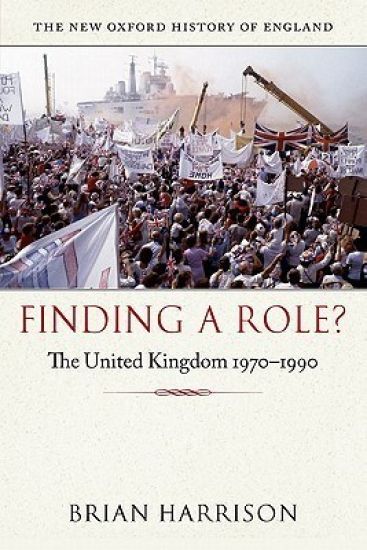
In 1970 the 'cold war' was still cold, Northern Ireland's troubles were escalating, the UK's relations with the EEC were unclear, and corporatist approaches to the economy precariously persisted. By 1990 Communism was crumbling world-wide, Thatcher's economic revolution had occurred, terrorism in Northern Ireland was waning, 'multi-culturalism' was in place, family structures were changing fast, and British political institutions had become controversial. Seven analytic chapters pursue these changes and accumulate rich detail on changes in international relations, landscape and townscape, social framework, family and welfare structures, economic policies and realities, intellect and culture, politics and government. The concluding chapter ranges chronologically even more widely to bring out the interaction of past and present, then asks how far the UK had by 1990 identified its world role. Like Harrison's Seeking a Role: The United Kingdom 1951-1970 (2009) - the immediately preceding volume in this series - Finding a Role? includes a full chronological table and an ample index of names and themes. This, the first thorough, wide-ranging, and synoptic study of the UK so far published on this period, has two overriding aims: to show how British institutions evolved, but also to illuminate changes in the British people: their hopes and fears, values and enjoyments, failures and achievements. It therefore equips its readers to understand events since 1990, and so to decide for themselves where the UK should now be going.
In this, the first of two self-standing volumes bringing The New Oxford History of England up to the present, Brian Harrison begins in 1951 with much of the empire intact and Britain enjoying high prestige in Europe. The United Kingdom could still then claim to be a great power whose welfare state exemplified compromise between Soviet planning and the USA's free market. When the volume ends in 1970, no such claims carried conviction. The empire had gone, central planning was in trouble, and even the British political system had become controversial. In an unusually wide-ranging, yet impressively detailed volume, Harrison approaches the period from unfamiliar directions. He explains how British politicians in the 1950s and 1960s responded to this transition by pursuing successive roles for Britain: worldwide as champion of freedom, and in Europe as exemplar of parliamentary government, the multi-racial society, and economic planning. His main focus, though, rests not on the politicians but on the decisions the British people made largely for themselves: on their environment, social structure and attitudes, race relations, family patterns, economic framework, and cultural opportunities. By 1970 the consumer society had supplanted postwar austerity, the socialist vision was fading, and 'the sixties' (the theme of his penultimate chapter) had introduced new and even exotic themes and values. Having lost an empire, Britain was still resourcefully seeking a role: it had yet to find it.
In 1970 the 'cold war' was still cold, Northern Ireland's troubles were escalating, the UK's relations with the EEC were unclear, and corporatist approaches to the economy precariously persisted. By 1990 Communism was crumbling world-wide, Thatcher's economic revolution had occurred, terrorism in Northern Ireland was waning, 'multi-culturalism' was in place, family structures were changing fast, and British political institutions had become controversial. Seven analytic chapters pursue these changes and accumulate rich detail on changes in international relations, landscape and townscape, social framework, family and welfare structures, economic policies and realities, intellect and culture, politics and government. The concluding chapter ranges chronologically even more widely to bring out the interaction of past and present, then asks how far the UK had by 1990 identified its world role. Like Harrison's Seeking a Role: The United Kingdom 1951-1970 (2009) - the immediately preceding volume in this series - Finding a Role? includes a full chronological table and an ample index of names and themes. This, the first thorough, wide-ranging, and synoptic study of the UK so far published on this period, has two overriding aims: to show how British institutions evolved, but also to illuminate changes in the British people: their hopes and fears, values and enjoyments, failures and achievements. It therefore equips its readers to understand events since 1990, and so to decide for themselves where the UK should now be going.
In this, the first of two self-standing volumes bringing The New Oxford History of England up to the present, Brian Harrison begins in 1951 with much of the empire intact and with Britain enjoying high prestige in Europe. The United Kingdom could still then claim to be a great power, whose welfare state exemplified compromise between Soviet planning and the USA's free market. When the volume ends in 1970, no such claims carried conviction. The empire had gone, central planning was in trouble, and even the British political system had become controversial. In an unusually wide-ranging, yet impressively detailed volume, Harrison approaches the period from unfamiliar directions. He explains how British politicians in the 1950s and 1960s responded to this transition by pursuing successive roles for Britain: worldwide as champion of freedom, and in Europe as exemplar of parliamentary government, the multi-racial society, and economic planning. His main focus, though, rests not on the politicians but on the decisions the British people made largely for themselves: on their environment, social structure and attitudes, race relations, family patterns, economic framework, and cultural opportunities. By 1970 the consumer society had supplanted postwar austerity, the socialist vision was fading, and 'the sixties' (the theme of his penultimate chapter) had introduced new and even exotic themes and values. Having lost an empire, Britain was still resourcefully seeking a role: it had yet to find it.

The Transformation of British Politics, 1860-1995
Brian Harrison
Oxford University Press
1996
nidottu
The British political system, though often criticised, has been the model and the inspiration for many national governments world-wide. Yet it is now at the centre of controversial debate within Britain itself. Over the 130 years since Bagehot wrote his English Constitution, no historian has investigated in depth how it has evolved in all its dimensions, and few political scientists have looked further back than the Second World War. This is the first book to provide a detailed explanation of how the British political system came to acquire the form it has today. Brian Harrison's broad-ranging, authorative analysis runs continuously from the 1860s to the 1990s. He investigates such topics as civil liberties, pressure groups, parliament, elections and the parties, central and local government, cabinet, and monarchy. He examines the international and cultural influences on the working of the political system, and concludes by surveying current proposals for reform. With an ample guide to further reading, and a full chronology of leading events, this book will be essential reading for students of politics and history.
This is the first major study of the personalities, achievements, and tactics of British feminist leaders between the wars. It brings out the breadth and scale of their activities, and explains their contribution towards broadening women's political, occupational, and family roles at home and abroad. Dr Harrison clarifies the organizational context and ancestry of inter-war feminism through creating a portrait gallery of sixteen prominent but very different feminists. Some (Lady Astor and Ellen Wilkinson, for example) are well-known, but are approached from a new angle; others, equally significant and interesting, are now almost forgotten. Overall, the book provides a composite portrait of the reforming personality, and illuminates the tactical and strategic dilemmas that face the reformer who aims to transform a hostile climate by working through democratic institutions. Drawing on interviews as well as a wide range of manuscript and other sources, Prudent Revolutionaries throws new light on the first generation of women to possess the vote in Britain. It makes a valuable contribution to the social and political history of Britain between the wars.