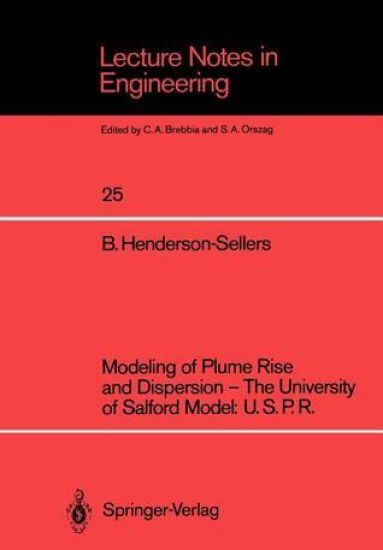
Kirjojen hintavertailu. Mukana 12 657 676 kirjaa ja 12 kauppaa.

Kirjailija

Brian Henderson-Sellers

Kirjat ja teokset yhdessä paikassa: 5 kirjaa, julkaisuja vuosilta 1987-2016, suosituimpien joukossa On the Mathematics of Modelling, Metamodelling, Ontologies and Modelling Languages. Vertaile teosten hintoja ja tarkista saatavuus suomalaisista kirjakaupoista.

5 kirjaa

Kirjojen julkaisuhaarukka 1987-2016.

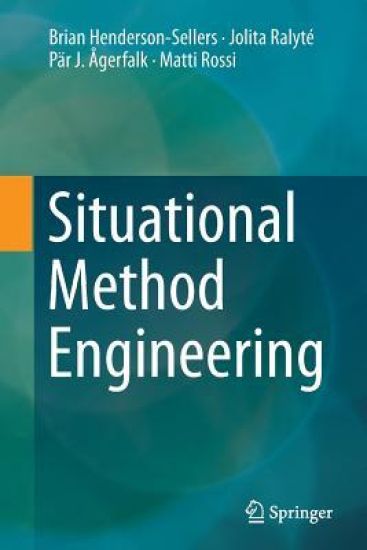
Situational Method Engineering

Situational Method Engineering

Brian Henderson-Sellers; Jolita Ralyté; Pär J. Ågerfalk; Matti Rossi

Springer-Verlag Berlin and Heidelberg GmbH Co. K
2016
nidottu
While previously available methodologies for software – like those published in the early days of object technology – claimed to be appropriate for every conceivable project, situational method engineering (SME) acknowledges that most projects typically have individual characteristics and situations. Thus, finding the most effective methodology for a particular project needs specific tailoring to that situation. Such a tailored software development methodology needs to take into account all the bits and pieces needed for an organization to develop software, including the software process, the input and output work products, the people involved, the languages used to describe requirements, design, code, and eventually also measures of success or failure.The authors have structured the book into three parts. Part I deals with all the basic concepts, terminology and overall ideas underpinning situational method engineering. As a summary of this part, they present a formal meta-model that enables readers to create their own quality methods and supporting tools. In Part II, they explain how to implement SME in practice, i.e., how to find method components and put them together and how to evaluate the resulting method. For illustration, they also include several industry case studies of customized or constructed processes, highlighting the impact that high-quality engineered methods can have on the success of an industrial software development. Finally, Part III summarizes some of the more recent and forward-looking ideas.This book presents the first summary of the state of the art for SME. For academics, it provides a comprehensive conceptual framework and discusses new research areas. For lecturers, thanks to its step-by-step explanations from basics to the customization and quality assessment of constructed methods, it serves as a solid basis for comprehensive courses on the topic. For industry methodologists, it offers a reference guide onfeatures and technologies to consider when developing in-house software development methods or customising and adopting off-the-shelf ones.
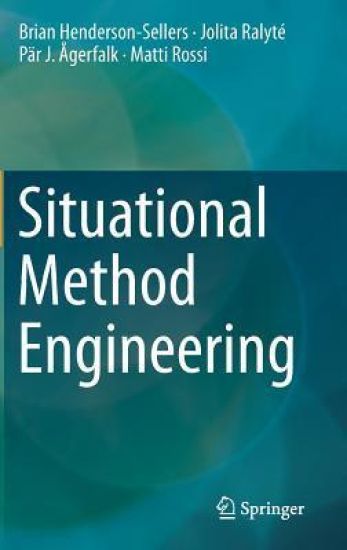
Situational Method Engineering

Situational Method Engineering

Brian Henderson-Sellers; Jolita Ralyté; Pär J. Ågerfalk; Matti Rossi

Springer-Verlag Berlin and Heidelberg GmbH Co. K
2014
sidottu
While previously available methodologies for software – like those published in the early days of object technology – claimed to be appropriate for every conceivable project, situational method engineering (SME) acknowledges that most projects typically have individual characteristics and situations. Thus, finding the most effective methodology for a particular project needs specific tailoring to that situation. Such a tailored software development methodology needs to take into account all the bits and pieces needed for an organization to develop software, including the software process, the input and output work products, the people involved, the languages used to describe requirements, design, code, and eventually also measures of success or failure.The authors have structured the book into three parts. Part I deals with all the basic concepts, terminology and overall ideas underpinning situational method engineering. As a summary of this part, they present a formal meta-model that enables readers to create their own quality methods and supporting tools. In Part II, they explain how to implement SME in practice, i.e., how to find method components and put them together and how to evaluate the resulting method. For illustration, they also include several industry case studies of customized or constructed processes, highlighting the impact that high-quality engineered methods can have on the success of an industrial software development. Finally, Part III summarizes some of the more recent and forward-looking ideas.This book presents the first summary of the state of the art for SME. For academics, it provides a comprehensive conceptual framework and discusses new research areas. For lecturers, thanks to its step-by-step explanations from basics to the customization and quality assessment of constructed methods, it serves as a solid basis for comprehensive courses on the topic. For industry methodologists, it offers a reference guide onfeatures and technologies to consider when developing in-house software development methods or customising and adopting off-the-shelf ones.
On the Mathematics of Modelling, Metamodelling, Ontologies and Modelling Languages

On the Mathematics of Modelling, Metamodelling, Ontologies and Modelling Languages

Brian Henderson-Sellers

Springer-Verlag Berlin and Heidelberg GmbH Co. K
2012
nidottu
Computing as a discipline is maturing rapidly. However, with maturity often comes a plethora of subdisciplines, which, as time progresses, can become isolationist. The subdisciplines of modelling, metamodelling, ontologies and modelling languages within software engineering e.g. have, to some degree, evolved separately and without any underpinning formalisms. Introducing set theory as a consistent underlying formalism, Brian Henderson-Sellers shows how a coherent framework can be developed that clearly links these four, previously separate, areas of software engineering. In particular, he shows how the incorporation of a foundational ontology can be beneficial in resolving a number of controversial issues in conceptual modelling, especially with regard to the perceived differences between linguistic metamodelling and ontological metamodelling. An explicit consideration of domain-specific modelling languages is also included in his mathematical analysis of models, metamodels, ontologies and modelling languages.This encompassing and detailed presentation of the state-of-the-art in modelling approaches mainly aims at researchers in academia and industry. They will find the principled discussion of the various subdisciplines extremely useful, and they may exploit the unifying approach as a starting point for future research.
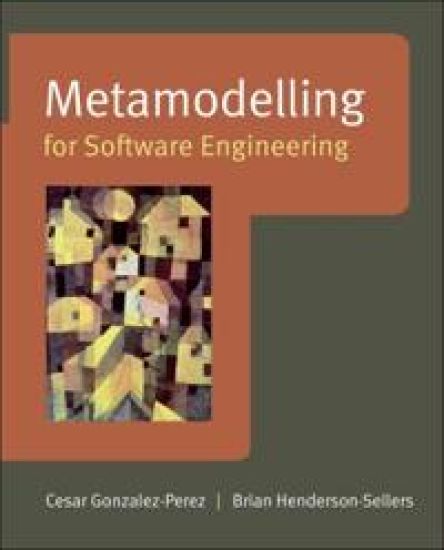
Metamodelling for Software Engineering

Metamodelling for Software Engineering

Cesar Gonzalez-Perez; Brian Henderson-Sellers

John Wiley Sons Inc
2008
sidottu
This book focuses on metamodelling as a discipline, exploring its foundations, techniques and results. It presents a comprehensive metamodel that covers process, product and quality issues under a common framework. Issues covered include: An explanation of what metamodelling is and why it is necessary in the context of software engineering.Basic concepts and principles of traditional metamodelling, and some existing results of this approach.Problems associated with traditional approaches to Metamodelling are discussed, alongside an exploration of possible solutions and alternative approaches.Advanced topics such as the extension of the object-oriented paradigm for metamodelling purposes or the foundations of powertype-based tool development will be studied.Finally, a comprehensive case study is introduced and developed, showing how to use many of the concepts explained in the previous chapters. This book provides a comprehensive conceptual framework for metamodelling and includes case studies and exercises which will demonstrate practical uses of metamodelling. For lecturers and educators, the book provides a layered repository of contents, starting from the basics of metamodelling in the first chapters, through specific issues such as trans-layer control or non-strict approaches, up to advanced topics such as universal powertyping or extensions to the object-oriented paradigm. The book also serves as an in-depth reference guide to features and technologies to consider when developing in-house software development methods or customising and adopting off-the-shelf ones. Software tool developers and vendors can benefit from the book by finding in it a comprehensive guide to the implementation of frameworks and toolsets for computer-aided software modelling and development.