

Kirjailija
Brian Johnston
Kirjat ja teokset yhdessä paikassa: 51 kirjaa, julkaisuja vuosilta 1980-2023, suosituimpien joukossa Hope For Humanity - God's Fix For A Broken World. Vertaile teosten hintoja ja tarkista saatavuus suomalaisista kirjakaupoista.
51 kirjaa
Kirjojen julkaisuhaarukka 1980-2023.

Following the success of "A Delicious Slice of Johnners", Barry Johnston has edited another delightful anthology based on three of his father's most popular books, "Brian Johnston's Guide to Cricket", "Chatterboxes" and "It's Been A Piece Of Cake".
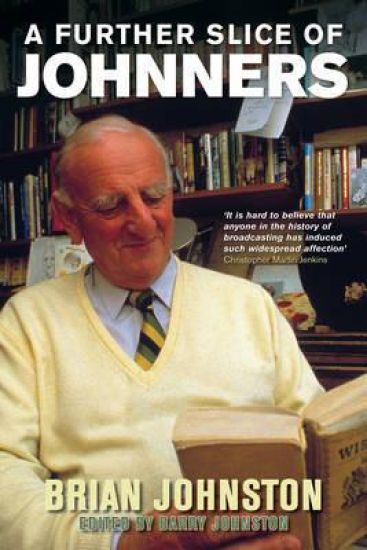
When Brian Johnston was a schoolboy, his reports were full of phrases such as 'talks too much in school' and 'apt to be a buffoon'. Later millions of radio listeners would be delighted to discover that some things never changed! Johnners brought his unique wit and personal charm to an enormous range of BBC radio and television programmes for nearly 50 years, from In Town Tonight and Down Your Way to Test Match Special. After Brian died in 1994, Christopher Martin-Jenkins wrote: 'It is hard to believe that anyone in the history of broadcasting has induced such widespread affection'. A Further Slice of Johnners covers Brian's early days, from his childhood in Hertfordshire and his schooldays at Eton and Oxford to his job in the family coffee business in the City and his service with the Grenadier Guards during the Second World War. There is also a selection of the most memorable characters and locations from his fifteen years on the Radio Four programme Down Your Way. Finally there is a collection of Brian's popular 'View From the Boundary' interviews on Test Match Special, including fascinating conversations with Eric Idle, John Major and Peter O'Toole.
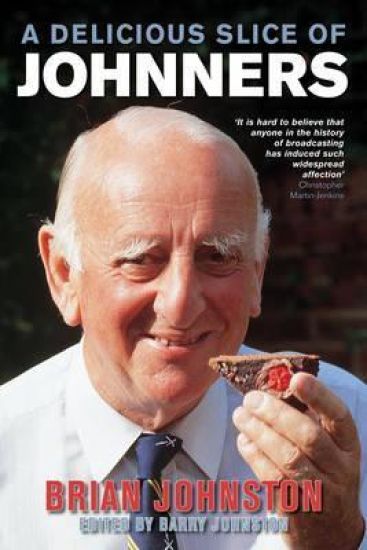
Following Brian Johnston's death in 1994, Prime Minister John Major appeared to speak for the nation when he remarked that 'Summers will never be the same.' To an Englishman's ears, the sound of leather against willow will always be closely associated with the cheerful tones of Johnners.Brian Johnston was a man who admitted: 'I have this absurd hankering to make people laugh.' He also summed up his books as 'the meanderings of a remarkably happy and lucky person, to whom life, like cricket, is a funny game and still a lot of fun.' Lovingly edited by his eldest son, Barry, A Delicious Slice of Johnners is a wonderfully enjoyable compendium of three of Johnners' best loved books, the autobiographies It's Been a Lot of Fun and It's a Funny Game, and Rain Stops Play

Not All Men Are Monsters: Sex. Travel. Food. Life.
Brian Johnston
Createspace Independent Publishing Platform
2009
nidottu
The true story of Brian, a self-confident chef travelling with determination and focus, until he meets a Japanese girl who confuses everything.Commitment and dedication to his work in developing countries has always seemed to be enough, but after feeling a profound connection followed by rejection, Brian reflects deeply on past behaviours, unsure if his eagerness to see intimate relationships work has matched his willingness to move on.The challenges are compounded as he tries to get to know his newest encounter by email and chat, while he travels and researches culture and cuisine, meeting a diversity of inspiring people in Europe, Africa and Asia along the way.Will personal growth and understanding be worth the effort, or is the high road leading to an airport the smarter way to go?http: //SexTravelFoodLife.wordpress.co

After a long sojourn in China, Brian Johnston arrived in Cairns to join his sister on a campervan trip across the 'top end'. Into the Never-Never is a beautifully written and often hilarious account of their adventures in the remote outback and on to the coast and the cities, in search of the Australia they knew only from tourist brochures and soap operas. The book is suffused with Johnston's growing affection for the country and its people. It is also shadowed by an acute awareness of Australia s underlying cultural tensions. From warts-and-all accounts of casual racism in the outback to unabashed delight in Sydney s Mardi Gras, Into the Never-Never presents Australia s burgeoning cultural diversity in microcosm. In his second traveller's tale, Brian Johnston's dry wit and wonderful descriptive powers are once again in evidence. Whether bogged on a beach in Broome, sightseeing in Canberra with a Laotian friend, or speaking with the traditional owners on a cliff-top in Kakadu, he never loses his keen sense of the absurd and his sensitivity to the nuances of everyday encounters.

Brian Johnston's approach to Ibsen, now well known, is unlike any other. Johnston sees Ibsen's twelve realist plays as a single cyclical work, the "realist" method of which hides a much larger poetic intention than has previously been suspected. He believes that the cycle constitutes one of the major works of the European imagination, comparable in scale to Goethe or Dante. And he has shown Ibsen to be the heir to Romantic and Hegelian art and thought, adapting this heritage to the circumstances of his own day.This work demonstrates how the language and scene, characters and "props," of the Ibsen dramas establish a bold and far-reaching theatrical goal: nothing less than an account of our biological and cultural identity in its multilayered totality. Johnston argues that Ibsen's realist text, while stimulating the appearance of nineteenth-century life, also objectively and precisely builds up an alternative image in which archetypal figures and situations from our cultural past repossess the realist stage. Thus he sees the Ibsen "strategy" in his realist plays as twofold: (1) the dialectical subversion of the nineteenth-century reality presented in the plays, and (2) the forced recovery of the archetypal from the past, in a procedure similar to James Joyce's in Ulysses. By "supertext" Johnston means a reservoir of cultural reference upon which Ibsen continuously drew in his realist work just as in is earlier poetic and historical dramas.
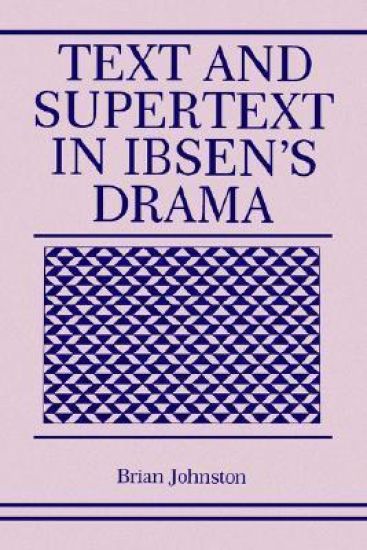
Brian Johnston's approach to Ibsen, now well known, is unlike any other. Johnston sees Ibsen's twelve realist plays as a single cyclical work, the "realist" method of which hides a much larger poetic intention than has previously been suspected. He believes that the cycle constitutes one of the major works of the European imagination, comparable in scale to Goethe or Dante. And he has shown Ibsen to be the heir to Romantic and Hegelian art and thought, adapting this heritage to the circumstances of his own day.This work demonstrates how the language and scene, characters and "props," of the Ibsen dramas establish a bold and far-reaching theatrical goal: nothing less than an account of our biological and cultural identity in its multilayered totality. Johnston argues that Ibsen's realist text, while stimulating the appearance of nineteenth-century life, also objectively and precisely builds up an alternative image in which archetypal figures and situations from our cultural past repossess the realist stage. Thus he sees the Ibsen "strategy" in his realist plays as twofold: (1) the dialectical subversion of the nineteenth-century reality presented in the plays, and (2) the forced recovery of the archetypal from the past, in a procedure similar to James Joyce's in Ulysses. By "supertext" Johnston means a reservoir of cultural reference upon which Ibsen continuously drew in his realist work just as in is earlier poetic and historical dramas.

To the Third Empire was first published in 1980. Minnesota Archive Editions uses digital technology to make long-unavailable books once again accessible, and are published unaltered from the original University of Minnesota Press editions. Critical acclaim greeted Brian Johnston's 1975 book on Ibsen's final phase, The Ibsen Cycle. Choice called it "the single most provocative and critically exciting books of Ibsen criticism in decades." Johnston now turns his attention to the early works, using the same thematic premise - that the plays follow a clear progression, influenced by the Hegalian aesthetic that pervaded Europe in the mid-nineteenth century. The result is an explanation of the early career that demonstrates both its unity and its essential relation to the realistic cycle that followed. In advancing his argument Johnston provides close readings of ten plays, ranging from Cataline to Emperor and Galilean and including Brand and Peer Gynt. Scholars and students of drama, comparative literature, and Ibsen studies will find To the Third Empire an essential work.