Kirjojen hintavertailu. Mukana 12 390 323 kirjaa ja 12 kauppaa.

Kirjailija

Brian P. Owensby

Kirjat ja teokset yhdessä paikassa: 5 kirjaa, julkaisuja vuosilta 1999-2021, suosituimpien joukossa New World of Gain. Vertaile teosten hintoja ja tarkista saatavuus suomalaisista kirjakaupoista.

5 kirjaa

Kirjojen julkaisuhaarukka 1999-2021.

New World of Gain

New World of Gain

Brian P. Owensby

Stanford University Press
2021
pokkari
In the centuries before Europeans crossed the Atlantic, social and material relations among the indigenous Guaraní people of present-day Paraguay were based on reciprocal gift-giving. But the Spanish and Portuguese newcomers who arrived in the sixteenth century seemed interested in the Guaraní only to advance their own interests, either through material exchange or by getting the Guaraní to serve them. This book tells the story of how Europeans felt empowered to pursue individual gain in the New World, and how the Guaraní people confronted this challenge to their very way of being. Although neither Guaraní nor Europeans were positioned to grasp the larger meaning of the moment, their meeting was part of a global sea change in human relations and the nature of economic exchange. Brian P. Owensby uses the centuries-long encounter between Europeans and the indigenous people of South America to reframe the notion of economic gain as a historical development rather than a matter of human nature. Owensby argues that gain—the pursuit of individual, material self-interest—must be understood as a global development that transformed the lives of Europeans and non-Europeans, wherever these two encountered each other in the great European expansion spanning the sixteenth to nineteenth centuries.
New World of Gain

New World of Gain

Brian P. Owensby

Stanford University Press
2021
sidottu
In the centuries before Europeans crossed the Atlantic, social and material relations among the indigenous Guaraní people of present-day Paraguay were based on reciprocal gift-giving. But the Spanish and Portuguese newcomers who arrived in the sixteenth century seemed interested in the Guaraní only to advance their own interests, either through material exchange or by getting the Guaraní to serve them. This book tells the story of how Europeans felt empowered to pursue individual gain in the New World, and how the Guaraní people confronted this challenge to their very way of being. Although neither Guaraní nor Europeans were positioned to grasp the larger meaning of the moment, their meeting was part of a global sea change in human relations and the nature of economic exchange. Brian P. Owensby uses the centuries-long encounter between Europeans and the indigenous people of South America to reframe the notion of economic gain as a historical development rather than a matter of human nature. Owensby argues that gain—the pursuit of individual, material self-interest—must be understood as a global development that transformed the lives of Europeans and non-Europeans, wherever these two encountered each other in the great European expansion spanning the sixteenth to nineteenth centuries.
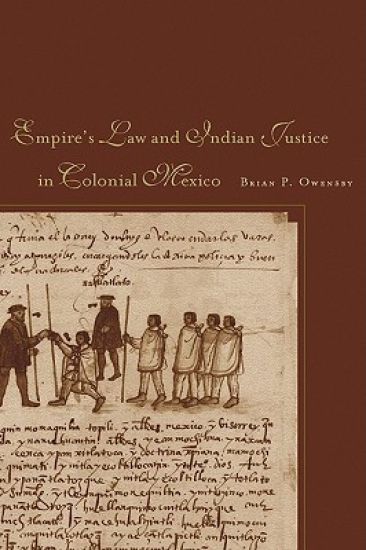
Empire of Law and Indian Justice in Colonial Mexico

Empire of Law and Indian Justice in Colonial Mexico

Brian P. Owensby

Stanford University Press
2011
pokkari
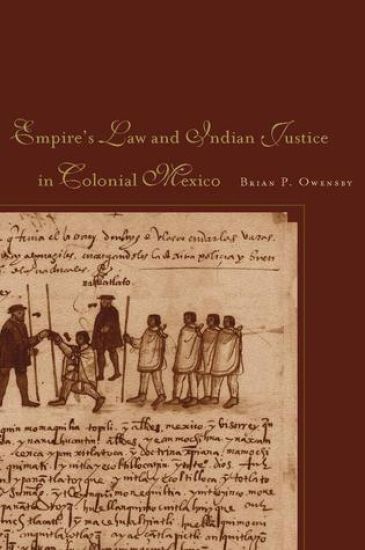
Empire of Law and Indian Justice in Colonial Mexico shows how Indian litigants and petitioners made sense of Spanish legal principles and processes when the dust of conquest had begun to settle after 1600. By juxtaposing hundreds of case records with written laws and treatises, Owensby reveals how Indians saw the law as a practical and moral resource that allowed them to gain a measure of control over their lives and to forge a relationship to a distant king. Several chapters elucidate central concepts of Indian claimants in their encounter with the law over the seventeenth century—royal protection, possession of property, liberty, notions of guilt, village autonomy and self-rule, and subjecthood. Owensby concludes that Indian engagement with Spanish law was the first early modern experiment in cosmopolitan legality, one that faced the problem of difference head on and sought to bridge the local and the international. In so doing, it enabled indigenous claimants to forge a colonial politics of justice that opened up space for a conversation between colonial rulers and ruled.
Empire of Law and Indian Justice in Colonial Mexico

Empire of Law and Indian Justice in Colonial Mexico

Brian P. Owensby

Stanford University Press
2008
sidottu
Empire of Law and Indian Justice in Colonial Mexico shows how Indian litigants and petitioners made sense of Spanish legal principles and processes when the dust of conquest had begun to settle after 1600. By juxtaposing hundreds of case records with written laws and treatises, Owensby reveals how Indians saw the law as a practical and moral resource that allowed them to gain a measure of control over their lives and to forge a relationship to a distant king. Several chapters elucidate central concepts of Indian claimants in their encounter with the law over the seventeenth century—royal protection, possession of property, liberty, notions of guilt, village autonomy and self-rule, and subjecthood. Owensby concludes that Indian engagement with Spanish law was the first early modern experiment in cosmopolitan legality, one that faced the problem of difference head on and sought to bridge the local and the international. In so doing, it enabled indigenous claimants to forge a colonial politics of justice that opened up space for a conversation between colonial rulers and ruled.
Intimate Ironies

Intimate Ironies

Brian P. Owensby

Stanford University Press
1999
sidottu
The middle-class condition, seen during the twentieth century as both the symbol of progress and order and the means to achieve it, has largely evaded historical analysis. Blending historical methods and anthropological sensibilities, Intimate Ironies relates the everyday lives of an emergent white-collar middle class to Brazilian national politics in the twentieth century. Focusing on the period between 1920 and 1950, the author looks beyond ideologies to reveal how, amidst the turmoil of modernization, middle-class men and women strained to wrest order from the ordeal of change. Drawing on legacies of hierarchy and patronage and orienting themselves in very concrete ways to the middle-class ideal of Western modernity, these Brazilian men and women recast the meaning of work and home to set themselves apart from those below them and to project a sense of moral superiority over those above. The author shows how anxieties growing out of this ambivalent position deeply conditioned their role in national politics, from experiments groping toward middle-class populism during the 1930's to the moralistic distrust of institutional politics that characterized the middle-class political outlook after World War II. Intimate Ironies represents a novel approach to the history of urban middle classes in the twentieth century. Most studies of the middle class have concentrated on culture or political behavior; rarely have the two been brought together. By linking everyday life and politics, the book reinvigorates the study of political history and class in modern Latin American societies, in the process complementing recent studies of organized labor and the industrial elites in Latin America. And by telling an unorthodox story of the middle class, the author challenges the very possibility of a linear, progressive narrative of social development.