

Kirjailija
Brian Richardson
Kirjat ja teokset yhdessä paikassa: 27 kirjaa, julkaisuja vuosilta 1994-2026, suosituimpien joukossa The Book Of All Books. Vertaile teosten hintoja ja tarkista saatavuus suomalaisista kirjakaupoista.
27 kirjaa
Kirjojen julkaisuhaarukka 1994-2026.

After some years using published material to teach newcomers the rudiments of bridge bidding, the author became somewhat disillusioned with the approach advocated in the majority of beginning bridge texts. The matters that particularly concerned him were related to the view espoused by many bridge teachers that it is important to keep all bidding 'natural' so as not to confuse beginners. The author felt that if confusion exists, it is likely to be the teaching approach that causes the confusion, rather than the subject matter itself. The proponents of this 'natural' bidding approach, decline to teach beginning students Jacoby Transfer Bids, Weak Two Opening Bids and, in some cases, Stayman. The reason often given is that teaching 'natural' bidding is difficult enough for beginning bridge students, and we should not confuse them by teaching them conventions or treatments that say something different. These same teachers seem to see no inconsistency in their approach of saying, when the students are doing a second (or third) class with them - "oh, remember when I told you that when your partner makes an opening bid of 1NT and you have 7 points and a five card ♥ suit, that you should bid 2♥? Well, I want you to forget that, because I am going to teach you now that, with that same hand, you should bid 2♦." The author has two problems with that approach. Firstly, it seems to downplay the ability of students to understand these specific bids. The author contends that it is most likely that this is a 'teaching failure' rather than a 'learning failure' The author has found that once students fully understand that it is desirable to have the strong hand as Declarer, most of them have little problem understanding the rationale behind Jacoby Transfer Bids. Putting the bids in context seems to make the task of learning Transfer Bids much easier. Secondly, if teachers are hoping to encourage their students to become duplicate bridge players, it makes sense for them to be using a bidding system that other players are using. As almost all duplicate bridge players use Stayman, Jacoby Transfer Bids and Weak Two Opening Bids, the author's students are introduced to these bids in their first series of lessons. And it is important to note that an understanding of these 3 aspects of bridge bidding will not prove to be a disadvantage in social bridge. The theme throughout the book is one of providing clear, consistent guidelines for a relatively simple modern approach to bidding. The author repeatedly emphasizes that once newcomers have a reasonable understanding of basic bidding, they, and their partner, can 'tweak' the approach taught in this text. The author is an avid duplicate bridge player and encourages all of his students to try that form of the game. However, the reality is that many bridge players enjoy the game in its more social form, and have no real desire to go past that form of the game. This is perfectly understandable, and the bidding style taught in this text is consistent with either form of the game. This book is organized into nine Chapters. CHAPTER 1 - The Basics. This Chapter is really 'Ground Zero'. It recognizes that some people who wish to learn to play bridge have had little, if any, experience of playing card games. The text introduces students to the absolute basics: -the suits -the rank, or hierarchy, of suits -how to count points -what is a 'game' in bridge -dealing -arranging the cards in your hand -the process of bidding -the process of playing -scoring. In this first, very basic, Chapter, students have a hand of bridge to play. At the end of the Chapter there is a brief test to enable students to check their mastery of the material provided in the text. Clearly not all students "need" this Chapter. Nevertheless as the purpose of the book is to provide a text to enable ALL students to be int
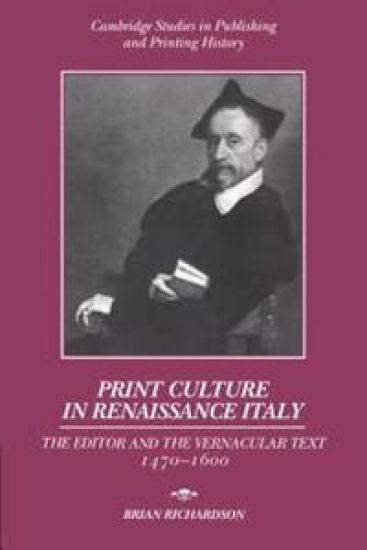
The emergence of print in late fifteenth-century Italy gave a crucial new importance to the editors of texts, who determined the form in which texts from the Middle Ages would be read, and who could strongly influence the interpretation and status of texts by adding introductory material or commentary. Brian Richardson here examines the Renaissance circulation and reception of works by earlier writers including Dante, Petrarch, Boccaccio and Ariosto, as well as popular contemporary works of entertainment. In so doing he sheds light on the impact of the new printing and editing methods on Renaissance culture, including the standardisation of vernacular Italian and its spread to new readers and writers, the establishment of new standards in textual criticism, and the increasing rivalry between the two cities on which this study is chiefly focused, Venice and Florence.

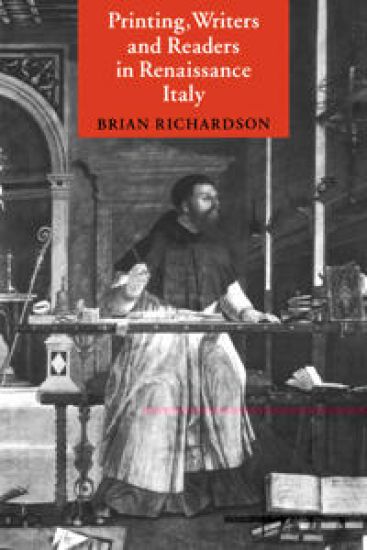
Printing, Writers and Readers in Renaissance Italy
Brian Richardson
Cambridge University Press
1999
pokkari
The spread of printing to Renaissance Italy had a dramatic impact on all users of books. As works came to be diffused more widely and cheaply, so authors had to adapt their writing and their methods of publishing to the demands and opportunities of the new medium, and reading became a more frequent and user-friendly activity. Printing, Writers and Readers in Renaissance Italy focuses on this interaction between the book industry and written culture. After describing the new technology and the contexts of publishing and bookselling, it examines the continuities and changes faced by writers in the shift from manuscript to print, the extent to which they benefited from print in their careers, and the greater accessibility of books to a broader spectrum of readers, including women and the less well educated. This is the first integrated study of a topic of central importance in Italian and European culture.

Professional services marketing is a relatively new form of marketing that has been recogonized only since the late 1980s. Most of the attempts to write about marketing for professional services have been a regurgitation of the traditional marketing approach that has evolved since the 1960s and have concentrated on minor differences and adjustments. In many ways, what is needed is a fresh approach which takes into account the complex political, social, economic, legislative and cultural backdrop and provides a way for design professionals, such as architects and engineers, to look to the future. This book does just that.
The emergence of print in late fifteenth-century Italy gave a crucial new importance to the editors of texts, who determined the form in which texts from the Middle Ages would be read, and who could strongly influence the interpretation and status of texts by adding introductory material or commentary. Brian Richardson here examines the Renaissance circulation and reception of works by earlier writers including Dante, Petrarch, Boccaccio and Ariosto, as well as popular contemporary works of entertainment. In so doing he sheds light on the impact of the new printing and editing methods on Renaissance culture, including the standardisation of vernacular Italian and its spread to new readers and writers, the establishment of new standards in textual criticism, and the increasing rivalry between the two cities on which this study is chiefly focused, Venice and Florence.