Kirjojen hintavertailu. Mukana 12 595 353 kirjaa ja 12 kauppaa.

Kirjailija

Brian Sutton-Smith

Kirjat ja teokset yhdessä paikassa: 6 kirjaa, julkaisuja vuosilta 1981-2011, suosituimpien joukossa Recess Battles. Vertaile teosten hintoja ja tarkista saatavuus suomalaisista kirjakaupoista.

6 kirjaa

Kirjojen julkaisuhaarukka 1981-2011.

Recess Battles

Recess Battles

Anna R. Beresin; Brian Sutton-Smith

University Press of Mississippi
2011
nidottu
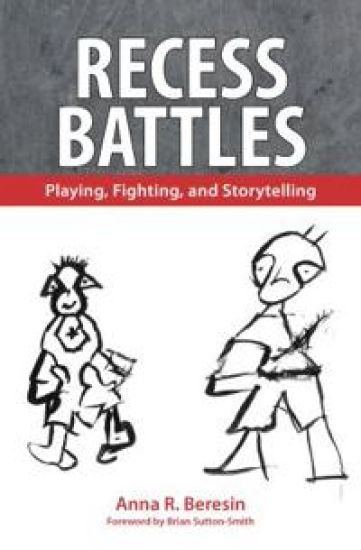
As children wrestle with culture through their games, recess itself has become a battleground for the control of children's time. Based on dozens of interviews and the observation of over a thousand children in a racially integrated, working-class public school, Recess Battles is a moving reflection of urban childhood at the turn of the millennium. The book debunks myths about recess violence and challenges the notion that schoolyard play is a waste of time. The author videotaped and recorded children of the Mill School in Philadelphia from 1991 to 2004 and asked them to offer comments as they watched themselves at play. These sessions in Recess Battles raise questions about adult power and the changing frames of class, race, ethnicity, and gender. The grown-ups' clear misunderstanding of the complexity of children's play is contrasted with the richness of the children's folk traditions.Recess Battles is an ethnographic study of lighthearted games, a celebratory presentation of children's folklore and its conflicts, and a philosophical text concerning the ironies of everyday childhood. Rooted in video micro-ethnography and the traditions of theorists such as Bourdieu, Willis, and Bateson, Recess Battles is written for a lay audience with extensive academic footnotes. International scholar Dr. Brian Sutton-Smith contributes a foreword, and the children themselves illustrate the text with black and white paintings.
Recess Battles

Recess Battles

Anna R. Beresin; Brian Sutton-Smith

University Press of Mississippi
2010
sidottu
As children wrestle with culture through their games, recess itself has become a battleground for the control of children's time. Based on dozens of interviews and the observation of over a thousand children in a racially integrated, working-class public school, Recess Battles is a moving reflection of urban childhood at the turn of the millennium. The book debunks myths about recess violence and challenges the notion that schoolyard play is a waste of time. The author videotaped and recorded children of the Mill School in Philadelphia from 1991 to 2004 and asked them to offer comments as they watched themselves at play. These sessions in Recess Battles raise questions about adult power and the changing frames of class, race, ethnicity, and gender. The grown-ups' clear misunderstanding of the complexity of children's play is contrasted with the richness of the children's folk traditions.Recess Battles is an ethnographic study of lighthearted games, a celebratory presentation of children's folklore and its conflicts, and a philosophical text concerning the ironies of everyday childhood. Rooted in video micro-ethnography and the traditions of theorists such as Bourdieu, Willis, and Bateson, Recess Battles is written for a lay audience with extensive academic footnotes. International scholar Dr. Brian Sutton-Smith contributes a foreword, and the children themselves illustrate the text with black and white paintings.

The Genesis of Animal Play

The Genesis of Animal Play

Gordon M. Burghardt; Brian Sutton-Smith

Bradford Books
2006
pokkari
In The Genesis of Animal Play, Gordon Burghardt examines the origins and evolution of play in humans and animals. He asks what play might mean in our understanding of evolution, the brain, behavioral organization, and psychology. Is play essential to development? Is it the driving force behind human and animal behavior? What is the proper place for the study of play in the cognitive, behavioral, and biological sciences?The engaging nature of play-who does not enjoy watching a kitten attack a ball of yarn?-has made it difficult to study. Some scholars have called play undefinable, nonexistent, or a mystery outside the realm of scientific analysis. Using the comparative perspectives of ethology and psychology, The Genesis of Animal Play goes further than other studies in reviewing the evidence of play throughout the animal kingdom, from human babies to animals not usually considered playful. Burghardt finds that although playfulness may have been essential to the origin of much that we consider distinctive in human (and mammalian) behavior, it only develops through a specific set of interactions among developmental, evolutionary, ecological, and physiological processes. Furthermore, play is not always beneficial or adaptive.Part I offers a detailed discussion of play in placental mammals (including children) and develops an integrative framework called surplus resource theory. The most fascinating and most controversial sections of the book, perhaps, are in the seven chapters in part II in which Burghardt presents evidence of playfulness in such unexpected groups of animals as kangaroos, birds, lizards, and "Fish That Leap, Juggle, and Tease." Burghardt concludes by considering the implications of the diversity of play for future research, and suggests that understanding the origin and development of play can shape our view of society and its accomplishments through history.
The Ambiguity of Play

The Ambiguity of Play

Brian Sutton-Smith

Harvard University Press
2001
nidottu
Every child knows what it means to play, but the rest of us can merely speculate. Is it a kind of adaptation, teaching us skills, inducting us into certain communities? Is it power, pursued in games of prowess? Fate, deployed in games of chance? Daydreaming, enacted in art? Or is it just frivolity? Brian Sutton-Smith, a leading proponent of play theory, considers each possibility as it has been proposed, elaborated, and debated in disciplines from biology, psychology, and education to metaphysics, mathematics, and sociology.Sutton-Smith focuses on play theories rooted in seven distinct “rhetorics”—the ancient discourses of Fate, Power, Communal Identity, and Frivolity and the modern discourses of Progress, the Imaginary, and the Self. In a sweeping analysis that moves from the question of play in child development to the implications of play for the Western work ethic, he explores the values, historical sources, and interests that have dictated the terms and forms of play put forth in each discourse’s “objective” theory.This work reveals more distinctions and disjunctions than affinities, with one striking exception: however different their descriptions and interpretations of play, each rhetoric reveals a quirkiness, redundancy, and flexibility. In light of this, Sutton-Smith suggests that play might provide a model of the variability that allows for “natural” selection. As a form of mental feedback, play might nullify the rigidity that sets in after successful adaption, thus reinforcing animal and human variability. Further, he shows how these discourses, despite their differences, might offer the components for a new social science of play.
A History of Children's Play

A History of Children's Play

Brian Sutton-Smith

University of Pennsylvania Press
1981
sidottu
New Zealand children from 1840 to 1890 were subjected to an unusual combination of agrarian existence and an industrial social philosophy in the newly formed schools. When schools became more universal in the expanding industrial society, a new emphasis on the control of children developed, and from 1920 onward, adult supervision in the form of heavily organized sports and playgrounds encroached more and more on the untrammeled freedom of the rural environment. Returning to his home country of New Zealand, Brian Sutton-Smith documents the relationship between children's play and the actual process of history. Drawing on interviews with hundreds of informants from every province and school district of New Zealand, the author illuminates for the first time the various social, cultural, historical, and psychological context in which children's play occurs. He treats both formal and informal play, as well as the play of both boys and girls.
The Folkstories of Children

The Folkstories of Children

Brian Sutton-Smith

University of Pennsylvania Press
1981
pokkari
What prompts children to tell stories? What does the word "story" mean to a child at two or five years of age? The Folkstories of Children, first published in 1981, features nearly five hundred stories that were volunteered by fifty children between the ages of two and ten and transcribed word for word. The stories are organized chronologically by the age of the teller, revealing the progression of verbal competence and the gradual emergence of staging and plot organization. Many stories told by two-year-olds, for example, have only beginnings with no middle or end; the "narrative" is held together by rhyme or alliteration. After the age of three or four, the same children tell stories that feature a central character and a narrative arc. The stories also exhibit each child's growing awareness and management of his or her environment and life concerns. Some children see their stories as dialogues between teller and audience, others as monologues expressing concerns about fate and the forces of good and evil. Brian Sutton-Smith discusses the possible origins of the stories themselves: folktales, parent and teacher reading, media, required writing of stories in school, dreams, and play. The notes to each chapter draw on this context as well as folktale analysis and child development theory to consider why and how the stories take their particular forms. The Folkstories of Children provides valuable evidence and insight into the ways children actively and inventively engage language as they grow.