Kirjojen hintavertailu. Mukana 12 390 323 kirjaa ja 12 kauppaa.

Kirjailija

Brian Wentz

Kirjat ja teokset yhdessä paikassa: 4 kirjaa, julkaisuja vuosilta 2010-2025, suosituimpien joukossa Human-Computer Interaction and International Public Policymaking. Vertaile teosten hintoja ja tarkista saatavuus suomalaisista kirjakaupoista.

4 kirjaa

Kirjojen julkaisuhaarukka 2010-2025.

Human-Computer Interaction and International Public Policymaking

Human-Computer Interaction and International Public Policymaking

Jonathan Lazar; Julio Abascal; Simone Barbosa; Jeremy Barksdale; Batya Friedman; Jens Grossklags; Jan Gulliksen; Jeff Johnson; Tom McEwan; Loïc Martínez-Normand; Wibke Michalk; Janice Tsai; Gerrit van der Veer; Hans von Axelson; Ake Walldius; Gill Whitney; Marco Winckler; Volker Wulf; Elizabeth F. Churchill; Lorrie Cranor; Janet Davis; Alan Hedge; Harry Hochheiser; Juan Pablo Hourcade; Clayton Lewis; Lisa Nathan; Fabio Paterno; Blake Reid; Whitney Quesenbery; Ted Selker; Brian Wentz

now publishers Inc
2016
nidottu
This monograph lays out a discussion framework for understanding the role of human-computer interaction (HCI) in public policymaking. It takes an international view, discussing potential areas for research and application and their potential for impact. The aim is to provide a solid foundation for discussion, cooperation and collaborative interaction, and to outline future programs of activity.It starts with an introduction to HCI and public policy and goes on to discuss how HCI research and practices already inform public policy, providing representative examples. It then discusses how public policy influences HCI and provides representative public policy areas that are relevant to HCI, and where HCI could have even more impact in the future. It concludes by laying out a framework for involvement and suggested actions by the HCI community in public policy internationally.This monograph summarizes the observations and recommendations from a daylong workshop at the CHI 2013 conference in Paris, France. The workshop invited the community’s perspectives regarding the intersection of governmental policies, international and domestic standards, recent HCI research discoveries, and emergent considerations and challenges. It also incorporates contributions made after the workshop by workshop participants and by individuals who were unable to participate in the workshop but whose work and interests were highly related and relevant.
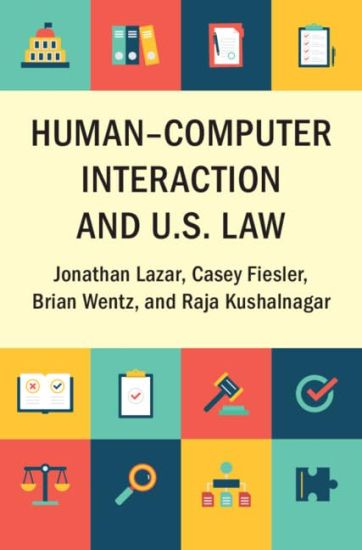
Human-Computer Interaction and U.S. Law

Human-Computer Interaction and U.S. Law

Jonathan Lazar; Casey Fiesler; Brian Wentz; Raja Kushalnagar; Lorrie Cranor

Cambridge University Press
2025
sidottu
The core topics at the intersection of human-computer interaction (HCI) and US law -- privacy, accessibility, telecommunications, intellectual property, artificial intelligence (AI), dark patterns, human subjects research, and voting -- can be hard to understand without a deep foundation in both law and computing. Every member of the author team of this unique book brings expertise in both law and HCI to provide an in-depth yet understandable treatment of each topic area for professionals, researchers, and graduate students in computing and/or law. Two introductory chapters explaining the core concepts of HCI (for readers with a legal background) and U.S. law (for readers with an HCI background) are followed by in-depth discussions of each topic.
Human-Computer Interaction and U.S. Law

Human-Computer Interaction and U.S. Law

Jonathan Lazar; Casey Fiesler; Brian Wentz; Raja Kushalnagar; Lorrie Cranor

Cambridge University Press
2025
pokkari
The core topics at the intersection of human-computer interaction (HCI) and US law -- privacy, accessibility, telecommunications, intellectual property, artificial intelligence (AI), dark patterns, human subjects research, and voting -- can be hard to understand without a deep foundation in both law and computing. Every member of the author team of this unique book brings expertise in both law and HCI to provide an in-depth yet understandable treatment of each topic area for professionals, researchers, and graduate students in computing and/or law. Two introductory chapters explaining the core concepts of HCI (for readers with a legal background) and U.S. law (for readers with an HCI background) are followed by in-depth discussions of each topic.
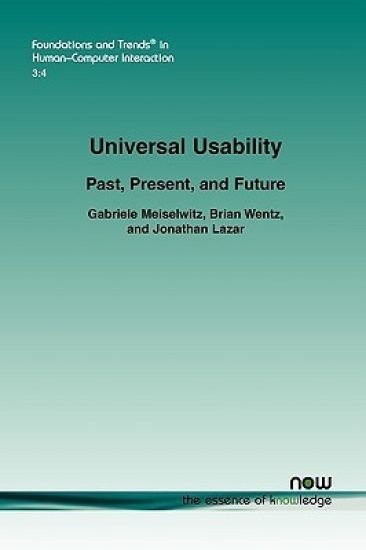
Universal Usability

Universal Usability

Gabriele Meiselwitz; Brian Wentz; Jonathan Lazar

now publishers Inc
2010
nidottu
Computers are used all over the world in a variety of contexts by users with all levels of technical experience. This includes users such as kindergarteners, older users, people with various impairments, people who are busy doing other tasks (such as driving a car), and users with differing levels of education, literacy, and socio-economic means. The concept of computer interfaces that will be easy to use, for all of these users, in all of these different situations, is known as universal usability.Making progress towards this goal requires innovations in techniques for gathering and understanding requirements; designing and developing interfaces; evaluation and assessment; standards practices; and public policy, and much work in this field remains to be done. This survey presents an overview of universal usability as it currently exists in the human-computer interaction literature, and presents some future directions for work in universal usability.