Kirjojen hintavertailu. Mukana 12 595 353 kirjaa ja 12 kauppaa.

Kirjailija

Brian Winston

Kirjat ja teokset yhdessä paikassa: 20 kirjaa, julkaisuja vuosilta 1998-2020, suosituimpien joukossa Bad News (Routledge Revivals). Vertaile teosten hintoja ja tarkista saatavuus suomalaisista kirjakaupoista.

20 kirjaa

Kirjojen julkaisuhaarukka 1998-2020.

Bad News (Routledge Revivals)

Bad News (Routledge Revivals)

Peter Beharrell; Howard Davis; John Eldridge; John Hewitt; Jean Hart; Gregg Philo; Paul Walton; Brian Winston

Routledge
2009
nidottu
It is a commonly held belief that television news in Britain, on whatever channel, is more objective, more trustworthy, more neutral than press reporting. The illusion is exploded in this controversial study by the Glasgow University Media Group, originally published in 1976.The authors undertook an exhaustive monitoring of all television broadcasts over 6 months, from January to June 1975, with particular focus upon industrial news broadcasts, the TUC, strikes and industrial action, business and economic affairs.Their analysis showed how television news favours certain individuals by giving them more time and status. But their findings did not merely deny the neutrality of the news, they gave a new insight into the picture of industrial society that TV news constructs.
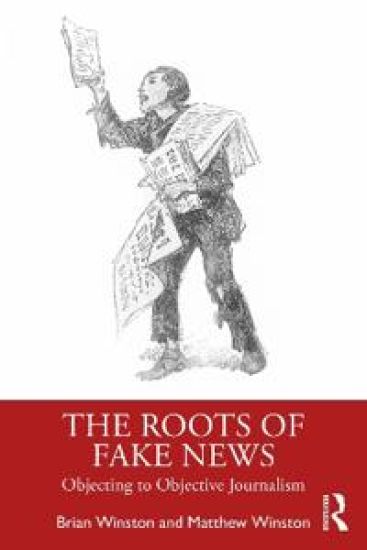
The Roots of Fake News

The Roots of Fake News

Brian Winston; Matthew Winston

Routledge
2020
sidottu
The Roots of Fake News argues that ‘fake news’ is not a problem caused by the power of the internet, or by the failure of good journalism to assert itself. Rather, it is within the news’s ideological foundations – professionalism, neutrality, and most especially objectivity – that the true roots of the current ‘crisis’ are to be found.Placing the concept of media objectivity in a fuller historical context, this book examines how current perceptions of a crisis in journalism actually fit within a long history of the ways news media have avoided, obscured, or simply ignored the difficulties involved in promising objectivity, let alone ‘truth’. The book examines journalism’s relationships with other spheres of human endeavour (science, law, philosophy) concerned with the pursuit of objective truth, to argue that the rising tide of ‘fake news’ is not an attack on the traditional ideologies which have supported journalism. Rather, it is an inevitable result of their inherent flaws and vulnerabilities.This is a valuable resource for students and scholars of journalism and history alike who are interested in understanding the historical roots, and philosophical context of a fiercely contemporary issue.
The Roots of Fake News

The Roots of Fake News

Brian Winston; Matthew Winston

Routledge
2020
nidottu
The Roots of Fake News argues that ‘fake news’ is not a problem caused by the power of the internet, or by the failure of good journalism to assert itself. Rather, it is within the news’s ideological foundations – professionalism, neutrality, and most especially objectivity – that the true roots of the current ‘crisis’ are to be found.Placing the concept of media objectivity in a fuller historical context, this book examines how current perceptions of a crisis in journalism actually fit within a long history of the ways news media have avoided, obscured, or simply ignored the difficulties involved in promising objectivity, let alone ‘truth’. The book examines journalism’s relationships with other spheres of human endeavour (science, law, philosophy) concerned with the pursuit of objective truth, to argue that the rising tide of ‘fake news’ is not an attack on the traditional ideologies which have supported journalism. Rather, it is an inevitable result of their inherent flaws and vulnerabilities.This is a valuable resource for students and scholars of journalism and history alike who are interested in understanding the historical roots, and philosophical context of a fiercely contemporary issue.
Misunderstanding Media

Misunderstanding Media

Brian Winston

Routledge
2018
nidottu
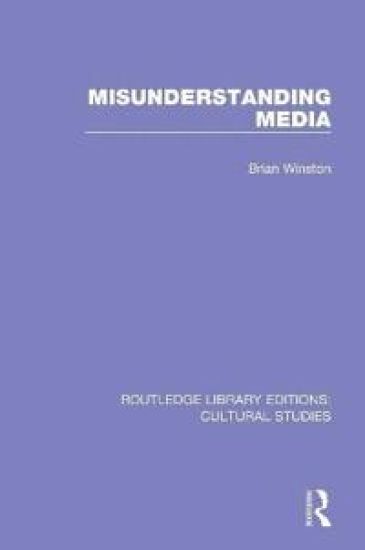
The 1980s saw constant reports of an information revolution. This book, first published in 1986, challenges this view. It argues that the information revolution is an illusion, a rhetorical gambit, an expression of profound historical ignorance, and a movement dedicated to purveying misunderstanding and disseminating disinformation. In this historically based attack on the information revolution, Professor Winston takes a had look at the four central information technologies – telephones, television, computers and satellites. He describes how these technologies were created and diffused, showing that instead of revolution we just have ‘business as usual’. He formulates a ‘law’ of the suppression of radical potential – a law which states that new telecommunication technologies are introduced into society only insofar as their disruptive potential is contained. Despite the so-called information revolution, the major institutions of society remain unchanged, and most of us remain in total ignorance of the history of technology.
The Act of Documenting

The Act of Documenting

Brian Winston; Gail Vanstone; Wang Chi

Bloomsbury Academic USA
2017
nidottu
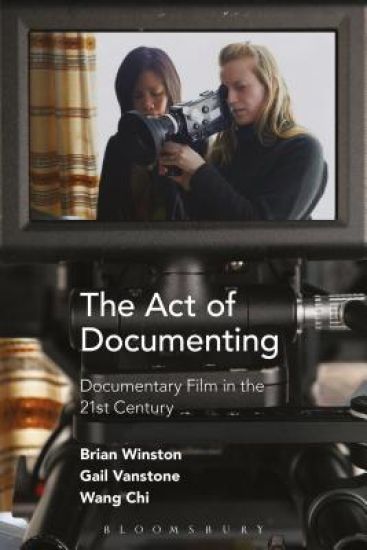
Documentary has never attracted such audiences, never been produced with such ease from so many corners of the globe, never embraced such variety of expression. The very distinctions between the filmed, the filmer and the spectator are being dissolved. The Act of Documenting addresses what this means for documentary’s 21st century position as a genus in the “class” cinema; for its foundations as, primarily, a scientistic, eurocentric and patriarchal discourse; for its future in a world where assumptions of photographic image integrity cannot be sustained. Unpacked are distinctions between performance and performativy and between different levels of interaction, linearity and hypertextuality, engagement and impact, ethics and conditions of reception. Winston, Vanstone and Wang Chi explore and celebrate documentary's potentials in the digital age.
The Act of Documenting

The Act of Documenting

Brian Winston; Gail Vanstone; Wang Chi

Bloomsbury Academic USA
2017
sidottu
Documentary has never attracted such audiences, never been produced with such ease from so many corners of the globe, never embraced such variety of expression. The very distinctions between the filmed, the filmer and the spectator are being dissolved. The Act of Documenting addresses what this means for documentary’s 21st century position as a genus in the “class” cinema; for its foundations as, primarily, a scientistic, eurocentric and patriarchal discourse; for its future in a world where assumptions of photographic image integrity cannot be sustained. Unpacked are distinctions between performance and performativy and between different levels of interaction, linearity and hypertextuality, engagement and impact, ethics and conditions of reception. Winston, Vanstone and Wang Chi explore and celebrate documentary's potentials in the digital age.
Misunderstanding Media

Misunderstanding Media

Brian Winston

Routledge
2016
sidottu
The 1980s saw constant reports of an information revolution. This book, first published in 1986, challenges this view. It argues that the information revolution is an illusion, a rhetorical gambit, an expression of profound historical ignorance, and a movement dedicated to purveying misunderstanding and disseminating disinformation. In this historically based attack on the information revolution, Professor Winston takes a had look at the four central information technologies – telephones, television, computers and satellites. He describes how these technologies were created and diffused, showing that instead of revolution we just have ‘business as usual’. He formulates a ‘law’ of the suppression of radical potential – a law which states that new telecommunication technologies are introduced into society only insofar as their disruptive potential is contained. Despite the so-called information revolution, the major institutions of society remain unchanged, and most of us remain in total ignorance of the history of technology.
Media Technology and Society

Media Technology and Society

Brian Winston

Routledge
2015
sidottu
Challenging the popular myth of a present-day 'information revolution', Media Technology and Society is essential reading for anyone interested in the social impact of technological change. Winston argues that the development of new media forms, from the telegraph and the telephone to computers, satellite and virtual reality, is the product of a constant play-off between social necessity and suppression: the unwritten law by which new technologies are introduced into society only insofar as their disruptive potential is limited.
A Right to Offend

A Right to Offend

Brian Winston

Bloomsbury Academic
2012
nidottu
Over the past two decades, there have been a series of events that have brought into question the concept and practice of free expression. In this new book, Winston provides an account of the current state of freedom of expression in the western world. He analyses all the most pertinent cases of conflict during the last two decades - including the fatwa against Salman Rushdie, the incident of the Danish cartoons and offended celebrities - examining cultural, legal and journalistic aspects of each case. A Right to Offend offers us a deeper understanding of the increasingly threatening environment in which free speech operates and is defended, as well as how it informs and is central to journalism practice and media freedom more generally. It is important reading for all those interested in freedom of expression in the twenty-first century.
A Right to Offend

A Right to Offend

Brian Winston

Bloomsbury Academic
2012
sidottu
Over the past two decades, there have been a series of events that have brought into question the concept and practice of free expression. In this new book, Winston provides an account of the current state of freedom of expression in the western world. He analyses all the most pertinent cases of conflict during the last two decades - including the fatwa against Salman Rushdie, the incident of the Danish cartoons and offended celebrities - examining cultural, legal and journalistic aspects of each case. A Right to Offend offers us a deeper understanding of the increasingly threatening environment in which free speech operates and is defended, as well as how it informs and is central to journalism practice and media freedom more generally. It is important reading for all those interested in freedom of expression in the twenty-first century.
More Bad News (Routledge Revivals)

More Bad News (Routledge Revivals)

Peter Beharrell; Howard Davis; John Eldridge; John Hewitt; Jean Hart; Gregg Philo; Paul Walton; Brian Winston

Routledge
2009
nidottu
First published in 1980, More Bad News is the Second Volume in the research findings of the Glasgow University Media Group. It develops the analytic findings and methods of the first volume Bad News through a series of Case Studies of Television News Coverage, and argues that much of what passes as balanced and factual news reporting is produced from a highly partial viewpoint. Focusing on the British economy in crisis, and its thematic linkage with the Social Contract during the first four months of 1975, the book deals with three main levels of activity: the story, the language and the visuals. As the book unpacks each level of routine news coverage a picture emerges which has the surface appearance of neutrality and balance but is in fact highly partial and restricted
More Bad News (Routledge Revivals)

More Bad News (Routledge Revivals)

Peter Beharrell; Howard Davis; John Eldridge; John Hewitt; Jean Hart; Gregg Philo; Paul Walton; Brian Winston

Routledge
2009
sidottu
First published in 1980, More Bad News is the Second Volume in the research findings of the Glasgow University Media Group. It develops the analytic findings and methods of the first volume Bad News through a series of Case Studies of Television News Coverage, and argues that much of what passes as balanced and factual news reporting is produced from a highly partial viewpoint. Focusing on the British economy in crisis, and its thematic linkage with the Social Contract during the first four months of 1975, the book deals with three main levels of activity: the story, the language and the visuals. As the book unpacks each level of routine news coverage a picture emerges which has the surface appearance of neutrality and balance but is in fact highly partial and restricted
Bad News - Volumes 1 and 2 (Routledge Revivals)

Bad News - Volumes 1 and 2 (Routledge Revivals)

Peter Beharrell; Howard Davis; John Eldridge; John Hewitt; Jean Hart; Gregg Philo; Paul Walton; Brian Winston

Routledge
2009
muu
It is a commonly held belief that television news in Britain, on whatever channel, is more objective, more trustworthy, more neutral than press reporting. The illusion is exploded in this controversial 2-volume study by the Glasgow University Media Group, originally published in 1976 and 1980.
Bad News (Routledge Revivals)

Bad News (Routledge Revivals)

Peter Beharrell; Howard Davis; John Eldridge; John Hewitt; Jean Hart; Gregg Philo; Paul Walton; Brian Winston

Routledge
2009
sidottu
It is a commonly held belief that television news in Britain, on whatever channel, is more objective, more trustworthy, more neutral than press reporting. The illusion is exploded in this controversial study by the Glasgow University Media Group, originally published in 1976.The authors undertook an exhaustive monitoring of all television broadcasts over 6 months, from January to June 1975, with particular focus upon industrial news broadcasts, the TUC, strikes and industrial action, business and economic affairs.Their analysis showed how television news favours certain individuals by giving them more time and status. But their findings did not merely deny the neutrality of the news, they gave a new insight into the picture of industrial society that TV news constructs.
Claiming the Real

Claiming the Real

Brian Winston

BFI Publishing
2008
nidottu
Claiming the Real II describes the origins, development and current state of documentary cinema, and the social, political, industrial and ethical factors that determine its production. This new edition addresses the ethical quagmires, digital technologies and proliferating forms that have transformed documentary cinema.
Messages

Messages

Brian Winston

Routledge
2005
sidottu
Easy to read, and highly topical, Messages writes a history of mass communication in Europe and its outreaches, as a search for the origins of media forms from print and stage, to photography, film and broadcasting.Arguing that the development of the mass media has been an essential engine driving the western concept of an individual, Brian Winston examines how the right of free expression is under attack, and how the roots of media expression need to be recalled to make a case for the media’s importance for the protection of individual liberty.Relating to the US constitution, and key laws in the UK which form the foundation of our society, this is a highly useful book for students of media, communication, history, and journalism.
Messages

Messages

Brian Winston

Routledge
2005
nidottu
Easy to read, and highly topical, Messages writes a history of mass communication in Europe and its outreaches, as a search for the origins of media forms from print and stage, to photography, film and broadcasting.Arguing that the development of the mass media has been an essential engine driving the western concept of an individual, Brian Winston examines how the right of free expression is under attack, and how the roots of media expression need to be recalled to make a case for the media’s importance for the protection of individual liberty.Relating to the US constitution, and key laws in the UK which form the foundation of our society, this is a highly useful book for students of media, communication, history, and journalism.
Lies, Damn Lies and Documentaries

Lies, Damn Lies and Documentaries

Brian Winston

BFI Publishing
2000
nidottu
Despite its centrality to the daily lives of a variety of journalists, the topic of ethics is relatively unexplored. This work provides a comprehensive treatment of the subject. The book looks at crisis of confidence in public service broadcasting and the controversy surrounding docusoaps to provide a foundational study of ethics and the documentary.
Media,Technology and Society

Media,Technology and Society

Brian Winston

Routledge
1998
sidottu
Challenging the popular myth of a present-day 'information revolution', Media Technology and Society is essential reading for anyone interested in the social impact of technological change. Winston argues that the development of new media forms, from the telegraph and the telephone to computers, satellite and virtual reality, is the product of a constant play-off between social necessity and suppression: the unwritten law by which new technologies are introduced into society only insofar as their disruptive potential is limited.
Media Technology and Society

Media Technology and Society

Brian Winston

Routledge
1998
nidottu
Challenging the popular myth of a present-day 'information revolution', Media Technology and Society is essential reading for anyone interested in the social impact of technological change. Winston argues that the development of new media forms, from the telegraph and the telephone to computers, satellite and virtual reality, is the product of a constant play-off between social necessity and suppression: the unwritten law by which new technologies are introduced into society only insofar as their disruptive potential is limited.