Kirjojen hintavertailu. Mukana 12 390 323 kirjaa ja 12 kauppaa.

Kirjailija

Bruce A. Arrigo

Kirjat ja teokset yhdessä paikassa: 10 kirjaa, julkaisuja vuosilta 2002-2012, suosituimpien joukossa The French Connection in Criminology. Vertaile teosten hintoja ja tarkista saatavuus suomalaisista kirjakaupoista.

10 kirjaa

Kirjojen julkaisuhaarukka 2002-2012.

Introduction to Forensic Psychology

Introduction to Forensic Psychology

Stacey L. Shipley; Bruce A. Arrigo

Academic Press Inc
2012
sidottu
Introduction to Forensic Psychology, Third Edition, has been completely restructured to explain in greater detail how courses on forensic psychology are taught, making it more applicable as a textbook than previous editions. It also features more figures, tables and text boxes, making it a true textbook. What this book has that others do not is equal representation of criminal behavior, the court systems, and law enforcement/prisons. It also has equal representation of criminal and civil forensics. Other texts tend to be weighted towards just criminal behavior or just criminal justice and primarily criminal or civic forensics but not both. This new edition also has equal representation of issues to pertaining to adults and children. It contains new coverage of cyberbullying, tests and assessments in the courtroom, mental deficiency and competency to stand trial, and information on mothers who kill their children. Adult, juvenile and family issues are dealt with separately, making it easier to find what you need. Case illustrations dramatically highlight how the lives of individuals have been (or could be) impacted by developments in psychology and law. Chapters now include pedagogy, including outlines, main points, and relevant websites. This book is intended for professors teaching introduction to forensic psychology, as well as for students interested in adult, child, and family forensics as they apply to criminal and civic forensics law enforcement/prisons.

The Ethics of Total Confinement

The Ethics of Total Confinement

Bruce A. Arrigo; Heather Y. Bersot; Brian G. Sellers

Oxford University Press Inc
2011
sidottu
In three parts, this volume in the AP-LS series explores the phenomena of captivity and risk management, guided and informed by the theory, method, and policy of psychological jurisprudence. The authors present a controversial thesis that demonstrates how the forces of captivity and risk management are sustained by several interdependent "conditions of control." These conditions impose barriers to justice and set limits on citizenship for one and all. Situated at the nexus of political/social theory, mental health law and jurisprudential ethics, the book examines and critiques constructs such as offenders and victims; self and society; therapeutic and restorative; health; harm; and community. So, too, are three "total confinement" case law data sets on which this analysis is based. The volume stands alone in its efforts to systematically "diagnose" the moral reasoning lodged within prevailing judicial opinions that sustain captivity and risk management practices impacting: (1) the rights of juveniles found competent to stand criminal trial, the mentally ill placed in long-term disciplinary isolation, and sex offenders subjected to civil detention and community re-entry monitoring; (2) the often unmet needs of victims; and (3) the demands of an ordered society. Carefully balancing sophisticated insights with concrete and cutting-edge applications, the book concludes with a series of provocative, yet practical, recommendations for future research and meaningful reform within institutional practice, programming, and policy. The Ethics of Total Confinement is a thought-provoking and timely must-read for anyone interested in the ethical and legal issues regarding madness, citizenship, and social justice.
Revolution in Penology

Revolution in Penology

Bruce A. Arrigo; Dragan Milovanovic

Rowman Littlefield Publishers
2010
nidottu
Revolution in Penology is a thoroughly original and thought-provoking critique of penal harm, the recursive pains of imprisonment cycle, and the normalization of violence. Relying on selected insights derived from continental philosophy, cultural studies, and chaos theory, internationally renowned social theorists, Bruce A. Arrigo and Dragan Milovanovic, deconstruct the human agency/social structure duality that sustains the prison form, its parts and segments understood as correctional principles/practices, and the prison industrial complex that is informed by and stands above them all.
Revolution in Penology

Revolution in Penology

Bruce A. Arrigo; Dragan Milovanovic

Rowman Littlefield Publishers
2008
sidottu
Revolution in Penology is a thoroughly original and thought-provoking critique of penal harm, the recursive pains of imprisonment cycle, and the normalization of violence. Relying on selected insights derived from continental philosophy, cultural studies, and chaos theory, internationally renowned social theorists, Bruce A. Arrigo and Dragan Milovanovic, deconstruct the human agency/social structure duality that sustains the prison form, its parts and segments understood as correctional principles/practices, and the prison industrial complex that is informed by and stands above them all.
The Terrorist Identity

The Terrorist Identity

Michael P. Arena; Bruce A. Arrigo

New York University Press
2006
sidottu
Who would strap a bomb to his chest, walk into a crowded subway station and blow himself up? Only by examining how a terrorist understands his own identity and actions can this question be answered. The authors of The Terrorist Identity explore how the notion of self-concept combined with membership in terrorist and extremist groups, can shape and sustain the identity of a terrorist as well as their subsequent justification for violence and the legitimacy of their actions. The book provides an understanding of identity that draws on concepts from psychology, criminology, and sociology. Notably, the book examines several case studies of various terrorist groups, including: the Provisional Irish Republican Army, Hamas, the Shining Path, the Liberation Tigers of Tamil Eelam, and racist Skinheads. By making the construct of identity central to this analysis The Terrorist Identity explains how violent and extremist collective behavior emerges culturally, how it informs the identity of group members socially, and how participants assume their place in these groups completely even at the expense of life-threatening harm to others or to themselves.
The Terrorist Identity

The Terrorist Identity

Michael P. Arena; Bruce A. Arrigo

New York University Press
2006
pokkari
Who would strap a bomb to his chest, walk into a crowded subway station and blow himself up? Only by examining how a terrorist understands his own identity and actions can this question be answered. The authors of The Terrorist Identity explore how the notion of self-concept combined with membership in terrorist and extremist groups, can shape and sustain the identity of a terrorist as well as their subsequent justification for violence and the legitimacy of their actions. The book provides an understanding of identity that draws on concepts from psychology, criminology, and sociology. Notably, the book examines several case studies of various terrorist groups, including: the Provisional Irish Republican Army, Hamas, the Shining Path, the Liberation Tigers of Tamil Eelam, and racist Skinheads. By making the construct of identity central to this analysis The Terrorist Identity explains how violent and extremist collective behavior emerges culturally, how it informs the identity of group members socially, and how participants assume their place in these groups completely even at the expense of life-threatening harm to others or to themselves.
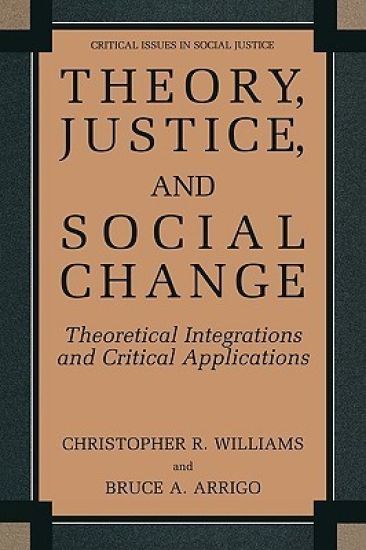
Theory, Justice, and Social Change

Theory, Justice, and Social Change

Christopher R. Williams; Bruce A. Arrigo

Kluwer Academic/Plenum Publishers
2005
nidottu
Throughout history, social and intellectual crises have given rise to compelling suggestions for reform steeped in various progressive sensibilities. For example, within the discipline of criminology -- particularly during the 1980’s and 1990’s -- a number of unconventional theoretical perspectives emerged that sought to challenge many of the assumptions embedded within its own mainstream discourse, and to propose alternative solutions for meaningful, sustainable change. Conceived of as "critical" in overarching orientation, these efforts to rethink the foundations of criminological verstehen can be traced to several specific theoretical and methodological strands of inquiry (e.g., anarchism, peacemaking, chaos theory, postmodernism). Though distinct in some respects, these emerging models are linked paradigmatically by their shared discontent with conventional criminological thought and by their radicalized posture toward existing and previously unexamined epistemic crises. Collectively, this is an agenda for reform that seeks to establish a more humane and just social order, particularly as citizens and society confront the institutional and communal problems posed by crime, delinquency, and deviance. Theory, Justice, and Social Change: Theoretical Integrations and Critical Applications represents a provocative series of essays that systematically reviews or extends the role of critical social theory in fostering justice and change in several relevant, though problematic, social contexts. Mindful of the need to address both conceptual exegeses and pragmatic concerns, the articles contained in this volume grapple with the ongoing "double crisis" that confronts theory and practice in the construction of knowledge. By appropriating and integrating various insights from several heterodox and critically animated lines of inquiry, each chapter deftly exposes where and how conventional sociological and criminological thought has failed toeffectively address such human social issues as homelessness, mental illness, minority rights, juvenile justice, global violence, and criminal punishment. In doing so, Theory, Justice, and Social Change provides new and much needed direction regarding theory development in the social sciences, and indicates why charting such a course of theory/action yields more enlightened prospects for justice and change in society and in our lives.
The French Connection in Criminology

The French Connection in Criminology

Bruce A. Arrigo; Dragan Milovanovic; Robert Carl Schehr

State University of New York Press
2005
pokkari
Brings the insights of postmodernism to the concerns of criminology and includes examples of how social theory can function in the real-world realm of criminal law. Winner of the 2005 Outstanding Book Award presented by the Crime and Juvenile Delinquency Division of the Society for the Study of Social Problems Winner of the 2005 Outstanding Book Award presented by the Crime and Juvenile Delinquency Division of the Society for the Study of Social Problems This is the first comprehensive, accessible, and integrative overview of postmodernism's contribution to law, criminology, and social justice. The book begins by reviewing the major contributions of eleven prominent figures responsible for the development of French postmodern social theory. This "first" wave includes Roland Barthes, Jean Baudrillard, Hélène Cixous, Gilles Deleuze, Jacques Derrida, Michel Foucault, Félix Guattari, Luce Irigaray, Julia Kristeva, Jacques Lacan, and Jean-François Lyotard. Their respective insights are then linked to "second" wave scholars who have appropriated their conceptualizations and applied them to pressing issues in law, crime, and social justice research. Compelling and concrete examples are provided for how affirmative and integrative postmodern inquiry can function meaningfully in the world of criminal justice. Topics explored include confinement law and prison resistance; critical race theory and a jurisprudence of color; media/literary studies and feminism; restorative justice and victim-offender mediation processes; and the emergence of social movements, including innocence projects and intentional communities.
Theory, Justice, and Social Change

Theory, Justice, and Social Change

Christopher R. Williams; Bruce A. Arrigo

Kluwer Academic/Plenum Publishers
2004
sidottu
Throughout history, social and intellectual crises have given rise to compelling suggestions for reform steeped in various progressive sensibilities. For example, within the discipline of criminology -- particularly during the 1980’s and 1990’s -- a number of unconventional theoretical perspectives emerged that sought to challenge many of the assumptions embedded within its own mainstream discourse, and to propose alternative solutions for meaningful, sustainable change. Conceived of as "critical" in overarching orientation, these efforts to rethink the foundations of criminological verstehen can be traced to several specific theoretical and methodological strands of inquiry (e.g., anarchism, peacemaking, chaos theory, postmodernism). Though distinct in some respects, these emerging models are linked paradigmatically by their shared discontent with conventional criminological thought and by their radicalized posture toward existing and previously unexamined epistemic crises. Collectively, this is an agenda for reform that seeks to establish a more humane and just social order, particularly as citizens and society confront the institutional and communal problems posed by crime, delinquency, and deviance. Theory, Justice, and Social Change: Theoretical Integrations and Critical Applications represents a provocative series of essays that systematically reviews or extends the role of critical social theory in fostering justice and change in several relevant, though problematic, social contexts. Mindful of the need to address both conceptual exegeses and pragmatic concerns, the articles contained in this volume grapple with the ongoing "double crisis" that confronts theory and practice in the construction of knowledge. By appropriating and integrating various insights from several heterodox and critically animated lines of inquiry, each chapter deftly exposes where and how conventional sociological and criminological thought has failed toeffectively address such human social issues as homelessness, mental illness, minority rights, juvenile justice, global violence, and criminal punishment. In doing so, Theory, Justice, and Social Change provides new and much needed direction regarding theory development in the social sciences, and indicates why charting such a course of theory/action yields more enlightened prospects for justice and change in society and in our lives.
Punishing the Mentally Ill

Punishing the Mentally Ill

Bruce A. Arrigo; George B. Palermo

State University of New York Press
2002
pokkari
A provocative exploration of a wide range of controversies in mental health law, this book argues that the criminal justice system punishes citizens for being mentally ill.A powerful, sophisticated, and original critique on how the disciplines of law and psychiatry behave and on how the mental health and justice systems operate, Punishing the Mentally Ill reveals where, how, and why the identity and humanity of persons with psychiatric disorders are consciously and unconsciously denied. Author Bruce A. Arrigo contends that despite periodic and well-intentioned efforts at reform, the current law-psychiatry system functions to punish the mentally ill for being different. The book synthesizes a wide range of mainstream and critical literature in sociology, law, philosophy, history, psychology, and psychoanalysis to establish a new theory of punishment at the law-psychiatry divide. To situate the analysis, enduring psycholegal issues are explored including the meaning of mental illness, definitions and predictions of dangerousness, the ethics of advocacy, the right to community-based treatment, the logic of forensic courtroom verdicts, transcarceration, and the execution of mentally disordered offenders among others. Punishing the Mentally Ill shows that current mental disability law research, programming, and policy are seriously flawed and that wholesale reform is necessary if the goals of citizen justice, social well-being, and humanism are to be realized.