

Kirjailija
Bruce Greenwald
Kirjat ja teokset yhdessä paikassa: 7 kirjaa, julkaisuja vuosilta 2003-2019, suosituimpien joukossa Value Investing. Vertaile teosten hintoja ja tarkista saatavuus suomalaisista kirjakaupoista.
7 kirjaa
Kirjojen julkaisuhaarukka 2003-2019.
Creating a Learning Society
Joseph E. Stiglitz; Bruce Greenwald
Columbia University Press
2015
pokkari
Since its publication Creating a Learning Society has served as an effective tool for those who advocate government policies to advance science and technology. It shows persuasively how enormous increases in our standard of living have been the result of learning how to learn, and it explains how advanced and developing countries alike can model a new learning economy on this example. Creating a Learning Society: Reader's Edition uses accessible language to focus on the work's central message and policy prescriptions. As the book makes clear, creating a learning society requires good governmental policy in trade, industry, intellectual property, and other important areas. The text's central thesis-that every policy affects learning-is critical for governments unaware of the innovative ways they can propel their economies forward.
Creating a Learning Society
Joseph E. Stiglitz; Bruce Greenwald
Columbia University Press
2014
sidottu
It has long been recognized that an improved standard of living results from advances in technology, not from the accumulation of capital. It has also become clear that what truly separates developed from less-developed countries is not just a gap in resources or output but a gap in knowledge. In fact, the pace at which developing countries grow is largely a function of the pace at which they close that gap. Thus, to understand how countries grow and develop, it is essential to know how they learn and become more productive and what government can do to promote learning. In Creating a Learning Society, Joseph E. Stiglitz and Bruce C. Greenwald cast light on the significance of this insight for economic theory and policy. Taking as a starting point Kenneth J. Arrow's 1962 paper "Learning by Doing," they explain why the production of knowledge differs from that of other goods and why market economies alone typically do not produce and transmit knowledge efficiently. Closing knowledge gaps and helping laggards learn are central to growth and development. But creating a learning society is equally crucial if we are to sustain improved living standards in advanced countries. Combining accessible prose with technical economic analysis, Stiglitz and Greenwald provide new models of "endogenous growth," up-ending thowhe thinking about both domestic and global policy and trade regimes. They show well-designed government trade and industrial policies can help create a learning society, and how poorly designed intellectual property regimes can retard learning. They also explain how virtually every government policy has effects, both positive and negative, on learning, a fact that policymakers must recognize. They demonstrate why many standard policy prescriptions, especially those associated with "neoliberal" doctrines focusing on static resource allocations, have impeded learning. Among the provocative implications are that free trade may lead to stagnation whereas broad-based industrial protection and exchange rate interventions may bring benefits-not just to the industrial sector, but to the entire economy. The volume concludes with brief commentaries from Philippe Aghion and Michael Woodford, as well as from Nobel Laureates Kenneth J. Arrow and Robert M. Solow.
The Most Important Thing Illuminated
Howard Marks; Bruce Greenwald
Columbia University Press
2013
sidottu
Howard Marks's The Most Important Thing distilled the investing insight of his celebrated client memos into a single volume and, for the first time, made his time-tested philosophy available to general readers. In this edition, Marks's wisdom is joined by the comments, insights, and counterpoints of four renowned investors and investment educators: Christopher C. Davis (Davis Funds), Joel Greenblatt (Gotham Capital), Paul Johnson (Nicusa Capital), and Seth A. Klarman (Baupost Group). These experts lend insight into such concepts as "second-level thinking," the price/value relationship, patient opportunism, and defensive investing. Marks also adds his own annotations, expanding on his book's original themes and issues. A new chapter addresses the importance of reasonable expectations, and a foreword by Bruce C. Greenwald, called "a guru to Wall Street's gurus" by the New York Times, speaks on value investing, productivity, and the economics of information. *** Howard Marks, the chairman and cofounder of Oaktree Capital Management, is renowned for his insightful assessments of market opportunity and risk. After four decades spent ascending to the top of the investment management profession, he is today sought out by the world's leading value investors, and his client memos brim with insightful commentary and a time-tested, fundamental philosophy. Now for the first time, all readers can benefit from Marks's wisdom, concentrated into a single volume that speaks to both the amateur and seasoned investor. Informed by a lifetime of experience and study, The Most Important Thing explains the keys to successful investment and the pitfalls that can destroy capital or ruin a career. Utilizing passages from his memos to illustrate his ideas, Marks teaches by example, detailing the development of an investment philosophy that fully acknowledges the complexities of investing and the perils of the financial world. Brilliantly applying insight to today's volatile markets, Marks offers a volume that is part memoir, part creed, with a number of broad takeaways. Marks expounds on such concepts as "second-level thinking," the price/value relationship, patient opportunism, and defensive investing. Frankly and honestly assessing his own decisions--and occasional missteps--he provides valuable lessons for critical thinking, risk assessment, and investment strategy. Encouraging investors to be "contrarian," Marks wisely judges market cycles and achieves returns through aggressive yet measured action. Which element is the most essential? Successful investing requires thoughtful attention to many separate aspects, and each of Marks's subjects proves to be the most important thing. "This is that rarity, a useful book."--Warren Buffett
Bruce Greenwald, one of the nation's leading business professors, presents a new and simplified approach to strategy that cuts through much of the fog that has surrounded the subject. Based on his hugely popular course at Columbia Business School, Greenwald and his coauthor, Judd Kahn, offer an easy-to-follow method for understanding the competitive structure of your industry and developing an appropriate strategy for your specific position. Over the last two decades, the conventional approach to strategy has become frustratingly complex. It's easy to get lost in a sophisticated model of your competitors, suppliers, buyers, substitutes, and other players, while losing sight of the big question: Are there barriers to entry that allow you to do things that other firms cannot?

Towards a New Paradigm in Monetary Economics
Stiglitz Joseph; Bruce Greenwald
Cambridge University Press
2003
pokkari
Towards a New Paradigm for Monetary Economics presents a pioneer treatment of critical topics in monetary economics. Unlike the prevailing monetary theory, this book focuses not on the role of money in facilitating transactions, but on the role of credit in facilitating economic activities more broadly. The ‘new paradigm’ emphasizes the demand and supply of loanable funds, which in turn requires the understanding of the imperfections of information and the role of banks. One enlightening view is that credit is quite different from other commodities in the sense that the former is based on information and default risk. The book consists of two parts. The first part develops a basic model of credit based on banks’ portfolio choices. The second part is dedicated to the policy implications, among which are the liberalization of financial markets, the East Asian Crisis, the 1991 US recession and the subsequent recovery.
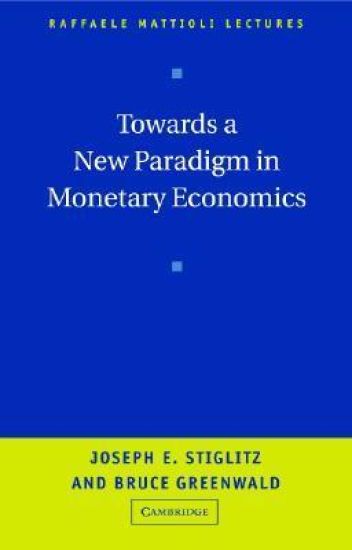
Towards a New Paradigm in Monetary Economics
Joseph Stiglitz; Bruce Greenwald
Cambridge University Press
2003
sidottu
Towards a New Paradigm for Monetary Economics presents a pioneer treatment of critical topics in monetary economics. Unlike the prevailing monetary theory, this book focuses not on the role of money in facilitating transactions, but on the role of credit in facilitating economic activities more broadly. The 'new paradigm' emphasizes the demand and supply of loanable funds, which in turn requires the understanding of the imperfections of information and the role of banks. One enlightening view is that credit is quite different from other commodities in the sense that the former is based on information and default risk. The book consists of two parts. The first part develops a basic model of credit based on banks' portfolio choices. The second part is dedicated to the policy implications, among which are the liberalization of financial markets, the East Asian Crisis, the 1991 US recession and the subsequent recovery.