Kirjojen hintavertailu. Mukana 12 390 323 kirjaa ja 12 kauppaa.

Kirjailija

Bruce J. West

Kirjat ja teokset yhdessä paikassa: 20 kirjaa, julkaisuja vuosilta 1985-2026, suosituimpien joukossa Lure Of Modern Science, The: Fractal Thinking. Vertaile teosten hintoja ja tarkista saatavuus suomalaisista kirjakaupoista.

Mukana myös kirjoitusasut: Bruce J West

20 kirjaa

Kirjojen julkaisuhaarukka 1985-2026.

Fractional Calculus for Skeptics II

Fractional Calculus for Skeptics II

Bruce J. West; YangQuan Chen

TAYLOR FRANCIS LTD
2026
sidottu
This second volume of the multi-volume Fractional Calculus for Skeptics explores the concept of “roughness” and its applications in complex systems. It demonstrates how fractional calculus offers valuable insights into modeling real-world phenomena that traditional calculus struggles to address. Building on the first volume's foundational work advocating a fractal/fractional calculus paradigm shift, this volume offers an in-depth exploration of the concept of “roughness,” drawing parallels to what Benoît B. Mandelbrot originally intended to call the “Science of Roughness.” The book introduces the novel concept of “body roughness” and demonstrates its practical applications through two case studies of “roughness-informed rehabilitation therapy” with closed-loop control systems. One study involves non-invasive, 40-Hz gamma-frequency sensory stimulation for Alzheimer's disease, and the other involves biologically variable ventilation using roughness-informed, closed-loop control. The four chapters are complemented by valuable appendices and essential chapter-end references, as well as insightful “take-home messages.” This book will appeal to students, researchers, and professionals in STEM fields, including engineering, physics, biology, biomedicine, control engineering, rehabilitation, big data, and machine learning.
On the Fractal Language of Medicine

On the Fractal Language of Medicine

Bruce J. West; W. Alan C. Mutch

TAYLOR FRANCIS LTD
2024
sidottu
On the Fractal Language of Medicine bridges a very clear gap among the knowledge gained over the last 20 years in the physical and life sciences on network theory, organ synchronicity and communication, the understanding of fractal signatures in health and disease and the importance of fractional calculus in integrating these concepts.The authors opine that the field of medicine has not appreciated this hard-won knowledge and has suffered greatly as a result. This book addresses this perceived deficiency by introducing medical researchers, clinicians, residents, first-year medical students and members of allied fields to the work of the so-called hard sciences. It seeks to facilitate effective communication between empiricists and theorists by making interdisciplinary efforts to explain complex mathematical concepts to physicians and, equally important, to elucidate complex medical concepts to physicists or mathematicians.This book will be of great interest to medical students, professionals and academics, as well as students and researchers of applied mathematics, especially those interested in fractional calculus and fractals.
Fractional Calculus for Skeptics I

Fractional Calculus for Skeptics I

Bruce J. West; YangQuan Chen

TAYLOR FRANCIS LTD
2024
sidottu
This book is the first of its kind on fractional calculus (FC), dedicated to advocating for FC in STEM education and research.Fractional calculus is increasingly used today, but there remains a core population of skeptics regarding the utility of this "new" calculus. This book is intended for those who are skeptical about the need for fractional calculus to describe dynamic complex networks and must be convinced of its use on a case-by-case basis. It is a one-stop resource to rapidly read and replace the appropriate skepticism with new knowledge. It offers compelling reasons from the perspectives of the physical, social, and life sciences as to why fractional calculus is needed when addressing the complexity of an underlying STEM phenomenon. The six chapters are accompanied by useful and essential appendices and chapter-end references. Each includes new (fractional-order) ways of thinking about statistics, complexity dynamics, and what constitutes a solution to a complexity science problem.The book will appeal to students and researchers in all STEM-related fields, such as engineering, physics, biology and biomedicine, climate change, big data, and machine learning. It is also suitable for general readers interested in these fields.

Crucial Event Rehabilitation Therapy

Crucial Event Rehabilitation Therapy

Bruce J. West; Paolo Grigolini; Mauro Bologna

Springer International Publishing AG
2023
nidottu
This book describes a new strategy for rehabilitation from injury and/or disease using Crucial Event Therapy. Recent studies have shown that individuals can recuperate more rapidly from surgery and other invasive procedures intended to correct the negative effects of disease or injury through the use of life support systems that operate at the body's natural biofrequencies. The same observation has been clinically shown to reverse the degenerative effects of neurodegenerative diseases such as Parkinson’s and Alzheimer's Disease. Crucial Event Therapy describes medicine as the operational control of the functions of the human body treated as a network-of-networks, with 1/f-variable crucial events coding the dynamic states of health and disease through information flow within a network and information exchange between biomedical networks. A new way of thinking based on the statistics of Cortical Events is presented and the relevant literature is suitably referenced. This is anideal book for biophysicists and data scientists seeking to understand the connection of complexity measures for the study of consciousness with the clinical aspects of designing a rehabilitation strategy.
Crucial Events: Why Are Catastrophes Never Expected?

Crucial Events: Why Are Catastrophes Never Expected?

Bruce J West; Paolo Grigolini

World Scientific Publishing Co Pte Ltd
2021
sidottu
A nonsimple (complex) system indicates a mix of crucial and non-crucial events, with very different statistical properties. It is the crucial events that determine the efficiency of information exchange between complex networks. For a large class of nonsimple systems, crucial events determine catastrophic failures - from heart attacks to stock market crashes.This interesting book outlines a data processing technique that separates the effects of the crucial from those of the non-crucial events in nonsimple time series extracted from physical, social and living systems. Adopting an informal conversational style, without sacrificing the clarity necessary to explain, the contents will lead the reader through concepts such as fractals, complexity and randomness, self-organized criticality, fractional-order differential equations of motion, and crucial events, always with an eye to helping to interpret what mathematics usually does in the development of new scientific knowledge.Both researchers and novitiate will find Crucial Events useful in learning more about the science of nonsimplicity.
Fractional Calculus View of Complexity
This book is not a text devoted to a pedagogical presentation of a specialized topic nor is it a monograph focused on the author's area of research. It accomplishes both these things while providing a rationale for why the reader ought to be interested in learning about fractional calculus. This book is for researchers who has heard about many of these scientifically exotic activities, but could not see how they fit into their own scientific interests, or how they could be made compatible with the way they understand science. It is also for beginners who have not yet decided where their scientific talents could be most productively applied. The book provides insight into the long-term direction of science and show how to develop the skills necessary to successfully do research in the twenty-first century.
Simplifying Complexity: Life is Uncertain, Unfair and Unequal
In life, we often face unavoidable complexities in terms of our ability to understand or influence outcomes. Some questions which arise due to these complexities are: Why can't the future be made certain? Why do the some people or events always end up at the center of controversy? Why do only a select few get ahead of their peers? Each question pertains to three central elements of complexities and these elements are: uncertainty, inequality and unfairness. Simplifying Complexity explains the scientific study of complex cognitive networks, as well as the methods scientists use to parse difficult problems into manageable pieces. Readers are introduced to scientific methodology and thought processes, followed by a discourse on perspectives on the three elements of complexity through concepts such as normal and non-normal statistics, scaling and complexity management. Simplifying Complexity combines basic cognitive science and scientific philosophy for both advanced students (in the fields of sociology, cognitive science, complex networks and change management) and for general readers looking for a more scientific guide to understanding and managing the nature of change in a complex world.
Nature’s Patterns and the Fractional Calculus
Complexity increases with increasing system size in everything from organisms to organizations. The nonlinear dependence of a system’s functionality on its size, by means of an allometry relation, is argued to be a consequence of their joint dependency on complexity (information). In turn, complexity is proven to be the source of allometry and to provide a new kind of force entailed by a system‘s information gradient. Based on first principles, the scaling behavior of the probability density function is determined by the exact solution to a set of fractional differential equations. The resulting lowest order moments in system size and functionality gives rise to the empirical allometry relations. Taking examples from various topics in nature, the book is of interest to researchers in applied mathematics, as well as, investigators in the natural, social, physical and life sciences. ContentsComplexityEmpirical allometryStatistics, scaling and simulationAllometry theoriesStrange kineticsFractional probability calculus
Networks of Echoes

Networks of Echoes

Bruce J. West; Malgorzata Turalska; Paolo Grigolini

Springer International Publishing AG
2016
nidottu
Networks of Echoes: Imitation, Innovation and Invisible Leaders is a mathematically rigorous and data rich book on a fascinating area of the science and engineering of social webs. There are hundreds of complex network phenomena whose statistical properties are described by inverse power laws. The phenomena of interest are not arcane events that we encounter only fleetingly, but are events that dominate our lives. We examine how this intermittent statistical behavior intertwines itself with what appears to be the organized activity of social groups. The book is structured as answers to a sequence of questions such as: How are decisions reached in elections and boardrooms? How is the stability of a society undermined by zealots and committed minorities and how is that stability re-established? Can we learn to answer such questions about human behavior by studying the way flocks of birds retain their formation when eluding a predator? These questions and others are answered using a generic model of a complex dynamic network—one whose global behavior is determined by a symmetric interaction among individuals based on social imitation. The complexity of the network is manifest in time series resulting from self-organized critical dynamics that have divergent first and second moments, are non-stationary, non-ergodic and non-Poisson. How phase transitions in the network dynamics influence such activity as decision making is a fascinating story and provides a context for introducing many of the mathematical ideas necessary for understanding complex networks in general. The decision making model (DMM) is selected to emphasize that there are features of complex webs that supersede specific mechanisms and need to be understood from a general perspective. This insightful overview of recent tools and their uses may serve as an introduction and curriculum guide in related courses.
Fractional Calculus View of Complexity

Fractional Calculus View of Complexity

Bruce J. West

Productivity Press
2015
sidottu
This book is not a text devoted to a pedagogical presentation of a specialized topic nor is it a monograph focused on the author's area of research. It accomplishes both these things while providing a rationale for why the reader ought to be interested in learning about fractional calculus. This book is for researchers who has heard about many of these scientifically exotic activities, but could not see how they fit into their own scientific interests, or how they could be made compatible with the way they understand science. It is also for beginners who have not yet decided where their scientific talents could be most productively applied. The book provides insight into the long-term direction of science and show how to develop the skills necessary to successfully do research in the twenty-first century.
Networks of Echoes

Networks of Echoes

Bruce J. West; Malgorzata Turalska; Paolo Grigolini

Springer International Publishing AG
2014
sidottu
Networks of Echoes: Imitation, Innovation and Invisible Leaders is a mathematically rigorous and data rich book on a fascinating area of the science and engineering of social webs. There are hundreds of complex network phenomena whose statistical properties are described by inverse power laws. The phenomena of interest are not arcane events that we encounter only fleetingly, but are events that dominate our lives. We examine how this intermittent statistical behavior intertwines itself with what appears to be the organized activity of social groups. The book is structured as answers to a sequence of questions such as: How are decisions reached in elections and boardrooms? How is the stability of a society undermined by zealots and committed minorities and how is that stability re-established? Can we learn to answer such questions about human behavior by studying the way flocks of birds retain their formation when eluding a predator? These questions and others are answered using a generic model of a complex dynamic network—one whose global behavior is determined by a symmetric interaction among individuals based on social imitation. The complexity of the network is manifest in time series resulting from self-organized critical dynamics that have divergent first and second moments, are non-stationary, non-ergodic and non-Poisson. How phase transitions in the network dynamics influence such activity as decision making is a fascinating story and provides a context for introducing many of the mathematical ideas necessary for understanding complex networks in general. The decision making model (DMM) is selected to emphasize that there are features of complex webs that supersede specific mechanisms and need to be understood from a general perspective. This insightful overview of recent tools and their uses may serve as an introduction and curriculum guide in related courses.
Fractal Physiology And Chaos In Medicine (2nd Edition)

Fractal Physiology And Chaos In Medicine (2nd Edition)

Bruce J West

World Scientific Publishing Co Pte Ltd
2013
sidottu
This exceptional book is concerned with the application of fractals and chaos, as well as other concepts from nonlinear dynamics to biomedical phenomena. Herein we seek to communicate the excitement being experienced by scientists upon making application of these concepts within the life sciences. Mathematical concepts are introduced using biomedical data sets and the phenomena being explained take precedence over the mathematics.In this new edition what has withstood the test of time has been updated and modernized; speculations that were not borne out have been expunged and the breakthroughs that have occurred in the intervening years are emphasized. The book provides a comprehensive overview of a nascent theory of medicine, including a new chapter on the theory of complex networks as they pertain to medicine.
Complex Webs

Complex Webs

Bruce J. West; Paolo Grigolini

Cambridge University Press
2010
sidottu
Complex Webs synthesises modern mathematical developments with a broad range of complex network applications of interest to the engineer and system scientist, presenting the common principles, algorithms, and tools governing network behaviour, dynamics, and complexity. The authors investigate multiple mathematical approaches to inverse power laws and expose the myth of normal statistics to describe natural and man-made networks. Richly illustrated throughout with real-world examples including cell phone use, accessing the Internet, failure of power grids, measures of health and disease, distribution of wealth, and many other familiar phenomena from physiology, bioengineering, biophysics, and informational and social networks, this book makes thought-provoking reading. With explanations of phenomena, diagrams, end-of-chapter problems, and worked examples, it is ideal for advanced undergraduate and graduate students in engineering and the life, social, and physical sciences. It is also a perfect introduction for researchers who are interested in this exciting new way of viewing dynamic networks.
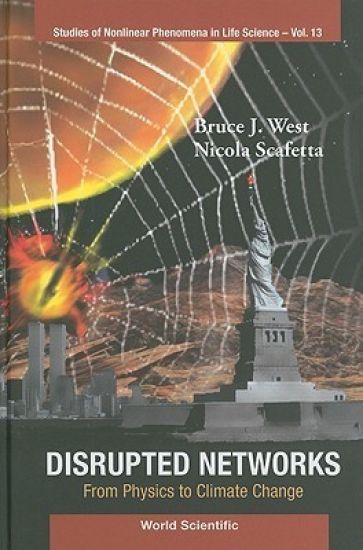
Disrupted Networks: From Physics To Climate Change

Disrupted Networks: From Physics To Climate Change

Bruce J West; Nicola Scafetta

World Scientific Publishing Co Pte Ltd
2010
sidottu
This book provides a lens through which modern society is shown to depend on complex networks for its stability. One way to achieve this understanding is through the development of a new kind of science, one that is not explicitly dependent on the traditional disciplines of biology, economics, physics, sociology and so on; a science of networks. This text reviews, in non-mathematical language, what we know about the development of science in the twenty-first century and how that knowledge influences our world. In addition, it distinguishes the two-tiered science of the twentieth century, based on experiment and theory (data and knowledge) from the three-tiered science of experiment, computation and theory (data, information and knowledge) of the twenty-first century in everything from psychophysics to climate change.This book is unique in that it addresses two parallel lines of argument. The first line is general and intended for a lay audience, but one that is scientifically sophisticated, explaining how the paradigm of science has been changed to accommodate the computer and large-scale computation. The second line of argument addresses what some consider the seminal scientific problem of climate change. The authors show how a misunderstanding of the change in the scientific paradigm has led to a misunderstanding of complex phenomena in general, and the causes of global warming in particular.
Where Medicine Went Wrong: Rediscovering The Path To Complexity

Where Medicine Went Wrong: Rediscovering The Path To Complexity

Bruce J West

World Scientific Publishing Co Pte Ltd
2006
nidottu
Where Medicine Went Wrong explores how the idea of an average value has been misapplied to medical phenomena, distorted understanding and lead to flawed medical decisions. Through new insights into the science of complexity, traditional physiology is replaced with fractal physiology, in which variability is more indicative of health than is an average. The capricious nature of physiological systems is made conceptually manageable by smoothing over fluctuations and thinking in terms of averages. But these variations in such aspects as heart rate, breathing and walking are much more susceptible to the early influence of disease than are averages.It may be useful to quote from the late Stephen Jay Gould's book Full House on the errant nature of averages: “… our culture encodes a strong bias either to neglect or ignore variation. We tend to focus instead on measures of central tendency, and as a result we make some terrible mistakes, often with considerable practical import.” Dr West has quantified this observation and make it useful for the diagnosis of disease.
Biodynamics

Biodynamics

Bruce J. West; Lori A. Griffin

John Wiley Sons Inc
2004
sidottu
You can never step in the same river twice, goes the old adage of philosophy. An observation on the transitory nature of fluids in motion, this saying also describes the endless variations researchers face when studying human movement. Understanding these biodynamics–why the wirewalker doesn’t fall–requires a grasp of the constant fluctuations and fine tunings which maintain balance in the complex, fluid system of human locomotion. Taking a comprehensive approach to the phenomenon of locomotion, Biodynamics: Why the Wirewalker Doesn’t Fall integrates physical laws and principles with concepts of fractals, chaos, and randomness. In so doing, it formulates a description of both the large-scale, smooth aspects of locomotion and the more minute, randomized mechanisms of this physiological process. Ideal for beginners in this subject, Biodynamics provides an elegant explanation without assuming the reader’s understanding of complex physical principles or mathematical equations. Chapter topics include: *Dimensions, measurement, and scaling *Mechanics and dynamics *Biometrics *Conservation of momentum *Biomechanics *Bioelectricity *Bioenergetics *Fluid mechanics and dynamics *Data analysis *Biostatistics Packed with problem sets, examples, and original line drawings, Biodynamics is an invaluable text for advanced undergraduates, graduate students, and instructors in medicine, biology, physiology, biophysics, and bioengineering.
Lure Of Modern Science, The: Fractal Thinking

Lure Of Modern Science, The: Fractal Thinking

Bill Deering; Bruce J West

World Scientific Publishing Co Pte Ltd
1995
sidottu
The authors describe mostly in non-technical language the development of a new scientific paradigm based on nonlinear deterministic dynamics and fractal geometry. The concepts from these two mathematical disciplines are interwoven with data from the physical, social and life sciences. In this way rather sophisticated mathematical concepts are made accessible through experimental data from various disciplines, and the formalism is relegated to appendices. It is shown that the complexity of natural and social phenomena invariably lead to inverse power law distributions, both in terms of probabilities and spectra. This book tries to show how to think differently about familiar phenomena, such as why the bell-shape curve ought not to be used in teaching or in the characterization of such complex phenomena as intelligence.
Fractal Physiology And Chaos In Medicine

Fractal Physiology And Chaos In Medicine

Bruce J West

World Scientific Publishing Co Pte Ltd
1990
sidottu
This book discusses the application of the concepts of fractals and chaos to biomedical phenomena. In particular, it argues against the outdated notion of homeostasis; using biomedical data sets and modern mathematical concepts, the author attempts to convince the reader that life is at least a homeodynamic process with multiple states — each being capable of survival. Although relying heavily on the new mathematical ideas, the author has attempted to make the book self-contained. The mathematics is developed in a biological context and mathematical formulation for its own sake is avoided. In this book, the phenomena to be explained motivate the mathematical development rather than the other way round.
Fractal Physiology And Chaos In Medicine

Fractal Physiology And Chaos In Medicine

Bruce J West

World Scientific Publishing Co Pte Ltd
1990
nidottu
This book discusses the application of the concepts of fractals and chaos to biomedical phenomena. In particular, it argues against the outdated notion of homeostasis; using biomedical data sets and modern mathematical concepts, the author attempts to convince the reader that life is at least a homeodynamic process with multiple states — each being capable of survival. Although relying heavily on the new mathematical ideas, the author has attempted to make the book self-contained. The mathematics is developed in a biological context and mathematical formulation for its own sake is avoided. In this book, the phenomena to be explained motivate the mathematical development rather than the other way round.
An Essay on the Importance of Being Nonlinear

An Essay on the Importance of Being Nonlinear

Bruce J. West

Springer-Verlag Berlin and Heidelberg GmbH Co. K
1985
nidottu
One of my favorite quotes is from a letter of Charles Darwin (1887): "I have long discovered that geologists never read each other's works, and that the only object in writing a book is proof of earnestness, and that you do not form your opinions without undergoing labour of some kind. " It is not clear if this private opinion of Darwin was one that he held to be absolutely true, or was one of those opinions that, as with most of us, coincides with our "bad days," but is replaced with a more optimistic view on our "good days. " I hold the sense of the statement to be true in general, but not with regard to scientists never reading each other's work. Even if that were true however, the present essay. would still have been written as a proof of earnestness. This essay outlines my personal view of how nonlinear mathematics may be of value in formulating models outside the physical sciences. This perspective has developed over a number of years during which time I have repeatedly been amazed at how an "accepted" model would fail to faithfully characterize the full range of avail­ able data because of its implicit or explicit dependence on linear concepts. This essay is intended to demonstrate how linear ideas have come to dominate and therefore limit a scientist's ability to understand any given class of phenomena.