Kirjojen hintavertailu. Mukana 12 657 676 kirjaa ja 12 kauppaa.

Kirjailija

Bruce Murray

Kirjat ja teokset yhdessä paikassa: 7 kirjaa, julkaisuja vuosilta 1973-2022, suosituimpien joukossa Journey into Space: The First Thirty Years of Space Exploration. Vertaile teosten hintoja ja tarkista saatavuus suomalaisista kirjakaupoista.

7 kirjaa

Kirjojen julkaisuhaarukka 1973-2022.

WITS: the Early Years

WITS: the Early Years

Bruce Murray; Keith Breckenridge

WITS UNIVERSITY PRESS
2022
pokkari
WITS: The Early Years is a history of the University up to 1939. First established in 1922, the University of the Witwatersrand, Johannesburg developed out of the South African School of Mines in Kimberley circa 1896. Examining the historical foundations, the struggle to establish a university in Johannesburg, and the progress of the University in the two decades prior to World War II, historian Bruce Murray captures the quality and texture of life in the early years of Wits University and the personalities who enlivened it and contributed to its growth. Particular attention is given to the wider issues and the challenges which faced Wits in its formative years. The book examines the role Wits came to occupy as a major centre of liberal thought and criticism in South Africa, its contribution to the development of the professions of the country, the relationship of its research to the wider society, and its attempts to grapple with a range of peculiarly South African problems, such as the admission of black students to the University and the relations of English- and Afrikaans-speaking white students within it. This edition of WITS: The Early Years is republished in the University's centenary year with a preface by Keith Breckenridge, who writes, 'In the republication of Murray's two volume history of Wits, readers have an opportunity to explore the often dramatic and contested story of this university … Murray produced an intimate, almost scandalous intellectual history of the institution that served as his home for practically half a century.'
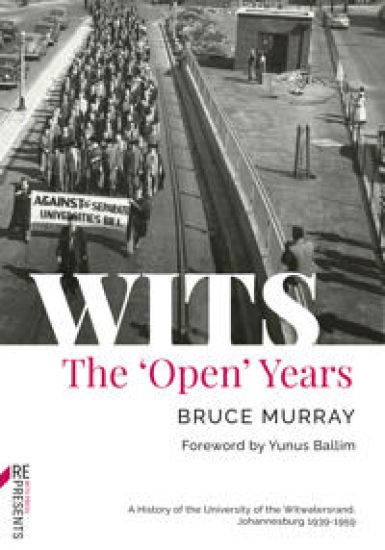
WITS: the 'Open' Years

WITS: the 'Open' Years

Bruce Murray; Yunus Ballim

WITS UNIVERSITY PRESS
2022
pokkari
In the period between the outbreak of World War II in 1939 and the enactment of university apartheid by the Nationalist Government in 1959, the University of the Witwatersrand, Johannesburg (Wits) developed as an 'open university', admitting students of all races. This, the second volume of the history of Wits by historian Bruce Murray, has as its central theme the process by which Wits became 'open', the compromises this process entailed, and the defence the University mounted to preserve its 'open' status in the face of the challenges posed by the Nationalist Government. The University's institutional autonomy is highlighted by Yunus Ballim in his preface to the centenary edition of WITS: The 'Open' Years. He writes: 'The emerging posture of a university willing to rise in defence of academic freedom was important because this was to become infused into the institutional culture of Wits.' The book looks at the University's role in South Africa's war effort, its contribution to the education of ex-volunteers after the war, its leading role in training job-seeking professionals required by a rapidly expanding economy, and the rise of research and postgraduate study. Students feature prominently through their political activities, the flourishing of a student intelligentsia, the heyday of the Remember and Give (Rag) parade, rugby intervarsity, and the stunning success of Wits sportsmen and women. WITS: The 'Open' Years paints a vivid picture of the range of personalities who enlivened the campus – among them some well-known figures in the new South Africa. The book includes chapters by Alf Stadler, who was Professor of Political Studies at Wits and the author of The Political Economy of Modern South Africa, and Jonty Winch, former Sports Officer at Wits and the author of Wits Sport.
Piau

Piau

Bruce Murray; Anne Murray

Dundurn Group Ltd
2017
pokkari
A glimpse into the life of Acadian folk hero Pierre Belliveau, known as Piau, who led his people into exile during the 1755 expulsion of the Acadians.Acadian leader Pierre Belliveau, known as Piau, led hundreds of Acadians into the wilderness to escape the Acadian Expulsion. He vowed to lead them to the Promised Land, where they could live without fear of deportation. Over the years he became a prisoner of war, was deported to Boston, and built a castle before finally leading his people to Memramcook, New Brunswick, the Promised Land. This historical novel, based on a true story, explores the armed and quiet resistance of the Acadian people and the Acadian figure who dedicated his life to securing the safety and well-being of his people. Told by a direct descendant of Pierre Belliveau, Bruce Murray, it is a story of suffering, courage, and hope.
Film and the German Left in the Weimar Republic

Film and the German Left in the Weimar Republic

Bruce Murray

University of Texas Press
1990
pokkari
The Weimar Republic of Germany, covering the post-World War I period of civil and governmental strife, witnessed a great struggle among a variety of ideologies, a struggle for which the arts provided one important arena. Leftist individuals and organizations critiqued mainstream art production and attempted to counter what they perceived as its conservative-to-reactionary influence on public opinion. In this groundbreaking study, Bruce Murray focuses on the leftist counter-current in Weimar cinema, offering an alternative critical approach to the traditional one of close readings of the classical films. Beginning with a brief review of pre-Weimar cinema (1896-1918), he analyzes the film activity of the Social Democratic Party, the German Communists, and independent leftists in the Weimar era. Leftist filmmakers, journalists, and commentators, who in many cases contributed significantly to marginal leftist as well as mainstream cinema, have, until now, received little scholarly attention. Drawing on exhaustive archival research and personal interviews, Murray shows how the plurality of aesthetic models represented in the work of individuals who participated in leftist experiments with cinema in the 1920S collapsed as Germany underwent the transition from parliamentary democracy to fascist dictatorship. He suggests that leftists shared responsibility for that collapse and asserts the value of such insights for those who contemplate alternatives to institutional forms of cinematic discourse today.
Flight to Mercury

Flight to Mercury

Bruce Murray; Eric Burgess

Columbia University Press
1977
sidottu
Documents the challenges and the social, political, and economic factors involved in the planning and technological achievement of the Mariner 10 mission, and features more than one hundred high-resolution photographs of the surface of Mercury.