Kirjojen hintavertailu. Mukana 12 595 353 kirjaa ja 12 kauppaa.

Kirjailija

Bruce Sterling

Kirjat ja teokset yhdessä paikassa: 21 kirjaa, julkaisuja vuosilta 1996-2026, suosituimpien joukossa Late Harvest. Vertaile teosten hintoja ja tarkista saatavuus suomalaisista kirjakaupoista.

21 kirjaa

Kirjojen julkaisuhaarukka 1996-2026.

Late Harvest

Late Harvest

Claude D'Anthenaise; William L. Fox; Adam Duncan Harris; Joanne Northrup; Snaebjornsdottir Wilson; Bruce Sterling; David B Walker

Hirmer Verlag
2015
sidottu
Late Harvest juxtaposes contemporary art made with taxidermy with historically significant wildlife paintin gs, resulting in intriguing parallels and startling aesthetic aesthetic contrasts. The publication seeks to simultaneously confirm — through historically - significant wildlife paintings — and subvert — through contemporary art and photography — viewers’ preconcepti ons of the place of animals in culture. The richly illustrated catalogue will feature artists as: Richard Ansdell, David Brooks, George Browne, Berlinde De Bruyckere, Petah Coyne, Raymond Ching, Kate Clark, Wim Delvoye, Mark Dion, Elmgreen & Dragset, Carle e Fernandez, Richard Friese, François Furet, Nicholas Galanin, George Bouverie Goddard, Damien Hirst, William Hollywood, Idiots (Afke Golsteijn and Floris Bakker), Alfred Kowalski, Robert Kuhn , Wilhelm Kuhnert, Bruno Liljefors, Polly Morgan, John Newsom, T im Noble and Sue Webster, Walter Robinson, George Rotig, Carl Rungius, Yinka Shonibare MBE, David Shrigley, Snæbjörnsdóttir/Wilson, Amy Stein, Archibald Thorburn, Mary Tsiongas, Joseph Wolf, Brigitte Zieger, Andrew Zuckerman The exhibition Late Harvest is organized by the Nevada Museum of Art in consultation with the National Museum of Wildlife Art. It is curated by JoAnne Northrup, Director of Contemporary Art Initiatives, together with consulting curator Adam Duncan Harris, Ph.D., Petersen Curator of Art & Research, National Museum of Wildlife Art.
Distraction

Distraction

Bruce Sterling

ORION PUBLISHING CO
2026
pokkari
"This is a very smart, very funny book" - Locus "Enthralling and subversive" - SF Commentary "An excellent piece of future-gazing" - Amazon Reviewer A Dutch Cold War is in full swing. The US is a shadow of its former self - its infrastructure is failing, and nomadic tribes roam freely among the states, living by no rules but their own. Oscar Valpariso - always impeccably dressed - is only half human, but he's master political strategist to potentially the next president. If he can straighten out his love life, gain control of a high-tech scientific facility, and solve a worldwide crisis that only he's noticed, America should be ripe for the taking . . .
World Brain

World Brain

H.G. Wells; Bruce Sterling

MIT Press
2021
nidottu
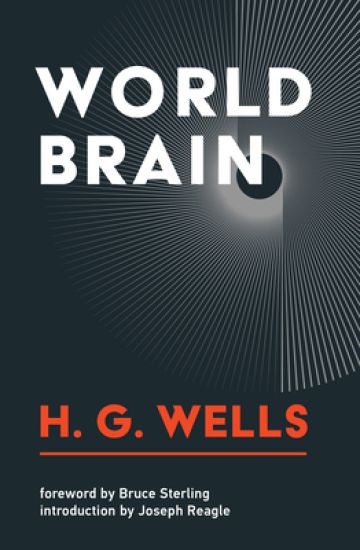
In 1937, H. G. Wells proposed a predigital, freely available World Encyclopedia to represent a civilization-saving World Brain. In a series of talks and essays in 1937, H. G. Wells proselytized for what he called a World Brain, as manifested in a World Encyclopedia--a repository of scientifically established knowledge--that would spread enlightenment around the world and lead to world peace. Wells, known to readers today as the author of The War of the Worlds and other science fiction classics, was imagining something like a predigital Wikipedia. The World Encyclopedia would provide a summary of verified reality (in about forty volumes); it would be widely available, free of copyright, and utilize the latest technology. Of course, as Bruce Sterling points out in the foreword to this edition of Wells's work, the World Brain didn't happen; the internet did. And yet, Wells anticipated aspects of the internet, envisioning the World Brain as a technical system of networked knowledge (in Sterling's words, a hypothetical super-gadget). Wells's optimism about the power of information might strike readers today as na vely utopian, but possibly also inspirational.
Robot Artists & Black Swans

Robot Artists & Black Swans

Bruce Sterling; Bruno Argento

Tachyon Publications
2021
sidottu
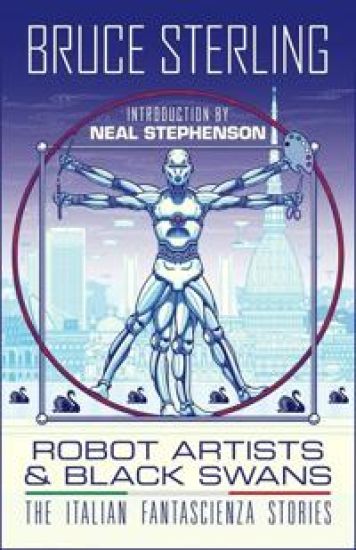
The Godfather of Cyberpunk has emerged in this new collection of Italian-themed fantasy and science-fiction stories. Bruce Sterling now introduces us to his alter ego: Bruno Argento, the preeminent author of fantascienza. Sterling, writing as Argento, skillfully combines cutting-edge technology with art, mythology, and history. "It's as if Sterling is the only writer paying attention."--Locus In the Esoteric City, a Turinese businessman's act of necromancy is catching up with him. The Black Swan, a rogue hacker, programs his way into alternate versions of Italy. A Parthenopean assassin awaits his destiny in the arms of a two-headed noblewoman. Infuriating to both artists and scientists, a robot wheelchair makes uncategorizable creations. Bruno Argento is the acknowledged master of Italian science fiction. Yet that same popular fantascienza author also is known in America--as Bruce Sterling. In Robot Artists and Black Swans, we present the first collection of their uniquely visionary Italian-themed fiction, including tales never before published in English.
OVEREXPOSED

OVEREXPOSED

Paolo Cirio; Bruce Sterling; Nato Thompson

Lulu.com
2019
nidottu
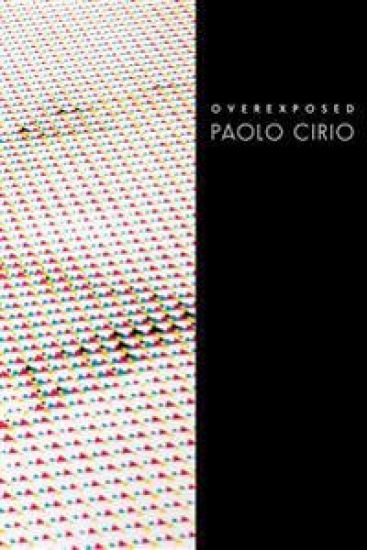
OVEREXPOSED is composed of a series of nine unauthorized photos of high-ranking U.S. intelligence officials of the NSA, CIA, NI, and FBI who were related to Edward Snowden's revelations. The appropriated material was found by monitoring photos and selfies published on Internet public platforms without the control of the officials. The images were reproduced with the street art HD Stencils technique, and they were disseminated onto public walls throughout major cities. The artwork satirizes the era of ubiquitous surveillance and overly-mediated political personas by exposing the officials accountable for secretive mass surveillance and over-classified intelligence programs. New modes of circulation, appropriation, contextualization, and technical reproduction of images are integrated into this artwork.
2001: An Odyssey In Words

2001: An Odyssey In Words

Alastair Reynolds; Bruce Sterling; Becky Chambers; Paul McAuley; Ian McDonald; Jane Rogers; Gwyneth Jones; Adrian Tchaikovsky; Yoon Ha Lee

NewCon Press
2018
nidottu
Produced to honour the centenary of Sir Arthur C. Clarke's birth, this anthology acts as a fund raiser for the Arthur C. Clarke Award.Original SF stories of precisely 2001 words from some of the biggest names in science fiction, including 10 winners of the Clarke Award and 13 authors who have been shortlisted, as well as non-fiction from thrice-winner China Mi ville and former judge Neil Gaiman.Contents: Introduction Golgotha - Dave Hutchinson The Monoliths of Mars - Paul McAuley Murmuration - Jane Rogers Ouroboros - Ian R MacLeod The Escape Hatch - Matthew De Abaitua Childhood's Friend - Rachel Pollack Takes from the White Hart - Bruce Sterling Your Death, Your Way, 100% Satisfaction Guaranteed - Emma Newman Distraction - Gwyneth Jones Dancers - Allen Stroud Entropy War - Yoon Ha Lee The Ontologist - Liz Williams Waiting in the Sky - Tom Hunter The Collectors - Adrian Tchaikovsky I Saw Three Ships - Phillip Mann Before They Left - Colin Greenland Drawn From the Eye - Jeff Noon Roads of Silver, Paths of Gold - Emmi It ranta The Fugue - Stephanie Holman Memories of a Table - Chris Beckett Child of Ours - Claire North Would-Be A.I., Tell Us a Tale #241: Sell 'em Back in Time by Hali Hallison - Ian Watson Last Contact - Becky Chambers The Final Fable - Ian Whates Ten Landscapes of Nili Fossae - Ian McDonald Child - Adam Roberts Providence - Alastair Reynolds 2001: A Space Prosthesis - The Extensions of Man - Andrew M. Butler (non-fiction) On Judging The Clarke Award - Neil Gaiman (non-fiction) Once More on the 3rd Law - China Mi ville (non-fiction)
Paid

Paid

Bruce Sterling

MIT Press
2018
pokkari
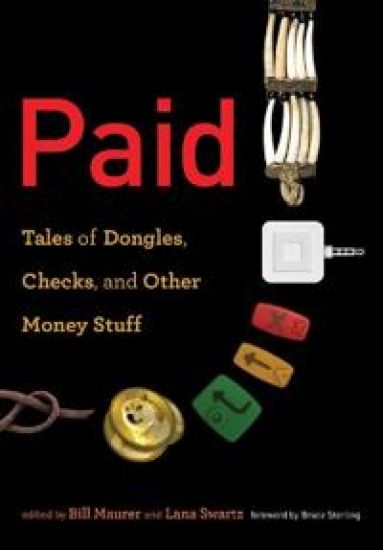
Stories about objects left in the wake of transactions, from cryptocurrencies to leaf-imprinted banknotes to records kept with knotted string.Museums are full of the coins, notes, beads, shells, stones, and other objects people have exchanged for millennia. But what about the debris, the things that allow a transaction to take place and are left in its wake? How would a museum go about curating our scrawls on electronic keypads, the receipts wadded in our wallets, that vast information infrastructure that runs the card networks? This book is a catalog for a museum exhibition that never happened. It offers a series of short essays, paired with striking images, on these often ephemeral, invisible, or unnoticed transactional objects-money stuff.Although we've been told for years that we're heading toward total cashlessness, payment is increasingly dependent on things. Consider, for example, the dongle, a clever gizmo that processes card payments by turning information from a card's magnetic stripe into audio information that can be read by a smart phone's headphone jack. Or dogecoin, a meme of a smiling, bewildered dog's interior monologue that fueled a virtual currency similar to Bitcoin. Or go further back and contemplate the paper currency printed with leaves by Benjamin Franklin to foil counterfeiters, or khipu, Incan records kept in knotted string.Paid's authors describe these payment-adjacent objects so engagingly that for a moment, financial leftovers seem more interesting than finance. Paid encourages us to take a moment to look at the nuts and bolts of our everyday transactions by looking at the stuff that surrounds them.ContributorsBernardo Batiz-Lazo, Maria Bezaitis, Finn Brunton, Lynn H. Gamble, David Graeber, Jane I. Guyer, Keith Hart, Sarah Jeong, Alexandra Lippman, Julien Mailland, Scott Mainwaring, Bill Maurer, Taylor C. Nelms, Rachel O'Dwyer, Michael Palm, Lisa Servon, David L. Stearns, Bruce Sterling, Lana Swartz, Whitney Anne Trettien, Gary Urton
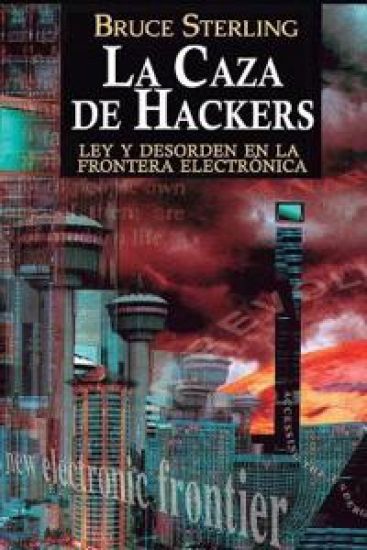
CAZA DE HACKERS,LA

CAZA DE HACKERS,LA

BRUCE STERLING

Grupo Ajec
2017
nidottu
En 1990, la Ca da del Sistema del d a de Martin Luther King, que afecto a la compa a telef nica AT&T y dej sin comunicaciones a millones de norteamericanos, desencaden la persecuci n y detenci n de decenas de hackers, acusados de causar la hundimiento, que hasta ese momento era ignorados por la polic a y las leyes. Bruce Sterling, autor de novelas como "El fuego sagrado", "Cismatrix" o "La M quina Diferencial", y considerado uno de los mayores expertos en el g nero del ciberpunk, nos ofrece en "La Caza de Hackers; Ley y Desorden en la Frontera Electr nica" un apasionante reportaje desde el principio de la era de internet, los ordenadores personales, y la frontera electr nica partiendo de la base de ese hecho inaudito. Con una entretenida prosa novelesca, Sterling nos lleva a conocer a todos los implicados en el asunto, desde los primeros activistas de internet hasta los polic as encargados del caso, que ciment los pilares de lo que hoy es la libertad de expresi n en Internet. 25 a os despu s de los sucesos del d a de Martin King, "La Caza de Hackers", se ha convertido en un libro de culto y un documento hist rico imprescindible para comprender y entender la transformaci n y el impacto de las nuevas comunicaciones en el Siglo XXI
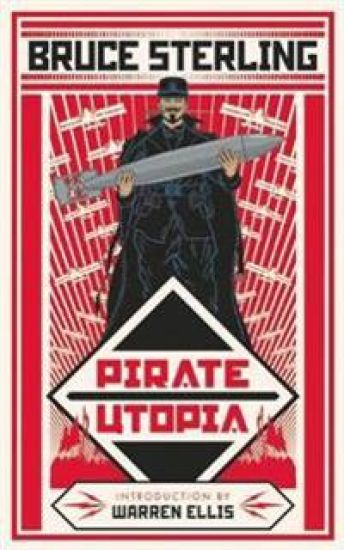
Pirate Utopia

Pirate Utopia

Bruce Sterling

Tachyon Publications
2016
sidottu
Original introduction by Warren Ellis, author of Transmetropolitan and Gun Machine Who are these bold rebels pillaging their European neighbors in the name of revolution? The Futurists! Utopian pirate warriors of the diminutive Regency of Carnaro, scourge of the Adriatic Sea. Mortal enemies of communists, capitalists, and even fascists (to whom they are not entirely unsympathetic). The ambitious Soldier-Citizens of Carnaro are led by a brilliant and passionate coterie of the perhaps insane. Lorenzo Secondari, World War I veteran, engineering genius, and leader of Croatian raiders. Frau Piffer, Syndicalist manufacturer of torpedos at a factory run by and for women. The Ace of Hearts, a dashing Milanese aristocrat, spymaster, and tactical savant. And the Prophet, a seductive warrior-poet who leads via free love and military ruthlessness. Fresh off of a worldwide demonstration of their might, can the Futurists engage the aid of sinister American traitors and establish global domination?
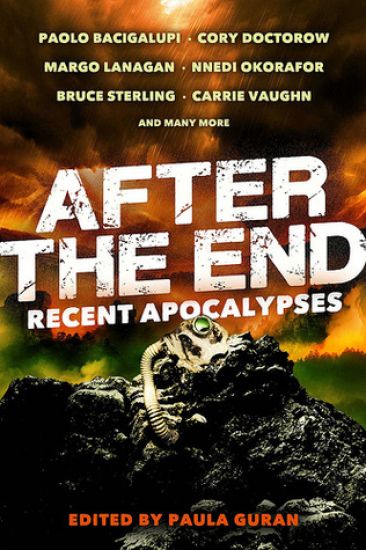
After the End: Recent Apocalypses

After the End: Recent Apocalypses

Paolo Bacigalupi; Cory Doctorow; Margo Lanagan; Nnedi Okorafor; Bruce Sterling; Carrie Vaughn

Prime Books
2013
nidottu
From the Sumerian epic of Gilgamesh to Norse prophecies of Ragnarok to the Revelations of Saint John to Cormac McCarthy’s The Road, and any number of fictional zombie Armageddons and the dystopic world of The Hunger Games, we have always wondered what will happen after the world as we know it ends. No matter what the doomsday scenario — cataclysmic climate change, political chaos, societal collapse, nuclear war, pestilence, or so many other dreaded variations — we inevitably believe that even though the world perishes, some portion of humankind will live on. Such stories involve death and disaster, but they are also tales of rebirth and survival. Grim or triumphant, these outstanding, post-apocalyptic stories selected from the best of those published in the tumultuous last decade allow us to consider what life will be like after the end.
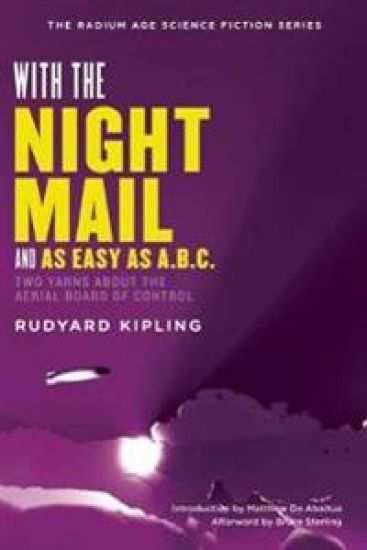
With the Night Mail

With the Night Mail

Rudyard Kipling; Bruce Sterling

Red Lemonade
2012
pokkari
"SHE: Do you like Kipling? HE: I don't know, I've never Kippled!" If you've never read Rudyard Kipling's science fiction, then you've never Kippled. Having achieved international fame with The Jungle Book, Captains Courageous, Kim, and his Just So Stories, in 1905 Kipling serialized a thrilling science fiction novella, With the Night Mail: A Story of 2000 A.D, in which the reader learns -- while following the exploits of an intercontinental mail dirigible battling foul weather -- about a planet-wide Aerial Board of Control, which enforces a rigid system of command and control not only in the skies (which are increasingly crowded with every manner of zeppelin) but in world affairs too. Kipling got so excited by his own utopian vision that when the story first appeared in McClure's Magazine, it was accompanied by phony advertisements for dirigible and aeronautical products that he'd written, plus other ersatz magazine clippings. In one of these latter, we read that the Aerial Board of Control had effectively outlawed war in 1967 -- by "reserving to every nation the right of waging war so long as it does not interfere with traffic and all that that implies." This turns out to imply a great deal! In Kipling's 1912 followup story, "As Easy As A.B.C.," which is set 65 years after With the Night Mail, we learn just how complete the Aerial Board's control is over the social and economic affairs of every nation. When a mob of disgruntled "Serviles" in the District of Northern Illinois demands the return of democracy, the A.B.C. sends a team of troubleshooters (from England, Russia, Japan, and Italy) and a fleet of 200 zeppelins to "take such steps as might be necessary for the resumption of traffic and all that that implies." Democracy, it seems, is an impediment to the smooth flow of international commerce -- so it was abolished during the 20th century, along with newspapers. What happens when the A.B.C. troubleshooters confront the democrats? Trouble!
Difference Engine

Difference Engine

William Gibson; Bruce Sterling

Orion Publishing Co
2011
pokkari
'A visionary steam-powered heavy metal fantasy. Gibson and Sterling create a high-Victorian virtual reality of extraordinary richness and detail' Ridley Scott, creator of ALIEN
We

We

Yevgeny Zamyatin; Bruce Sterling

Modern Library Inc
2006
pokkari
D-503, a mathematician in the one thousandth year of the One State and the chief architect of the Integral, threatens national security when he falls in love with the beautiful I-330 and rediscovers the meaning of passion and the soul, in a new translation of the futuristic Russian novel. Reprint. 20,000 first printing.
Shaping Things

Shaping Things

Bruce Sterling

MIT Press
2005
pokkari
A guide to the next great wave of technology-an era of objects so programmable that they can be regarded as material instantiations of an immaterial system."Shaping Things is about created objects and the environment, which is to say, it's about everything," writes Bruce Sterling in this addition to the Mediawork Pamphlet series. He adds: "Seen from sufficient distance, this is a small topic."Sterling offers a brilliant, often hilarious history of shaped things. We have moved from an age of artifacts, made by hand, through complex machines, to the current era of "gizmos." New forms of design and manufacture are appearing that lack historical precedent, he writes; but the production methods, using archaic forms of energy and materials that are finite and toxic, are not sustainable. The future will see a new kind of object; we have the primitive forms of them now in our pockets and briefcases: user-alterable, baroquely multi-featured, and programmable, that will be sustainable, enhanceable, and uniquely identifiable. Sterling coins the term "spime" for them, these future-manufactured objects with informational support so extensive and rich that they are regarded as material instantiations of an immaterial system. Spimes are designed on screens, fabricated by digital means, and precisely tracked through space and time. They are made of substances that can be folded back into the production stream of future spimes, challenging all of us to become involved in their production. Spimes are coming, says Sterling. We will need these objects in order to live; we won't be able to surrender their advantages without awful consequences.The vision of Shaping Things is given material form by the intricate design of Lorraine Wild. Shaping Things is for designers and thinkers, engineers and scientists, entrepreneurs and financiers; and anyone who wants to understand and be part of the process of technosocial transformation.
The Zenith Angle

The Zenith Angle

Bruce Sterling

Del Rey Books
2005
pokkari
"Gleeful, shrewd, speculative, cynical, closely observed . . . The Zenith Angle offers wisdom and solace, thrills and laughter."--The Washington Post "Compelling and important . . . A darkly comic fable of info-war, the black budget, ber-geek idealism, and the politics of Homeland Insecurity."--William Gibson, author of Pattern Recognition Pioneering computer wizard Derek "Van" Vandeveer has been living extra-large as a VP for a booming Internet company. But the September 11 attacks on America change everything. Recruited as the key member of an elite federal computer-security team, Van enters the labyrinthine trenches of the Washington intelligence community. His special genius is needed to debug the software glitch in America's most crucial KH-13 satellite, capable of detecting terrorist hotbeds worldwide. But the problem is much deeper. Now Van must make the unlikely leap from scientist to spy, team up with a ruthlessly resourceful ex-Special Forces commando, and root out an unknown enemy--one with access to a weapon of untold destructive power. "Great fun . . . A cyberthriller of 21st-century technologies that] peeps wittily behind the national security scenes of a modern superpower."--New Scientist "A comedic thriller for the homeland security era."--Entertainment Weekly
A Place So Foreign and Eight More

A Place So Foreign and Eight More

Bruce Sterling; Cory Doctorow

Running Press,U.S.
2003
pokkari
A collection of exciting new stories from one of the young guns of modern science fiction encompasses a wide range of topics from pop culture to utopian future visions, nerd pride, and trash, in such works as "Craphound," "All Day Sucker," "Shadow of the Mothaship," and "Return to Pleasure Island." Original.