Kirjojen hintavertailu. Mukana 12 453 482 kirjaa ja 12 kauppaa.

Kirjailija

Bruce W. Turnbull

Kirjat ja teokset yhdessä paikassa: 2 kirjaa, julkaisuja vuosilta 1999-2026, suosituimpien joukossa Group Sequential Methods with Applications to Clinical Trials. Vertaile teosten hintoja ja tarkista saatavuus suomalaisista kirjakaupoista.

2 kirjaa

Kirjojen julkaisuhaarukka 1999-2026.

Group Sequential Methods with Applications to Clinical Trials

Group Sequential Methods with Applications to Clinical Trials

Christopher Jennison; Bruce W. Turnbull

CRC Press Inc
1999
sidottu
Group sequential methods answer the needs of clinical trial monitoring committees who must assess the data available at an interim analysis. These interim results may provide grounds for terminating the study-effectively reducing costs-or may benefit the general patient population by allowing early dissemination of its findings. Group sequential methods provide a means to balance the ethical and financial advantages of stopping a study early against the risk of an incorrect conclusion. Group Sequential Methods with Applications to Clinical Trials describes group sequential stopping rules designed to reduce average study length and control Type I and II error probabilities. The authors present one-sided and two-sided tests, introduce several families of group sequential tests, and explain how to choose the most appropriate test and interim analysis schedule. Their topics include placebo-controlled randomized trials, bio-equivalence testing, crossover and longitudinal studies, and linear and generalized linear models. Research in group sequential analysis has progressed rapidly over the past 20 years. Group Sequential Methods with Applications to Clinical Trials surveys and extends current methods for planning and conducting interim analyses. It provides straightforward descriptions of group sequential hypothesis tests in a form suited for direct application to a wide variety of clinical trials. Medical statisticians engaged in any investigations planned with interim analyses will find this book a useful and important tool.
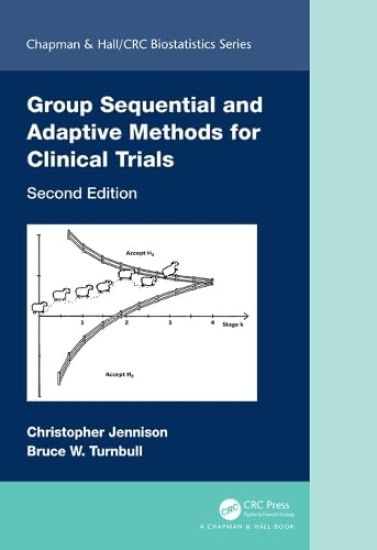
Group Sequential and Adaptive Methods for Clinical Trials

Group Sequential and Adaptive Methods for Clinical Trials

Christopher Jennison; Bruce W. Turnbull

Chapman Hall/CRC
2026
sidottu
In clinical trials, monitoring accumulating data at regular intervals is essential for balancing ethical and financial considerations against scientific rigor. This comprehensive second edition reflects the remarkable evolution in adaptive clinical trial methodology over the past two decades. Since publication of the first edition, these approaches have transformed from theoretical concepts to widely accepted practices, now endorsed by regulatory authorities, including formal FDA guidance.Features:Eleven entirely new chapters, including optimal design construction, delayed "pipeline" data accommodation, and multiple comparison proceduresEight dedicated chapters on adaptive methods including sample size re-assessment, seamless Phase II/III trials, multi-arm multi-stage trials, and enrichment designsExact methods for binary and Poisson data with applications to vaccine trialsExpanded discussion of binding versus non-binding futility boundaries for enhanced decision-makingA chapter with a thoroughly updated review of Bayesian approaches to sequential trial design and analysisIncorporates response-adaptive treatment assignment in group sequential designsPractical computational methods and software guidance for implementing the techniquesThis definitive resource serves statisticians, clinical researchers, pharmaceutical scientists, and regulatory professionals involved in clinical trial design and analysis. The text balances theoretical foundations with practical implementation guidance, making it invaluable for both experienced practitioners and those new to adaptive trial methodology. With twice the content of the first edition, this volume provides the comprehensive understanding needed to design more efficient, ethical, and scientifically rigorous clinical trials, ultimately accelerating the delivery of effective treatments to patients.