Kirjojen hintavertailu. Mukana 12 595 353 kirjaa ja 12 kauppaa.
Kirjailija
Bryan D. Jones
Kirjat ja teokset yhdessä paikassa: 17 kirjaa, julkaisuja vuosilta 1985-2019, suosituimpien joukossa The Great Broadening. Vertaile teosten hintoja ja tarkista saatavuus suomalaisista kirjakaupoista.
Was 1992 a realigning election? Did the midterm elections of 1994 realign the realignment? Will 1996 carry the United States forward on yet another changed trajectory? In this volume of original essays, leading political scientists examine key components of the American agenda and assess the current administration's position in light of historical
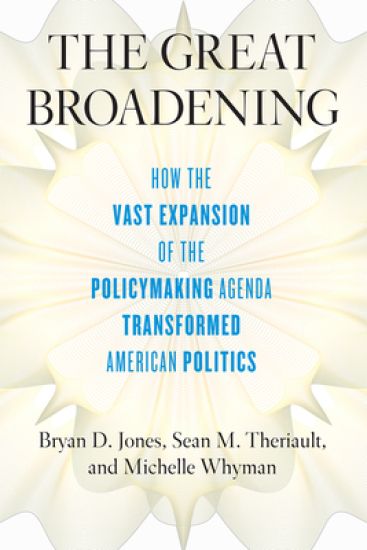
Beginning in the late 1950s and continuing through the 1970s, the United States experienced a vast expansion in national policy making. During this period, the federal government extended its scope into policy arenas previously left to civil society or state and local governments. With The Great Broadening, Bryan D. Jones, Sean M. Theriault, and Michelle Whyman examine in detail the causes, internal dynamics, and consequences of this extended burst of activity. They argue that the broadening of government responsibilities into new policy areas such as health care, civil rights, and gender issues and the increasing depth of existing government programs explain many of the changes in America politics since the 1970s. Increasing government attention to particular issues was motivated by activist groups. In turn, the beneficiaries of the government policies that resulted became supporters of the government’s activity, leading to the broad acceptance of its role. This broadening and deepening of government, however, produced a reaction as groups critical of its activities organized to resist and roll back its growth.
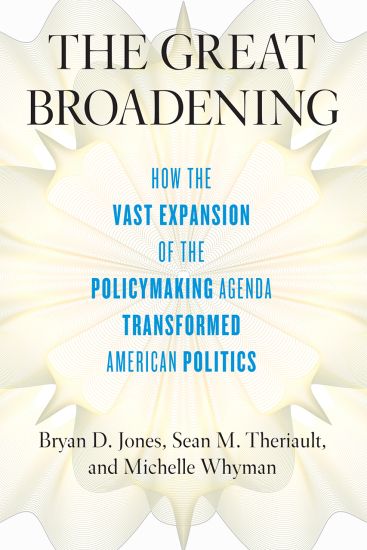
Beginning in the late 1950s and continuing through the 1970s, the United States experienced a vast expansion in national policy making. During this period, the federal government extended its scope into policy arenas previously left to civil society or state and local governments. With The Great Broadening, Bryan D. Jones, Sean M. Theriault, and Michelle Whyman examine in detail the causes, internal dynamics, and consequences of this extended burst of activity. They argue that the broadening of government responsibilities into new policy areas such as health care, civil rights, and gender issues and the increasing depth of existing government programs explain many of the changes in America politics since the 1970s. Increasing government attention to particular issues was motivated by activist groups. In turn, the beneficiaries of the government policies that resulted became supporters of the government's activity, leading to the broad acceptance of its role. This broadening and deepening of government, however, produced a reaction as groups critical of its activities organized to resist and roll back its growth.
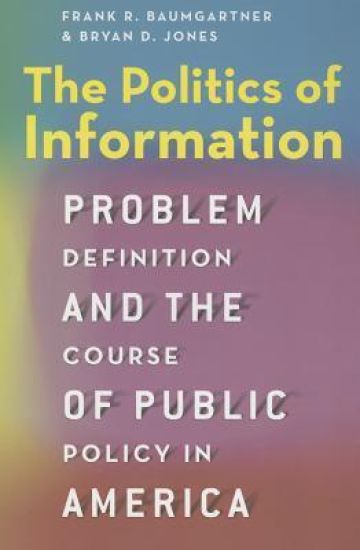
How does the government decide what's a problem and what isn't? Like individuals, Congress is subject to the "paradox of search." If policy makers don't look for problems, they won't find those that need to be addressed. But if they carry out a thorough search, they will almost certainly find new problems-and with the definition of each new problem comes the possibility of creating a program to address it. With The Politics of Attention, leading policy scholars Frank R. Baumgartner and Bryan D. Jones demonstrated the central role attention plays in how governments prioritize problems. Now, with The Politics of Information, they turn the focus to the problem-detection process itself, showing how the growth or contraction of government is closely related to how it searches for information and how, as an organization, it analyzes its findings. Better search processes that incorporate more diverse viewpoints lead to more intensive policy-making activity. Similarly, limiting search processes leads to declines in policy-making. At the same time, the authors find little evidence that the factors usually thought to be responsible for government expansion - partisan control, changes in presidential leadership, and shifts in public opinion - can be systematically related to the patterns they observe.
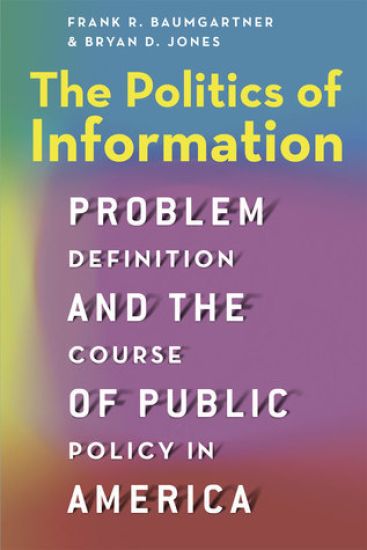
How does the government decide what's a problem and what isn't? Like individuals, Congress is subject to the "paradox of search." If policy makers don't look for problems, they won't find those that need to be addressed. But if they carry out a thorough search, they will almost certainly find new problems-and with the definition of each new problem comes the possibility of creating a program to address it. With The Politics of Attention, leading policy scholars Frank R. Baumgartner and Bryan D. Jones demonstrated the central role attention plays in how governments prioritize problems. Now, with The Politics of Information, they turn the focus to the problem-detection process itself, showing how the growth or contraction of government is closely related to how it searches for information and how, as an organization, it analyzes its findings. Better search processes that incorporate more diverse viewpoints lead to more intensive policy-making activity. Similarly, limiting search processes leads to declines in policy-making. At the same time, the authors find little evidence that the factors usually thought to be responsible for government expansion - partisan control, changes in presidential leadership, and shifts in public opinion - can be systematically related to the patterns they observe.
When "Agendas and Instability in American Politics" appeared fifteen years ago, offering a profoundly original account of how policy issues rise and fall on the national agenda, the "Journal of Politics" predicted that it would 'become a landmark study of public policy making and American politics'. That prediction proved true, and in this long-awaited second edition, Frank R. Baumgartner and Bryan D. Jones refine their influential argument and expand it to illuminate the workings of democracies beyond the United States. The authors retain all the substance of their contention that short-term, single-issue analysis cast public policy too narrowly as the result of cozy and dependable arrangements among politicians, interest groups, and the media. Baumgartner and Jones provide a different interpretation by taking the long view of several issues - including nuclear energy, urban affairs, smoking, and auto safety - to demonstrate that bursts of rapid, unpredictable policy change punctuate the patterns of stability more frequently associated with government. Featuring a new introduction and two additional chapters, this updated edition ensures that their findings will remain a touchstone of policy studies for many years to come.
When "Agendas and Instability in American Politics" appeared fifteen years ago, offering a profoundly original account of how policy issues rise and fall on the national agenda, the "Journal of Politics" predicted that it would 'become a landmark study of public policy making and American politics'. That prediction proved true, and in this long-awaited second edition, Frank R. Baumgartner and Bryan D. Jones refine their influential argument and expand it to illuminate the workings of democracies beyond the United States. The authors retain all the substance of their contention that short-term, single-issue analysis cast public policy too narrowly as the result of cozy and dependable arrangements among politicians, interest groups, and the media. Baumgartner and Jones provide a different interpretation by taking the long view of several issues - including nuclear energy, urban affairs, smoking, and auto safety - to demonstrate that bursts of rapid, unpredictable policy change punctuate the patterns of stability more frequently associated with government. Featuring a new introduction and two additional chapters, this updated edition ensures that their findings will remain a touchstone of policy studies for many years to come.
On any given day, policymakers are required to address a multitude of problems and make decisions about a variety of issues, from the economy and education to health care and defense. This has been true for years, but until now no studies have been conducted on how politicians manage the flood of information from a wide range of sources. How do they interpret and respond to such inundation? Which issues do they pay attention to and why? Bryan D. Jones and Frank R. Baumgartner answer these questions on decision-making processes and prioritization in "The Politics of Attention". Analyzing fifty years of data, Jones and Baumgartner's book is the first study of American politics based on a new information-processing perspective. The authors bring together the allocation of attention and the operation of governing institutions into a single model that traces public policies, public and media attention to them, and governmental decisions across multiple institutions. "The Politics of Attention offers a groundbreaking approach to American politics based on the responses of policymakers to the flow of information. It asks how the system solves, or fails to solve, problems rather than looking to how individual preferences are realized through political action.
The authors of this work contend that it is essential for all important actors in an urban community to join together in a shared vision of what is wrong in their schools and how to fix it, and to pursue that vision strongly and systematically over a long time.
This text draws on work in political science, economics, cognitive science and psychology to offer an innovative theory of how people and organizations adapt to change and why these adaptations do not always work. The author argues that our decision-making capabilities are rational and adaptive, but because our rationality is bounded and our adaptability limited, our actions are not based simply on objective information from our environments. Instead, we overemphasize some factors and neglect others, and our inherited limitations - such as short-term memory capacity - all act to affect our judgement.
This text draws on work in political science, economics, cognitive science and psychology to offer an innovative theory of how people and organizations adapt to change and why these adaptations do not always work. The author argues that our decision-making capabilities are rational and adaptive, but because our rationality is bounded and our adaptability limited, our actions are not based simply on objective information from our environments. Instead, we overemphasize some factors and neglect others, and our inherited limitations - such as short-term memory capacity - all act to affect our judgement.
Was 1992 a realigning election? Did the midterm elections of 1994 realign the realignment? Will 1996 carry the United States forward on yet another changed trajectory? In this volume of original essays, leading political scientists examine key components of the American agenda and assess the current administration's position in light of historical precedents and future trends. Each conclusion is unique, born of a combination of the empirical record and its interpretation, but essays by Bryan Jones and Larry Dodd help to put the wide-ranging views represented here in long-term perspective.
Most models of political decision-making maintain that individual preferences remain relatively constant. Why, then, are there often sudden abrupt changes in public opinion on political issues? Or total reversals in congressional support for specific legislation, as happened with the voting on the Superconducting Supercollider? Bryan D. Jones answers these questions by connecting insights from cognitive science and rational choice theory to political life. Individuals and political systems alike, Jones argues, tend to be attentive to only one issue at a time. Using numerous examples from elections, public-opinion polls, congressional deliberations and bureaucratic decision-making, he shows how shifting attentiveness can and does alter choices and political outcomes - even when underlying preferences remain relatively fixed. An individual, for example, may initially decide to vote for a candidate because of her stand on spending, but change his vote when he learns of her position on abortion, never really balancing the two options.
Most models of political decision-making maintain that individual preferences remain relatively constant. Why, then, are there often sudden abrupt changes in public opinion on political issues? Or total reversals in congressional support for specific legislation, as happened with the voting on the Superconducting Supercollider? Bryan D. Jones answers these questions by connecting insights from cognitive science and rational choice theory to political life. Individuals and political systems alike, Jones argues, tend to be attentive to only one issue at a time. Using numerous examples from elections, public-opinion polls, congressional deliberations and bureaucratic decision-making, he shows how shifting attentiveness can and does alter choices and political outcomes - even when underlying preferences remain relatively fixed. An individual, for example, may initially decide to vote for a candidate because of her stand on spending, but change his vote when he learns of her position on abortion, never really balancing the two options.
In this revised update, the authors have extended and refined their analysis of Detroit-area automakers and political leaders negotiating the selection of new factory sites and the consequent addition of thousands of jobs to the local economy. This analysis utilises the concept of ""solution sets"".