Kirjojen hintavertailu. Mukana 12 266 237 kirjaa ja 12 kauppaa.

Kirjailija

Bryan Frederick

Kirjat ja teokset yhdessä paikassa: 30 kirjaa, julkaisuja vuosilta 2015-2024, suosituimpien joukossa Improving Conflict-Phase Access. Vertaile teosten hintoja ja tarkista saatavuus suomalaisista kirjakaupoista.

30 kirjaa

Kirjojen julkaisuhaarukka 2015-2024.

What Deters and Why

What Deters and Why

Michael J Mazarr; Arthur Chan; Alyssa Demus; Bryan Frederick; Alireza Nader; Stephanie Pezard; Julia A Thompson; Elina Treyger

RAND
2019
nidottu
The challenge of deterring territorial aggression is taking on renewed importance, yet discussion of it has lagged in U.S. military and strategy circles. The authors aim to provide a fresh look, with two primary purposes: to review established concepts about deterrence, and to provide a framework for evaluating the strength of deterrent relationships. They focus on a specific type of deterrence: extended deterrence of interstate aggression.
U.S. Presence and the Incidence of Conflict

U.S. Presence and the Incidence of Conflict

Angela O'Mahony; Miranda Priebe; Bryan Frederick

RAND
2018
nidottu
There is an ongoing debate about whether U.S. military presence brings stability or an increased likelihood of conflict to a region. The authors of this report analyze historical data to assess how U.S. military presence--in particular, U.S. troop presence and military assistance--is associated with the interstate and intrastate conflict behavior of states and nonstate actors.
Religion, Conflict, and Stability in the Former Soviet Union
Despite the growing importance of religion in countries in the former Soviet Union (FSU), the role of religion in conflicts in the region is not well understood. This volume of essays by international scholars and policy experts finds that while religion has not been the source of conflict in the FSU, it has sometimes sustained or intensified it as states and nonstate groups increasingly rely on religion to mobilize their supporters.
The Past, Present, and Future of U.S. Ground Interventions

The Past, Present, and Future of U.S. Ground Interventions

Jennifer Kavanagh; Bryan Frederick; Matthew Povlock

RAND
2018
nidottu
This report uses an original data set of U.S. ground interventions to identify factors that determine where and when the United States is most likely to intervene militarily. The report focuses on interventions into armed conflicts, stability operations, and deterrence missions. It identifies signposts of future interventions that can be used by Army planners and also explores intervention lead time, duration, and resource constraints.
Building Armies, Building Nations

Building Armies, Building Nations

Michael Shurkin; John Gordon; Bryan Frederick

RAND
2018
nidottu
This report explores the relationship between armies and nation-building and argues that U.S.-sponsored Security Force Assistance (SFA) could become more effective by focusing less on force structure, military capabilities, and readiness, and focusing more on ideology and the extent to which a client army complements a host nation's larger nation-building project.
A More Peaceful World?

A More Peaceful World?

Stephen Watts; Bryan Frederick; Jennifer Kavanagh

RAND
2017
nidottu
This report analyzes trends in violent conflict and their implications for defense planning. It presents models that estimate the incidence of violent conflict both within and between countries and projects conflict trends to 2040 under different scenarios. The report concludes that conflict is likely to gradually decline in most regions in most plausible futures, while highlighting early warning indicators of potential increases in conflict.
Assessing Russian Reactions to U.S. and NATO Posture Enhancements

Assessing Russian Reactions to U.S. and NATO Posture Enhancements

Bryan Frederick; Matthew Povlock; Stephen Watts

RAND
2017
nidottu
Heightened tensions between Russia and NATO since 2014 have prompted the Alliance to take a fresh look at NATO's ability to deter potential Russian aggression. In this report, RAND researchers develop a framework that analysts can use to assess likely Russian reactions to ongoing and proposed NATO posture enhancements in Europe, which can help policymakers determine the utility and advisability of different options.
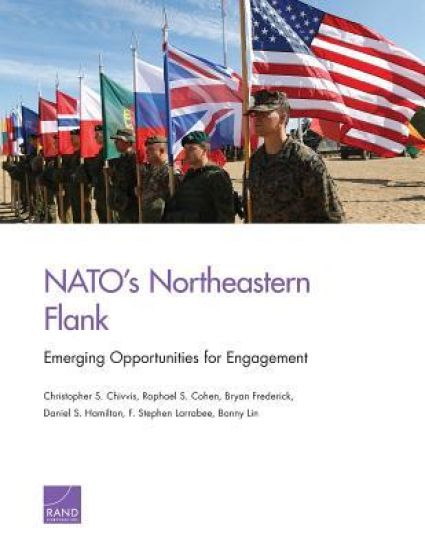
Nato's Northeastern Flank

Nato's Northeastern Flank

Christopher S Chivvis; Raphael S Cohen; Bryan Frederick; Daniel S Hamilton; F Stephen Larrabee; Bonny Lin

RAND
2017
nidottu
This report examines the impact of renewed tension between NATO and Russia on key allies and partners in central and northeastern Europe. The objective is to identify how changes in the interests, security strategies, and defense capabilities of these countries affect U.S. partnering in the region, with a focus on implications for the U.S. Air Force. Opportunities for strengthening partnerships exist in many areas.
The Continued Evolution of U.S. Law of Armed Conflict Implementation
In recent years, U.S. policies implementing the Law of Armed Conflict have increasingly restricted military activities. In this report, RAND researchers identify the ongoing or anticipated strategic, technological, and normative trends that could shift U.S. policies, how these trends might change battlefield and legal or normative dynamics, and the implications for the U.S. military that might result from these possible changes.