Kirjojen hintavertailu. Mukana 12 595 353 kirjaa ja 12 kauppaa.

Kirjailija

Byron E. Shafer

Kirjat ja teokset yhdessä paikassa: 15 kirjaa, julkaisuja vuosilta 1988-2023, suosituimpien joukossa Eternal Bandwagon. Vertaile teosten hintoja ja tarkista saatavuus suomalaisista kirjakaupoista.

Mukana myös kirjoitusasut: Byron E Shafer

15 kirjaa

Kirjojen julkaisuhaarukka 1988-2023.

The Social Roots of American Politics

The Social Roots of American Politics

Byron E. Shafer; Regina L. Wagner

OXFORD UNIVERSITY PRESS INC
2023
sidottu
A novel and powerful explanation of the social roots of American politics and the powerful forces in the background. The usual approach to political conflict is to look at policy battles inside government, then trace them back to political parties and organized interests. Yet, in The Social Roots of American Politics, Regina L. Wagner and Byron E. Shafer begin at the opposite end of the causal chain by looking at the social roots of American political conflict, how these roots produce differing policy preferences in the general public, and how those preferences get transmitted into American government. Drawing from over a half-century of public surveys of American voters, they demonstrate that class, race, religion, and gender provide the roots of these conflicts across the four primary domains of policy conflict: social welfare, civil rights, foreign affairs, and cultural values. They also factor in how regional differences affect partisan attachment, focusing on the South in particular. By turning the focus to deep-rooted social cleavages, this book provides a novel and powerful explanation of the basic forces that shape the contours of conflict in American politics.
The Social Roots of American Politics

The Social Roots of American Politics

Byron E. Shafer; Regina L. Wagner

OXFORD UNIVERSITY PRESS INC
2022
nidottu
A novel and powerful explanation of the social roots of American politics and the powerful forces in the background. The usual approach to political conflict is to look at policy battles inside government, then trace them back to political parties and organized interests. Yet, in The Social Roots of American Politics, Regina L. Wagner and Byron E. Shafer begin at the opposite end of the causal chain by looking at the social roots of American political conflict, how these roots produce differing policy preferences in the general public, and how those preferences get transmitted into American government. Drawing from over a half-century of public surveys of American voters, they demonstrate that class, race, religion, and gender provide the roots of these conflicts across the four primary domains of policy conflict: social welfare, civil rights, foreign affairs, and cultural values. They also factor in how regional differences affect partisan attachment, focusing on the South in particular. By turning the focus to deep-rooted social cleavages, this book provides a novel and powerful explanation of the basic forces that shape the contours of conflict in American politics.
The Long War over Party Structure

The Long War over Party Structure

Byron E. Shafer; Regina L. Wagner

Cambridge University Press
2022
pokkari
A long-standing debate in American politics is about the proper structure for political parties and the relative power that should be afforded to party professionals versus issue activists. In this book, Byron E. Shafer and Regina L. Wagner draw systematically on new data and indexes to evaluate the extent to which party structure changed from the 1950s on, and what the consequences have been for policy responsiveness, democratic representation, and party alignment across different issue domains. They argue that the reputed triumph of volunteer parties since the 1970s has been less comprehensive than the orthodox narrative assumes, but that the balance of power did shift, with unintended and sometimes perverse consequences. In the process of evaluating its central questions, this book gives an account of how partisan alignments evolved with newly empowered issue activists and major post-war developments from the civil rights movement to the culture wars.
Eternal Bandwagon

Eternal Bandwagon

Byron E. Shafer; Elizabeth M. Sawyer

Springer Nature Switzerland AG
2021
nidottu
Orthodox reporting and conventional scholarship focuses on the factors that distinguish each presidential contest and then attempts to explain them. This book rather, demonstrates that the politics of presidential nomination has been remarkably stable in the United States since the 1830s and right through to 2020. A common bandwagon dynamic, rolling once through party organizations and now through presidential primaries, permits a simple measure that has predicted nominations well before the decisive threshold was reached, while allowing precise comparisons across the years. So it becomes possible to separate the handful of things that matter for winnowing a large and diverse society into two individual presidential nominees. This funnel of causality moves through the occupational and careers seedbeds of a field of presidential aspirants, squeezing these fields by way of a small set of structural shapers, until party factions and factional struggles—not rules of the game, notcandidate characteristics, not nominating strategies, nor all the other ephemera so beloved of commentators and observers—actually choose a given nominee.
Eternal Bandwagon

Eternal Bandwagon

Byron E. Shafer; Elizabeth M. Sawyer

Springer Nature Switzerland AG
2020
sidottu
Orthodox reporting and conventional scholarship focuses on the factors that distinguish each presidential contest and then attempts to explain them. This book rather, demonstrates that the politics of presidential nomination has been remarkably stable in the United States since the 1830s and right through to 2020. A common bandwagon dynamic, rolling once through party organizations and now through presidential primaries, permits a simple measure that has predicted nominations well before the decisive threshold was reached, while allowing precise comparisons across the years. So it becomes possible to separate the handful of things that matter for winnowing a large and diverse society into two individual presidential nominees. This funnel of causality moves through the occupational and careers seedbeds of a field of presidential aspirants, squeezing these fields by way of a small set of structural shapers, until party factions and factional struggles—not rules of the game, notcandidate characteristics, not nominating strategies, nor all the other ephemera so beloved of commentators and observers—actually choose a given nominee.
The Long War over Party Structure

The Long War over Party Structure

Byron E. Shafer; Regina L. Wagner

Cambridge University Press
2019
sidottu
A long-standing debate in American politics is about the proper structure for political parties and the relative power that should be afforded to party professionals versus issue activists. In this book, Byron E. Shafer and Regina L. Wagner draw systematically on new data and indexes to evaluate the extent to which party structure changed from the 1950s on, and what the consequences have been for policy responsiveness, democratic representation, and party alignment across different issue domains. They argue that the reputed triumph of volunteer parties since the 1970s has been less comprehensive than the orthodox narrative assumes, but that the balance of power did shift, with unintended and sometimes perverse consequences. In the process of evaluating its central questions, this book gives an account of how partisan alignments evolved with newly empowered issue activists and major post-war developments from the civil rights movement to the culture wars.
The American Political Pattern

The American Political Pattern

Byron E. Shafer

University Press of Kansas
2016
sidottu
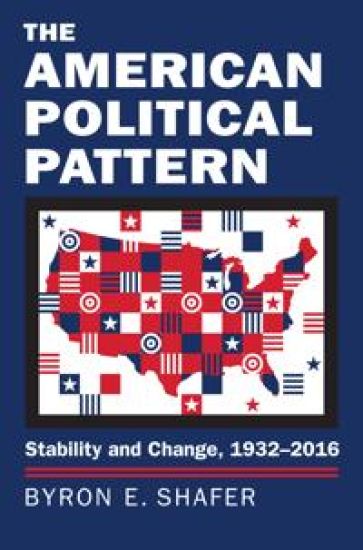
Politicians are polarized. Public opinion is volatile. Government is gridlocked. Or so journalists and pundits constantly report. But where are we, really, in modern American politics, and how did we get there? Those are the questions that Byron E. Shafer aims to answer in The American Political Pattern. Looking at the state of American politics at diverse points over the past eighty years, the book draws a picture, broad in scope yet precise in detail, of our political system in the modern era. It is a picture of stretches of political stability, but also, even more, of political change, one that goes a long way toward explaining how shifting factors alter the content of public policy and the character of American politicking.Shafer divides the modern world into four distinct periods: the High New Deal (1932-1938), the Late New Deal (1939-1968), the Era of Divided Government (1969-1992), and the Era of Partisan Volatility (1993-2016). Each period is characterized by a different arrangement of the same key factors: party balance, ideological polarization, issue conflict, and the policy-making process that goes with them.The American Political Pattern shows how these factors are in turn shaped by permanent aspects of the US Constitution, most especially the separation of powers and federalism, while their alignment is simultaneously influenced by the external demands for governmental action that arise in each period, including those derived from economic currents, major wars, and social movements. Analyzing these periods, Shafer sets the terms for understanding the structure and dynamics of politics in our own turbulent time. Placing the current political world in its historical and evolutionary framework, while illuminating major influences on American politics over time, his book explains where this modern world came from, why it endures, and how it might change yet again.
The American Political Pattern

The American Political Pattern

Byron E. Shafer

University Press of Kansas
2016
nidottu
Politicians are polarized. Public opinion is volatile. Government is gridlocked. Or so journalists and pundits constantly report. But where are we, really, in modern American politics, and how did we get there? Those are the questions that Byron E. Shafer aims to answer in The American Political Pattern. Looking at the state of American politics at diverse points over the past eighty years, the book draws a picture, broad in scope yet precise in detail, of our political system in the modern era. It is a picture of stretches of political stability, but also, even more, of political change, one that goes a long way toward explaining how shifting factors alter the content of public policy and the character of American politicking.Shafer divides the modern world into four distinct periods: the High New Deal (1932-1938), the Late New Deal (1939-1968), the Era of Divided Government (1969-1992), and the Era of Partisan Volatility (1993-2016). Each period is characterized by a different arrangement of the same key factors: party balance, ideological polarization, issue conflict, and the policy-making process that goes with them.The American Political Pattern shows how these factors are in turn shaped by permanent aspects of the US Constitution, most especially the separation of powers and federalism, while their alignment is simultaneously influenced by the external demands for governmental action that arise in each period, including those derived from economic currents, major wars, and social movements. Analyzing these periods, Shafer sets the terms for understanding the structure and dynamics of politics in our own turbulent time. Placing the current political world in its historical and evolutionary framework, while illuminating major influences on American politics over time, his book explains where this modern world came from, why it endures, and how it might change yet again.
The American Political Landscape

The American Political Landscape

Byron E. Shafer; Richard H. Spady

Harvard University Press
2014
sidottu
Social scientists and campaign strategists approach voting behavior from opposite poles. Reconciling these rival camps through a merger of precise statistics and hard-won election experience, The American Political Landscape presents a full-scale analysis of U.S. electoral politics over the past quarter-century. Byron Shafer and Richard Spady explain how factors not usually considered hard data, such as latent attitudes and personal preferences, interact to produce an indisputably solid result: the final tally of votes.Pundits and pollsters usually boil down U.S. elections to a stark choice between Democrat and Republican. Shafer and Spady explore the significance of a third possibility: not voting at all. Voters can and do form coalitions based on specific issues, so that simple party identification does not determine voter turnout or ballot choices. Deploying a new method that quantifiably maps the distribution of political attitudes in the voting population, the authors describe an American electoral landscape in flux during the period from 1984 to 2008. The old order, organized by economic values, ceded ground to a new one in which cultural and economic values enjoy equal prominence.This realignment yielded election outcomes that contradicted the prevailing wisdom about the importance of ideological centrism. Moderates have fared badly in recent contests as Republican and Democratic blocs have drifted further apart. Shafer and Spady find that persisting links between social backgrounds and political values tend to empty the ideological center while increasing the clout of the ideologically committed.
The American Public Mind

The American Public Mind

William J. M. Claggett; Byron E. Shafer

Cambridge University Press
2010
pokkari
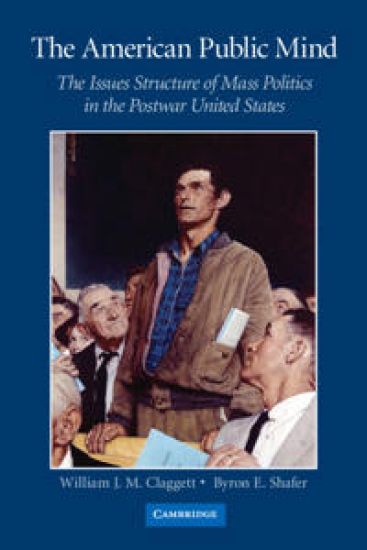
What is the real nature of substantive conflict in mass politics during the postwar years in the United States? How is it reflected in the American public mind? And how does this issue structure shape electoral conflict? William J. M. Claggett and Byron E. Shafer answer by developing measures of public preference in four great policy realms - social welfare, international relations, civil rights, and cultural values - for the entire period between 1952 and 2004. They use these to identify the issues that were moving the voting public at various points in time, while revealing the way in which public preferences shaped the structure of electoral politics. What results is the restoration of policy substance to the center of mass politics in the United States.
The American Public Mind

The American Public Mind

William J. M. Claggett; Byron E. Shafer

Cambridge University Press
2010
sidottu
What is the real nature of substantive conflict in mass politics during the postwar years in the United States? How is it reflected in the American public mind? And how does this issue structure shape electoral conflict? William J. M. Claggett and Byron E. Shafer answer by developing measures of public preference in four great policy realms - social welfare, international relations, civil rights, and cultural values - for the entire period between 1952 and 2004. They use these to identify the issues that were moving the voting public at various points in time, while revealing the way in which public preferences shaped the structure of electoral politics. What results is the restoration of policy substance to the center of mass politics in the United States.
The End of Southern Exceptionalism

The End of Southern Exceptionalism

Byron E. Shafer; Richard Johnston

Harvard University Press
2009
nidottu
The transformation of Southern politics after World War II changed the political life not just of this distinctive region, but of the entire nation. Until now, the critical shift in Southern political allegiance from Democratic to Republican has been explained, by scholars and journalists, as a white backlash to the civil rights revolution. In this myth-shattering book, Byron Shafer and Richard Johnston refute that view, one stretching all the way back to V. O. Key in his classic book Southern Politics. The true story is instead one of dramatic class reversal, beginning in the 1950s and pulling everything else in its wake. Where once the poor voted Republican and the rich Democrat, that pattern reversed, as economic development became the engine of Republican gains. Racial desegregation, never far from the heart of the story, often applied the brakes to these gains rather than fueling them.A book that is bound to shake up the study of Southern politics, this will also become required reading for pundits and political strategists, for all those who argue over what it takes to carry the South.
The Two Majorities and the Puzzle of Modern American Politics

The Two Majorities and the Puzzle of Modern American Politics

Byron E. Shafer

University Press of Kansas
2003
nidottu
Where did the Era of Divided Government come from? What sustains split partisan control of the institutions of American national government year after year? Why can it shift so easily from Democratic or Republican presidencies, coupled with Republican or Democratic Congresses? How can the vast array of issues and personalities that have surfaced in American politics over the last forty years fit so neatly within - indeed, reinforce - the sustaining political pattern of our time? These big questions constitute the puzzle of modern American politics. The old answer - a majority and a minority party, plus dominant and recessive public issues - will not work in the Era of Divided Government. Byron Shafer provides a convincing new answer that has three major elements. These elements in combination, not ""divided government"" as a catch phrase, are the real story of politics in our time. The first element is comprised of two great sets of public preferences that manifest themselves at the ballot box as two majorities. The old cluster of economic and welfare issues has not so much been displaced as simply joined by a second cluster of cultural and national concerns. The second element can be seen in the behavior of political parties and party activists, whose own preferences don't match those of the general public. That public remains reliably left of the active Republican Party on economic and welfare issues and reliably right of the active Democratic Party on cultural and national concerns. The third crucial element is found in an institutional arrangement - the distinctively American matrix of governmental institutions, which converts those first two elements into a framework for policymaking, year in and year out. Shafer examines how dominant features of the Reagan, first Bush, Clinton, and second Bush administrations reflect the interplay of these three elements. He also ranges across time and nations to put these modern elements and their composite pattern into a much larger historical and institutional framework. In this light, modern American politics appears as a distinctive recombination of familiar elements of a political style, a political process, and a political conflict that has been with us for some time.
The Two Majorities

The Two Majorities

Byron E. Shafer; William J.M. Claggett

Johns Hopkins University Press
1995
pokkari
Why do voters so often exhibit patterns of policy preference vastly different from what analysts and strategists predict? And why do these same voters consistently cast ballots that ensure the continuation of "divided government?" In The Two Majorities Byron Shafer and William Claggett offer groundbreaking political analysis that resolves many of the seeming contradictions in the contemporary American political scene. Provocatively, the authors argue that each party's best strategy for success is not to try to take popular positions on the whole range of issues, but to focus attention on the party's most successful cluster of issues.
Bifurcated Politics

Bifurcated Politics

Byron E Shafer

Harvard University Press
1988
sidottu
Even today, when it is often viewed as an institution in decline, the national party convention retains a certain raw, emotional, populist fascination. "Bifurcated Politics" is a portrait of the postwar convention as a changing institution a changing institution that still confirms the single most important decision in American politics. With the 1988 elections clearly in mind, Byron E. Shafer examines the status of the national party convention, which is created and dispersed within a handful of days but nevertheless becomes a self-contained world for participants, reporters, and observers alike. He analyzes such dramatic developments as the disappearance of the contest over the presidential nomination and its replacement by struggles over the publicizing of various campaigns, the decline of party officials and the rise of the organized interests, and the large and growing disjunction between what is happening at the convention hall and what the public sees between the convention on site and the convention on screen. He argues that, despite its declining status, the postwar convention has attracted and mirrored most of the major developments in postwar politics: the nationalization of that politics and the spread of procedural reform, a changing connection between the general public and political institutions, even the coming of a new and different sort of American politics. "Bifurcated Politics" tells the story of most of the postwar conventions, along with the nominating campaigns that preceded them. But it also develops a picture of the changing American politics around those stories. It will become the definitive study of the national party convention.