Kirjojen hintavertailu. Mukana 12 360 524 kirjaa ja 12 kauppaa.

Kirjailija

C. G. Jung

Kirjat ja teokset yhdessä paikassa: 355 kirjaa, julkaisuja vuosilta 1954-2026, suosituimpien joukossa Kalojen aika. Vertaile teosten hintoja ja tarkista saatavuus suomalaisista kirjakaupoista.

Mukana myös kirjoitusasut: C.G. Jung, C G Jung, C.G Jung, C. G Jung

355 kirjaa

Kirjojen julkaisuhaarukka 1954-2026.

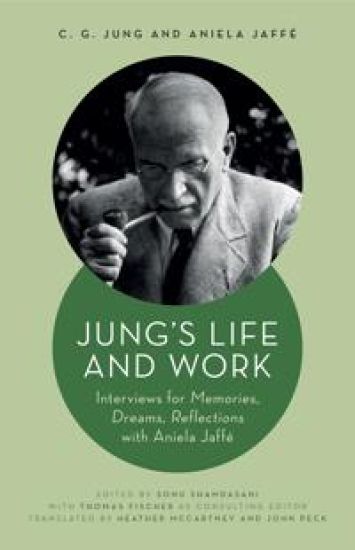
Jung's Life and Work

Jung's Life and Work

C. G. Jung; Aniela Jaffé

PRINCETON UNIVERSITY PRESS
2025
sidottu
The complete interviews that served as the basis for Jung’s bestselling memoir Memories, Dreams, ReflectionsFeatures a significant amount of material withheld from the original bookNewly translated and thoroughly annotated by world-renowned Jung expert Sonu ShamdasaniIn 1957, at the age of eighty-one, C. G. Jung began a collaboration with his student and secretary Aniela Jaffé and the legendary publisher Kurt Wolff on a book about his life. Memories, Dreams, Reflections would become a bestseller, yet it draws from less than half of Jaffé’s original interviews with Jung. Much of the material from these candid, wide-ranging conversations was left on the cutting-room floor. Jung’s Life and Work presents these interviews in their entirety for the first time.Marking the 150th anniversary of Jung’s birth, this new English translation captures the cadence and subtlety of the brilliant psychologist in his own words, giving voice to a thinker and teacher who is by turns witty and intellectually daring but also vulnerable and humbled by the world’s great mysteries. It restores numerous passages that were originally omitted or heavily edited and toned down for publication, “auntified” as Jung himself put it. Taken together, these talks reveal Jung actively discovering meaningful new connections in his life’s work. He shares his impressions of notable figures he encountered throughout his life—such as Sigmund Freud, William James, Albert Einstein, and H. G. Wells—and describes his striking visions, religious and paranormal experiences, and pioneering self-experimentation. Aided by Jaffé’s skillful questioning, Jung reflects on subjects ranging from Christianity and Buddhism and the fate of the West to the experiences that led to the formulation of his signature concepts of the collective unconscious, archetypes, anima and animus, and the shadow as well as on karma, the afterlife, and much more.With an introduction and extensive annotations by acclaimed Jung scholar Sonu Shamdasani that provide invaluable historical perspective, Jung’s Life and Work includes previously unpublished extracts from Jung’s letters and a completely reorganized text.

Jung on Ignatius of Loyola’s Spiritual Exercises

Jung on Ignatius of Loyola’s Spiritual Exercises

C. G. Jung

PRINCETON UNIVERSITY PRESS
2025
pokkari
Jung’s lectures on the psychology of Jesuit spiritual practice—unabridged in English for the first timeBetween 1933 and 1941, C. G. Jung delivered a series of public lectures at the Swiss Federal Institute of Technology (ETH) in Zurich. Intended for a general audience, these lectures addressed a broad range of topics, from yoga and meditation to dream analysis and the psychology of alchemy. Here for the first time are Jung’s complete lectures on Ignatius of Loyola’s Spiritual Exercises, delivered in the winter of 1939–1940.These illuminating lectures are the culmination of Jung’s investigation into traditional forms of meditation and their parallels to his psychotherapeutic method of active imagination. Jung presents Loyola’s exercises as the prime example of a Christian practice comparable to yoga and Eastern meditation, and gives a psychological interpretation of the visions depicted in the saint’s autobiographical writings. Offering a unique opportunity to encounter the brilliant psychologist as he shares his ideas with the general public, the lectures reflect Jung’s increasingly positive engagement with Roman Catholicism, a development that would lead to his fruitful collaborations after the war with eminent Catholic theologians such as Victor White, Bruno de Jésus-Marie, and Hugo Rahner.Featuring an authoritative introduction by Martin Liebscher along with explanations of Jungian concepts and psychological terminology, this splendid book provides an invaluable window on the evolution of Jung’s thought and a vital key to understanding his later work.
Consciousness and the Unconscious

Consciousness and the Unconscious

C. G. Jung

PRINCETON UNIVERSITY PRESS
2025
pokkari
Jung’s lectures on consciousness and the unconscious—in English for the first timeBetween 1933 and 1941, C. G. Jung delivered a series of public lectures at the Swiss Federal Institute of Technology (ETH) in Zurich. Intended for a general audience, these lectures addressed a broad range of topics, from dream analysis and yoga to the history of psychology. They are at the center of Jung’s intellectual activity in this period and provide the basis of his later work. Here for the first time in English is Jung’s introduction to his core psychological theories and methods, delivered in the summer of 1934.With candor and wit, Jung shares with his audience the path he himself took to understanding the nature of consciousness and the unconscious. He describes their respective characteristics using examples from his clinical experience as well as from literature, his travels, and everyday life. For Jung, consciousness is like a small island in the ocean of the unconscious, while the unconscious is part of the primordial condition of humankind. Jung explains various methods for uncovering the contents of the unconscious, in particular talk therapy and dream analysis.Complete with explanations of Jungian concepts and terminology, Consciousness and the Unconscious painstakingly reconstructs and translates these talks from detailed shorthand notes by attendees, making a critical part of Jung’s work available to today’s readers.
On Psychological and Visionary Art

On Psychological and Visionary Art

C. G. Jung

PRINCETON UNIVERSITY PRESS
2025
pokkari
The first English translation of Jung’s landmark lecture on Nerval’s hallucinatory memoirIn 1945, at the end of the Second World War and after a long illness, C. G. Jung delivered a lecture in Zürich on the French Romantic poet Gérard de Nerval. The lecture focused on Nerval's visionary memoir, Aurélia, which the poet wrote in an ambivalent attempt to emerge from madness. Published here for the first time, Jung’s lecture is both a cautionary psychological tale and a validation of Nerval’s visionary experience as a genuine encounter.Nerval explored the irrational with lucidity and exquisite craft. He privileged the subjective imagination as a way of fathoming the divine to reconnect with what the Romantics called the life principle. During the years of his greatest creativity, he suffered from madness and was institutionalized eight times. Contrasting an orthodox psychoanalytic interpretation with his own synthetic approach to the unconscious, Jung explains why Nerval was unable to make use of his visionary experiences in his own life. At the same time, Jung emphasizes the validity of Nerval’s visions, differentiating the psychology of a work of art from the psychology of the artist. The lecture suggests how Jung’s own experiments with active imagination influenced his reading of Nerval’s Aurélia as a parallel text to his own Red Book.With Craig Stephenson’s authoritative introduction, Richard Sieburth’s award-winning translation of Aurélia, and Alfred Kubin’s haunting illustrations to the text, and featuring Jung’s reading marginalia, preliminary notes, and revisions to a 1942 lecture, On Psychological and Visionary Art documents the stages of Jung’s creative process as he responds to an essential Romantic text.
Analytical Psychology in Exile

Analytical Psychology in Exile

C. G. Jung; Erich Neumann

PRINCETON UNIVERSITY PRESS
2025
pokkari
Two giants of twentieth-century psychology in dialogueC. G. Jung and Erich Neumann first met in 1933, at a seminar Jung was conducting in Berlin. Jung was fifty-seven years old and internationally acclaimed for his own brand of psychotherapy. Neumann, twenty-eight, had just finished his studies in medicine. The two men struck up a correspondence that would continue until Neumann's death in 1960. A lifelong Zionist, Neumann fled Nazi Germany with his family and settled in Palestine in 1934, where he would become the founding father of analytical psychology in the future state of Israel.Presented here in English for the first time are letters that provide a rare look at the development of Jung’s psychological theories from the 1930s onward as well as the emerging self-confidence of another towering twentieth-century intellectual who was often described as Jung’s most talented student. Neumann was one of the few correspondence partners of Jung’s who was able to challenge him intellectually and personally. These letters shed light on not only Jung’s political attitude toward Nazi Germany, his alleged anti-Semitism, and his psychological theory of fascism, but also his understanding of Jewish psychology and mysticism. They affirm Neumann’s importance as a leading psychologist of his time and paint a fascinating picture of the psychological impact of immigration on the German Jewish intellectuals who settled in Palestine and helped to create the state of Israel.Featuring Martin Liebscher’s authoritative introduction and annotations, this volume documents one of the most important intellectual relationships in the history of analytical psychology.
Psychology of the Unconscious: A Study of the Transformations and Symbolisms of the Libido
A landmark work that marks the beginning of Jung's divergence from the psychoanalytical school of Freud Psychology of the Unconscious is a key text for understanding the formation of Jung's ideas and his personal and psychological development at a crucial time in his life. In this influential book, Jung explores the fantasy system of Frank Miller, the young American woman whose account of her poetic and vivid mental images helped lead him to his redefinition of libido while encouraging his explorations in mythology. Miller's fantasies, with their mythological implications, supported Jung's notion that libido is not primarily sexual energy, as Freud had described it, but rather psychic energy in general, which springs from the unconscious and appears in consciousness as symbols. Jung shows how libido organizes itself as a metaphorical "hero," who first battles for deliverance from the "mother," the symbol of the unconscious, in order to become conscious, then returns to the unconscious for renewal. Jung's analytical commentary on these fantasies is a complex study of symbolic parallels derived from mythology, religion, ethnology, art, literature, and psychiatry, and foreshadows his fundamental concept of the collective unconscious and its contents, the archetypes.
The Quotable Jung

The Quotable Jung

C. G. Jung

PRINCETON UNIVERSITY PRESS
2025
pokkari
The definitive one-volume collection of Jung quotationsC. G. Jung (1875–1961) was a preeminent thinker of the modern era. In seeking to establish an interdisciplinary science of analytical psychology, he studied psychiatry, religion, mysticism, literature, physics, biology, education, and criminology. He introduced the concepts of extraversion and introversion, and terms such as complex, archetype, individuation, and the collective unconscious. He stressed the primacy of finding meaning in our lives.The Quotable Jung is the single most comprehensive collection of Jung quotations ever assembled. It is the essential introduction for anyone new to Jung and the Jungian tradition. It will also inspire those familiar with Jung to view him in an entirely new way. The Quotable Jung presents hundreds of the most representative selections from the vast array of Jung's books, essays, correspondence, lectures, seminars, and interviews, as well as the celebrated Red Book, in which Jung describes his own fearsome confrontation with the unconscious. Organized thematically, this collection covers such topics as the psyche, the symbolic life, dreams, the analytic process, good and evil, creativity, alchemical transformation, death and rebirth, the problem of the opposites, and more. The quotations are arranged so that the reader can follow the thread of Jung’s thought on these topics while gaining an invaluable perspective on his writings as a whole.Succinct and accessible, The Quotable Jung also features a preface by Judith Harris and a detailed chronology of Jung’s life and work.The single most comprehensive collection of Jung quotations ever assembledFeatures hundreds of quotesCovers such topics as the psyche, dreams, good and evil, death and rebirth, and moreIncludes a detailed chronology of Jung’s life and workServes as the ideal introduction to Jung and the Jungian tradition
On Dreams and the East

On Dreams and the East

C. G. Jung; Heinrich Zimmer

PRINCETON UNIVERSITY PRESS
2025
sidottu
Jung’s landmark seminar on the symbolism of yoga and its applications to dream analysisIn the summer of 1933, C. G. Jung conducted a seminar in Berlin attended by a large audience of some 150 people, including several Jewish Jungians who would soon leave Germany. Hitler had begun consolidating his position as dictator and these students were distressed at Jung’s recent decision to accept the presidency of a German professional psychotherapy society that was rapidly becoming Nazified and purged of Jews. On Dreams and the East makes these seminar sessions widely available for the first time, offering tantalizing insights into Jung’s evolving understanding of yoga and the realization of the self.The seminar commences with a presentation on the psychology of yoga by noted Indologist and linguist Heinrich Zimmer, whose collaboration in these talks reflects Jung’s growing engagement with the Hindu tradition, particularly Tantric yoga. Jung analyzes a series of dreams of a middle-aged male patient, focusing on mandalas and the centering process. He reflects on related motifs in alchemical symbolism, Navaho healing drawings, Mithraism, baptism symbolism, the foundation of Rome, ecclesiastic dances, and labyrinths, drawing connections with the symbolism of yoga and Tantra.Featuring a richly documented introduction by Giovanni Sorge, On Dreams and the East opens a window on Jung’s deepening exploration of Eastern thought and the comparative study of the individuation process at a critical juncture in his life and work.
Collected Works of C. G. Jung, Supplementary Volume a: The Zofingia Lectures
In paperback for the first time, the authoritative edition of the revealing lectures Jung delivered during medical school In 1895, after enrolling in the medical school of Basel University, Jung became a member of the Zofingia Society, a student fraternity to which he delivered five lectures over the next four years. Anticipating and illuminating his mature interest in empirical psychology, spiritualism, the occult, and the metaphysical, these talks confirm that Freudian psychoanalysis was a diversion in Jung's intellectual development.