Kirjojen hintavertailu. Mukana 12 152 606 kirjaa ja 12 kauppaa.
Kirjailija
C. J. Pascoe
Kirjat ja teokset yhdessä paikassa: 7 kirjaa, julkaisuja vuosilta 2011-2025, suosituimpien joukossa Dude, You're a Fag. Vertaile teosten hintoja ja tarkista saatavuus suomalaisista kirjakaupoista.
Mukana myös kirjoitusasut: C.J. Pascoe, C J Pascoe
High school and the difficult terrain of sexuality and gender identity are brilliantly explored in this smart, incisive ethnography. Based on eighteen months of fieldwork in a racially diverse working-class high school, "Dude, You're a Fag" sheds new light on masculinity both as a field of meaning and as a set of social practices. C. J. Pascoe's unorthodox approach analyzes masculinity as not only a gendered process but also a sexual one. She demonstrates how the 'specter of the fag' becomes a disciplinary mechanism for regulating heterosexual as well as homosexual boys and how the 'fag discourse' is as much tied to gender as it is to sexuality.
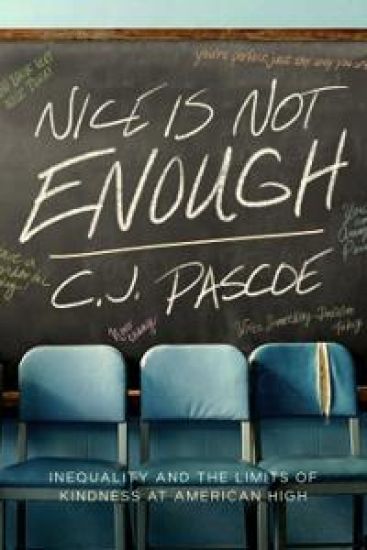
This provocative story of contemporary high school argues that a shallow culture of kindness can do more lasting harm than good. Based on two years of research, Nice Is Not Enough shares striking dispatches from one high school's "regime of kindness" to underline how the culture operates as a Band-Aid on persistent inequalities. Through incisive storytelling and thoughtful engagement with students, this brilliant study by C.J. Pascoe exposes uncomfortable truths about American politics and our reliance on individual solutions instead of profound systemic change. Nice Is Not Enough brings readers into American High, a middle- and working-class high school characterized by acceptance, connection, and kindness—a place where, a prominent sign states, "there is no room for hate." Here, inequality is narrowly understood as a problem of individual merit, meanness, effort, or emotion rather than a structural issue requiring deeper intervention. Surface-level sensitivity allows American High to avoid "political" topics related to social inequality based on race, sex, gender, or class. Being nice to each other, Pascoe reveals, does not serve these students or solve the broader issues we face; however, a true politics of care just might.
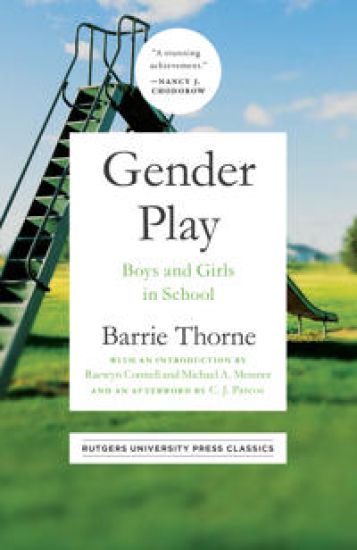
When it first appeared in 1993, Barrie Thorne’s Gender Play: Girls and Boys in School became an instant classic in the budding fields of feminist sociology and childhood studies. Through detailed first-hand observations of fourth and fifth graders at play, she investigated questions like: Why do girls and boys tend to self-segregate in the schoolyard? What can playful teasing and ritualized games like “cooties” and “chase and kiss” teach us about how children perform gendered identities? And how do children articulate their own conceptions of gender, distinct from those proscribed by the adult world? A detailed and perceptive ethnography told with compassion and humor, Gender Play immerses readers in the everyday lives of a group of working-class children to examine the social interactions that shape their gender identities. This new Rutgers Classic edition of Gender Play contains an introduction from leading sociologists of gender Michael A. Messner and Raewyn Connell that places Thorne’s innovative research in historical context. It also includes a new afterword by one of Thorne’s own students, acclaimed sociologist C.J. Pascoe, reflecting on both the lasting influence of Thorne’s work and the ways that American children’s understandings of gender have shifted in the past thirty years.
When it first appeared in 1993, Barrie Thorne’s Gender Play: Girls and Boys in School became an instant classic in the budding fields of feminist sociology and childhood studies. Through detailed first-hand observations of fourth and fifth graders at play, she investigated questions like: Why do girls and boys tend to self-segregate in the schoolyard? What can playful teasing and ritualized games like “cooties” and “chase and kiss” teach us about how children perform gendered identities? And how do children articulate their own conceptions of gender, distinct from those proscribed by the adult world? A detailed and perceptive ethnography told with compassion and humor, Gender Play immerses readers in the everyday lives of a group of working-class children to examine the social interactions that shape their gender identities. This new Rutgers Classic edition of Gender Play contains an introduction from leading sociologists of gender Michael A. Messner and Raewyn Connell that places Thorne’s innovative research in historical context. It also includes a new afterword by one of Thorne’s own students, acclaimed sociologist C.J. Pascoe, reflecting on both the lasting influence of Thorne’s work and the ways that American children’s understandings of gender have shifted in the past thirty years.
This provocative story of contemporary high school argues that a shallow culture of kindness can do more lasting harm than good. Based on two years of research, Nice Is Not Enough shares striking dispatches from one high school's "regime of kindness" to underline how the culture operates as a Band-Aid on persistent inequalities. Through incisive storytelling and thoughtful engagement with students, this brilliant study by C.J. Pascoe exposes uncomfortable truths about American politics and our reliance on individual solutions instead of profound systemic change. Nice Is Not Enough brings readers into American High, a middle- and working-class high school characterized by acceptance, connection, and kindness—a place where, a prominent sign states, "there is no room for hate." Here, inequality is narrowly understood as a problem of individual merit, meanness, effort, or emotion rather than a structural issue requiring deeper intervention. Surface-level sensitivity allows American High to avoid "political" topics related to social inequality based on race, sex, gender, or class. Being nice to each other, Pascoe reveals, does not serve these students or solve the broader issues we face; however, a true politics of care just might.
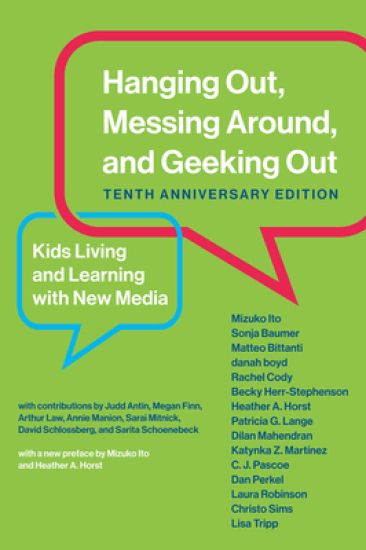
Mizuko Ito; Sonja Baumer; Matteo Bittanti; danah boyd; Rachel Cody; Becky Herr Stephenson; Heather A. Horst; Patricia G. Lange; Dilan Mahendran; Katynka Z. Martínez; C. J. Pascoe; Dan Perkel; Laura Robinson; Christo Sims; Lisa Tripp
The tenth-anniversary edition of a foundational text in digital media and learning, examining new media practices that range from podcasting to online romantic breakups.Hanging Out, Messing Around, and Geeking Out, first published in 2009, has become a foundational text in the field of digital media and learning. Reporting on an ambitious three-year ethnographic investigation into how young people live and learn with new media in varied settings-at home, in after-school programs, and in online spaces-it presents a flexible and useful framework for understanding the ways that young people engage with and through online platforms: hanging out, messing around, and geeking out, otherwise known as HOMAGO. Integrating twenty-three case studies-which include Harry Potter podcasting, video-game playing, music sharing, and online romantic breakups-in a unique collaborative authorship style, Hanging Out, Messing Around, and Geeking Out combines in-depth descriptions of specific group dynamics with conceptual analysis. Since its original publication, digital learning labs in libraries and museums around the country have been designed around the HOMAGO mode and educators have created HOMAGO guidebooks and toolkits. This tenth-anniversary edition features a new introduction by Mizuko Ito and Heather Horst that discusses how digital youth culture evolved in the intervening decade, and looks at how HOMAGO has been put into practice.This book was written as a collaborative effort by members of the Digital Youth Project, a three-year research effort funded by the John D. and Catherine T. MacArthur Foundation and conducted at the University of California, Berkeley, and the University of Southern California.
Exploring Masculinities: Identity, Inequality, Continuity, and Change is a comprehensive and contemporary reader for the growing field of men's and masculinities studies. It takes a conceptual approach by covering the wide range of scholarship being done on masculinities beyond the model of hegemonic masculinity. C.J. Pascoe and Tristan Bridges extend the boundaries of the field and provide a new framework for understanding masculinities studies. Rather than taking a topics-based approach to masculinity, Exploring Masculinities offers an innovative conceptual approach that enables students to study a given phenomenon from a variety of perspectives. It divides up the field in ways that provide accessible introductions to complex debates and key intra- and interdisciplinary distinctions. The book provides a portable set of conceptual tools on which scholars and students can rely to analyze masculinities in different contexts, time periods, and embodiments.