Kirjojen hintavertailu. Mukana 12 246 884 kirjaa ja 12 kauppaa.

Kirjailija

C. Randall Henning

Kirjat ja teokset yhdessä paikassa: 10 kirjaa, julkaisuja vuosilta 1989-2017, suosituimpien joukossa Can Nations Agree?. Vertaile teosten hintoja ja tarkista saatavuus suomalaisista kirjakaupoista.

10 kirjaa

Kirjojen julkaisuhaarukka 1989-2017.

Tangled Governance

Tangled Governance

C. Randall Henning

Oxford University Press
2017
sidottu
Tangled Governance addresses the institutions that were deployed to fight the euro crisis, reestablish financial stability in Europe, and prevent contagion to the rest of the world. Henning explains why European leaders chose to include the International Monetary Fund (IMF) in the crisis response and provides a detailed account of the decisions of the institutions that make up the troika (the European Commission, European Central Bank, and IMF). He examines the institutions negotiating strategies, the outcomes of their interaction, and the effectiveness of their cooperation. The institutional strategies of key member states, including Germany and the United States, are also explored in this study. The book locates its analysis within the framework of regime complexity, involving clusters of overlapping and intersecting regional and multilateral institutions. It tests conjectures in the regime-complexity literature against the seven cases of financial rescues of euro area countries that were stricken by crises between 2010 and 2015. Tangled Governance concludes that states use some institutions to control others, that complexity is the consequence of a strategy to control agency drift. States mediate conflicts among institutions and thereby limit fragmentation of the regime complex and underpin substantive efficacy. In reaching these conclusions, the book also answers several key puzzles, including why Germany and other northern European countries supported IMF inclusion despite its adopting positions opposed to their preferences; why crisis fighting arrangements endured intense conflicts among the institutions; and, finally, why the United States and the IMF promoted further steps to complete the monetary union.
Global Economics in Extraordinary Times – Essays in Honor of John Williamson

Global Economics in Extraordinary Times – Essays in Honor of John Williamson

C. Fred Bergsten; C. Randall Henning

The Peterson Institute for International Economics
2012
nidottu
Over the course of five decades, John Williamson has published an extraordinary number of books, articles, and other pieces on topics ranging from international monetary economics to development policy and bridging scholarly literature and policy debates. This book provides an overview and insight into Williamson's work. It includes contributions from the editors, Stanley Fischer, Edwin M. Truman, Paul De Grauwe, Yuemei Ji, Marcus Miller, Avinash Persaud, Stephany Griffith-Jones, Dagmar Hertova, Olivier Jeanne, Shankar Acharya, Jose Antonio Ocampo, and an essay by John Williamson on designing economic policy.
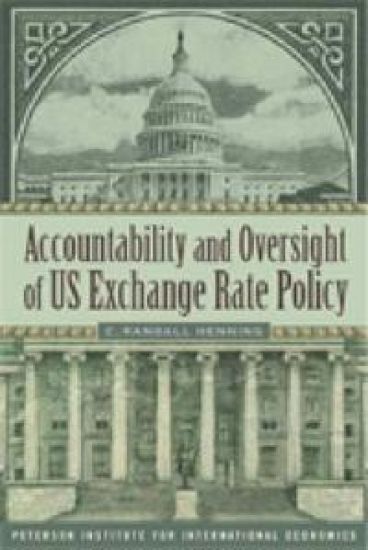
Accountability and Oversight of US Exchange Rate Policy

Accountability and Oversight of US Exchange Rate Policy

C. Randall Henning

The Peterson Institute for International Economics
2008
nidottu
The dispute over Chinese exchange rate policy within the United States has generated a series of legislative proposals to restrict the discretion of the US Treasury Department in determining currency manipulation and to reform the department's accountability to the Congress. This study reviews the Treasury's reports to the Congress on exchange rate policy-introduced by the 1988 trade act-and Congress's treatment of them. It finds that the accountability process has often not worked well in practice: The coverage of the reports has sometimes been incomplete and not provided a sufficient basis for congressional oversight. Nor has Congress always performed its own role well, holding hearings on less than half of the reports and overlooking important substantive issues. Several recommendations can improve guidance to the Treasury, standards for assessment, and congressional oversight.These include (1) refining the criteria used to determine currency manipulation and writing them into law; (2) explicitly harnessing US decisions on manipulation to the IMF's rules on exchange rates; (3) clarifying the general objectives of US exchange rate policy; (4) reaffirming the mandate to seek international macroeconomic and currency cooperation; and (5) institutionalizing multicommittee oversight of exchange rate policy by Congress. As they develop legislation targeting manipulation, furthermore, legislators should not lose sight of the broader purposes of the 1988 act relating to the effective valuation of the dollar, the current account, and their ramifications for the US economy overall.
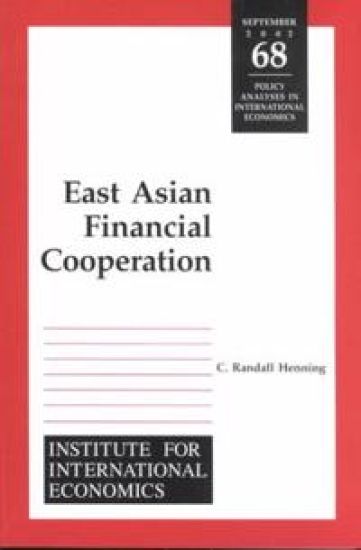
East Asian Financial Cooperation

East Asian Financial Cooperation

C. Randall Henning

The Peterson Institute for International Economics
2002
nidottu
Since the financial crisis in the late 1990s, Asian governments have been considering strengthening regional monetary and financial cooperation. Proposals have ranged from the Asian Monetary Fund to common currencies. During the past two years, China, Japan, Korea, and the member-states of ASEAN have established a set of financial facilities under an agreement made in Chiang Mai, Thailand. The Chiang Mai Initiative (CMI) mobilizes a portion of the very large reserve holdings of its members for financial stabilization in a crisis. Organized under the "ASEAN plus three" grouping, these arrangements do not include the United States or other countries outside the region. The CMI thus raises several important questions: Under what terms will financing be extended on a regional basis? Is it likely to stabilize or destabilize international capital flows? What will CMI's relationship be to the International Monetary Fund and other official financial institutions? How should governments build on these arrangements in the future? Could they provide the basis for broader integration of the East Asian region?This study examines the case for and against regional financial arrangements in East Asia, describes the CMI, compares it to financial arrangements in other regions, and recommends how the Initiative can preserve its complementarity to multilateral institutions and be strengthened in the future.The study specifically addresses the concerns of Americans, Europeans, and multilateral organizations, assessing the pros and cons of such regional financial arrangements for the global system.
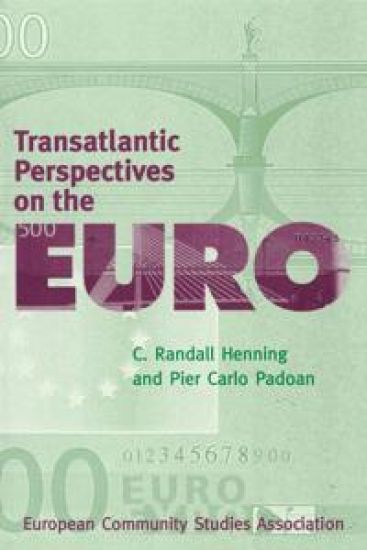
Transatlantic Perspectives on the Euro

Transatlantic Perspectives on the Euro

C. Randall Henning; Pier Carlo Padoan

Brookings Institution
2000
nidottu
"The European economic and monetary union has changed the structure of international monetary relations fundamentally. In this book two experts--one European, the other American--offer transatlantic perspectives on the ramifications of the monetary union and the launch of the euro. C. Randall Henning examines selected American views on Europe's monetary union, and looks at the political, economic, and institutional interests of the United States as they are affected by the creation of the euro. He examines the external monetary policymaking machinery of the union and discusses the relationship of the monetary union to international institutions, particularly the meetings of the G-7 finance ministers and central bank governors and the International Monetary Fund. Henning is generally sympathetic to European integration, supportive of the monetary union, and persuaded of the importance of international cooperation. Pier Carlo Padoan presents a European view of the role of the euro in the international system. He looks at the euro as a potential global currency and examines the transition phase between a regional currency and a global currency. Central to this is an analysis of the appropriate exchange rate policy for the euro. He also considers euro-dollar relations and the prospects for transatlantic cooperation. C. Randall Henning is a professor at The American University and a senior fellow at the Institute for International Economics. Pier Carlo Padoan is a professor at the University of Rome and the College of Europe. "
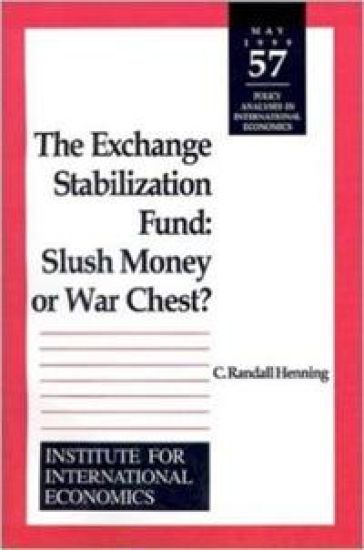
The Exchange Stabilization Fund – Slush Money or War Chest?

The Exchange Stabilization Fund – Slush Money or War Chest?

C. Randall Henning

The Peterson Institute for International Economics
1999
nidottu
The Exchange Stabilization Fund (ESF) holds more than $40 billion that is at the disposal of the US Secretary of the Treasury for use in foreign exchange intervention and international financial support operations. Its use in the Mexican rescue package of 1995 brought the ESF into the public spotlight for the first time in recent years, and it has been deployed in Brazil and several Asian crisis countries as well. Its availability for such packages and its total control by the Treasury secretary have therefore become very controversial. Randall Henning's study maintains that the Fund is an important element of US foreign policy and economic policy and that it should remain under the exclusive control of the Treasury, but that Congress should exercise effective oversight. Henning also covers the legislative history of the ESF and outlines the principles by which the Fund should be administered.
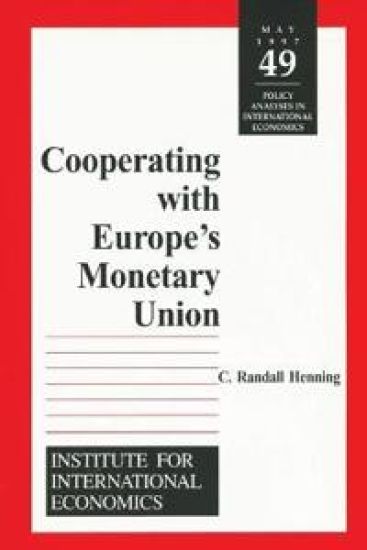
Cooperating with Europe`s Monetary Union

Cooperating with Europe`s Monetary Union

C. Randall Henning

The Peterson Institute for International Economics
1997
nidottu
Europe's monetary union will represent the most profound transformation of the international monetary system since the transition from fixed to flexible exchange rates in the early 1970s. It will compete with the erosion of American dominance and the dramatic increase in capital mobility for the distinction of being the most far-reaching change in the global monetary system since the Bretton Woods conference of 1944. Economic and Monetary Union (EMU) will create in Europe a new monetary actor with an economic size roughly comparable to the United States, ushering in a new era in international monetary relations. Nonetheless, while broad interests coincide, the creation of the monetary union will pose challenges to American, Japanese, and other non-European policymakers. Europe's monetary union could prove to be a difficult partner in international monetary cooperation. Henning recommends that European institutions and policy processes be strengthened, representation of the monetary union in the G-7 be consolidated, and that European, American, and Japanese authorities cooperate to reduce instability during the transition to monetary union.
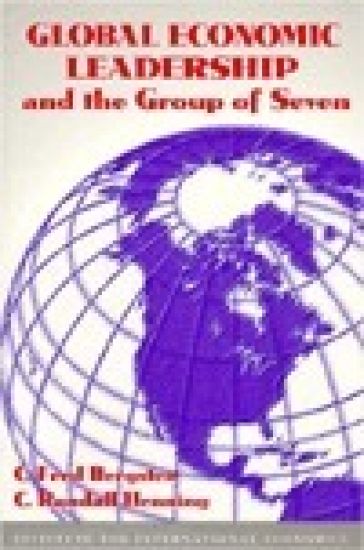
Global Economic Leadership and the Group of Seven

Global Economic Leadership and the Group of Seven

C. Fred Bergsten; C. Randall Henning

The Peterson Institute for International Economics
1996
nidottu
The decline of the dollar, the Mexican crisis, and sluggish global growth reveal the failure of the Group of Seven industrial nations to provide effective management of the world economy. The G-7 once played this crucial role effectively, and must do so again if future crises are to be averted and global prosperity to be promoted. This study assesses the G-7's record and the reasons for its demise. It outlines an action program that includes reforming the exchange rate regime, creating a new financial facility at the IMF to deal with crises sparked by private capital flows, and instituting an early warning system to prevent serious new disruptions in the world economy
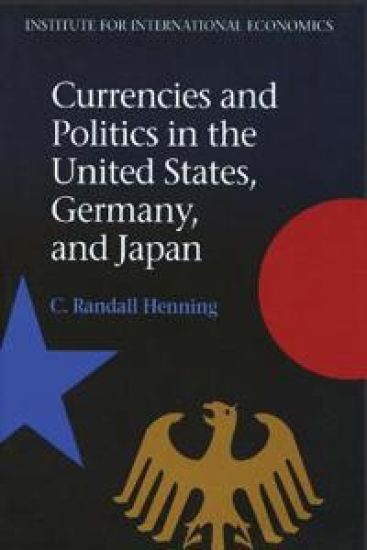
Currencies and Politics in the United States, Germany, and Japan

Currencies and Politics in the United States, Germany, and Japan

C. Randall Henning

The Peterson Institute for International Economics
1994
nidottu
Currencies and Politics is the first comprehensive, in-depth comparison of the institutions and processes that formulate domestic and external monetary policy in the U.S., Germany, and Japan. It outlines the differences in policymaking among the three countries and the policy patterns they produced over the postwar period.
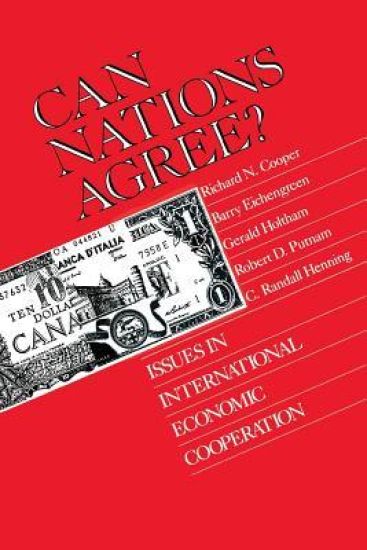
Can Nations Agree?

Can Nations Agree?

Richard N. Cooper; Barry Eichengreen; Gerald Holtham; Robert D. Putnam; C. Randall Henning

Brookings Institution
1989
nidottu
In the age of Three Mile Island and Chernobyl, a new international trade in industrial and human waste, the depletion of the ozone layer, and the greenhouse effect, the importance of international cooperation is supremely evident. In the economic arena, such problems include speculative instability in financial and primary commodities markets, competition in tax regimes, and the greatly enhanced scope for tax evasion. Can Nations Agree? examines the crucial issues surrounding international cooperation-conditions that foster cooperation toward common goals; ways to handle the friction arising from conflicting goals; and the structures that best promote cooperation. Although nations recognize the value of cooperation in an independent world, a variety of conditions inhibit the process. In recent decades the number of independent nations has risen rapidly, and so has the variety of decisionmakers and national interests to be reconciled. At the same time, the economic power of the United States has declined in relation to other successful capitalist countries. In the chapters on the 1978 Bonn economic summit, German macroeconomic policy, international cooperation on public health issues, and hegemony and stability, the scholars contributing to this volume analyze the history and process of international cooperation to offer fresh insight for future efforts.