Kirjojen hintavertailu. Mukana 12 245 819 kirjaa ja 12 kauppaa.

Kirjailija

C. Wagner

Kirjat ja teokset yhdessä paikassa: 3 kirjaa, julkaisuja vuosilta 1981-1999, suosituimpien joukossa Rational Consensus in Science and Society. Vertaile teosten hintoja ja tarkista saatavuus suomalaisista kirjakaupoista.

3 kirjaa

Kirjojen julkaisuhaarukka 1981-1999.

Your Sons and Daughters Shall Prophesy – Prophetic Gifts in Ministry Today

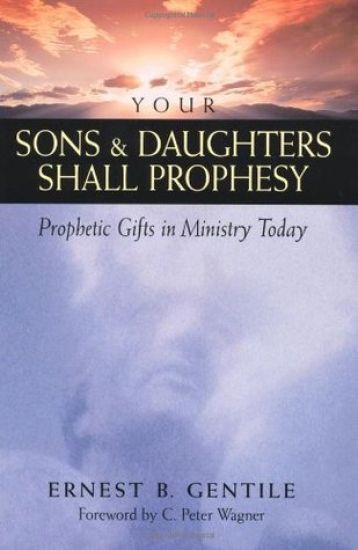
Your Sons and Daughters Shall Prophesy – Prophetic Gifts in Ministry Today

Ernest B. Gentile; C. Wagner

Chosen Books, a division of Baker Publishing Group
1999
nidottu
"Therefore, my brethren, desire earnestly to prophesy ..." (1 Cor. 14:39). Was Paul addressing only the Corinthian Christians, or does his admonition hold true for the church today? Does the voice of God speak directly and specifically to this generation? With a resounding yes, longtime pastor and international speaker Ernest B. Gentile shows that the apostles intended prophecy to continue as a vital function in the ongoing development of the church. In twenty-three carefully laid out chapters, Your Sons and Daughters Shall Prophesy presents the scriptural background and theoretical concepts behind prophecy, interspersed with personal observations, firsthand accounts, and practical suggestions. This thorough yet readable study on prophecy skillfully bridges the gap between scholarly analysis and popular presentation. Each chapter concludes with a page of insightful quotations from popular writers and pastoral leaders. Teachers and students, as well as anyone with an interest in prophecy, will find all the information they need to explore this crucial and sometimes controversial subject. Nine charts and graphs, three appendixes, indexes, and an extensive bibliography are included.
Rational Consensus in Science and Society

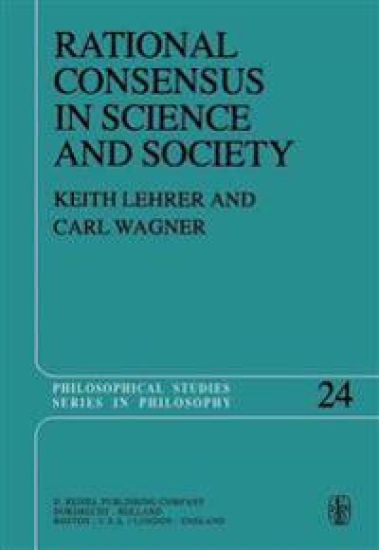
Rational Consensus in Science and Society

Keith Lehrer; C. Wagner

Kluwer Academic Publishers
1981
nidottu
TItis book is the joint project of a philosopher, Lehrer, and a mathematician, Wagner. The book is, therefore, divided into a first part written by Lehrer, which is primarily philosophical, and a second part written by Wagner that is primarily formal. The authors were, however, influenced by each other throughout. Our book articulates a theory of rational consensus in science and society. The theory is applied to politics, ethics, science, and language. We begin our exposition with an elementary mathematical model of consensus developed by Lehrer in a series of articles [1976a, 1976b, 1977, 1978]. Chapter 3 contains material from [1978]. Lehrer formulated the elementary model when he was a Fellow of the Center for Advanced Study in the Be­ havioral Sciences, Stanford, in 1973 with the invaluable mathematical assist­ of Kit Fine, Gerald Kramer and Lionel McKenzie. In the summer of ance 1977, Lehrer and Wagner met at the Center in a Summer Seminar on Freedom and Causality supported by the Andrew W. Mellon Foundation. Wagner read the manuscript of Lehrer [1978] and subsequently solved some mathematical problems of the elementary model. After discussions of philosophical prob­ lems associated with that model, Wagner developed the foundations for the extended model. These results were reported in Wagner [1978, 1981a].
Rational Consensus in Science and Society

Rational Consensus in Science and Society

Keith Lehrer; C. Wagner

Kluwer Academic Publishers
1981
sidottu
TItis book is the joint project of a philosopher, Lehrer, and a mathematician, Wagner. The book is, therefore, divided into a first part written by Lehrer, which is primarily philosophical, and a second part written by Wagner that is primarily formal. The authors were, however, influenced by each other throughout. Our book articulates a theory of rational consensus in science and society. The theory is applied to politics, ethics, science, and language. We begin our exposition with an elementary mathematical model of consensus developed by Lehrer in a series of articles [1976a, 1976b, 1977, 1978]. Chapter 3 contains material from [1978]. Lehrer formulated the elementary model when he was a Fellow of the Center for Advanced Study in the Be­ havioral Sciences, Stanford, in 1973 with the invaluable mathematical assist­ of Kit Fine, Gerald Kramer and Lionel McKenzie. In the summer of ance 1977, Lehrer and Wagner met at the Center in a Summer Seminar on Freedom and Causality supported by the Andrew W. Mellon Foundation. Wagner read the manuscript of Lehrer [1978] and subsequently solved some mathematical problems of the elementary model. After discussions of philosophical prob­ lems associated with that model, Wagner developed the foundations for the extended model. These results were reported in Wagner [1978, 1981a].