Kirjojen hintavertailu. Mukana 12 390 323 kirjaa ja 12 kauppaa.
Kirjailija
Carl E. Schneider
Kirjat ja teokset yhdessä paikassa: 5 kirjaa, julkaisuja vuosilta 1999-2016, suosituimpien joukossa The Practice of Autonomy. Vertaile teosten hintoja ja tarkista saatavuus suomalaisista kirjakaupoista.
Since its original release in 1939, Carl Schneider's The German Church on the American Frontier has been the premier published resource on the unique "Evangelischer Kirchenverein des Westens" (Evangelical Church Society of the West), 1840-66, which later assumed a wider denominational identity as the German Evangelical Synod of North America, the church of the Niebuhr family. Known eventually as the Evangelical Synod of North America, the group's ecumenical and irenic heritage contributed to mergers that resulted in the Evangelical and Reformed Church, 1934-1957, and thereafter in the United Church of Christ.
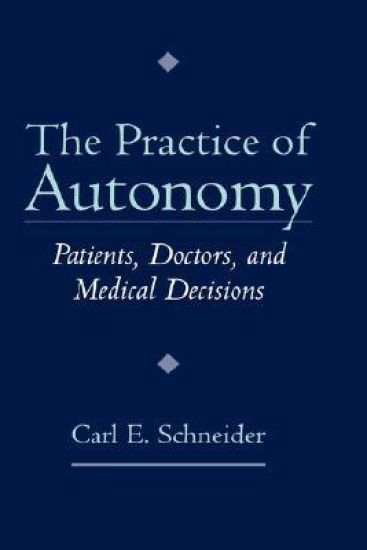
This is a book written across the grain of contemporary ethics, where the principle of autonomy has triumphed.It is an attempt to see the law of medicine, the principles of bioethics, and the encounter between doctor and patient from the patient's point of view. While Schneider agrees that many patients now want to make their own medical decisions, and virtually all want to be treated with dignity and solicitude, he argues that most do not want to assume the full burden of decision-making that some bioethicists and lawyers have thrust upon them. What patients want, according to Schneider, is more ambiguous, complicated, and ambivalent than being "empowered." In this book he tries to chart that ambiguity, to take the autonomy paradigm past current pieties into the uncertain realities of modern medicine.
Perhaps no kind of regulation is more common or less useful than mandated disclosure--requiring one party to a transaction to give the other information. It is the iTunes terms you assent to, the doctor's consent form you sign, the pile of papers you get with your mortgage. Reading the terms, the form, and the papers is supposed to equip you to choose your purchase, your treatment, and your loan well. More Than You Wanted to Know surveys the evidence and finds that mandated disclosure rarely works. But how could it? Who reads these disclosures? Who understands them? Who uses them to make better choices? Omri Ben-Shahar and Carl Schneider put the regulatory problem in human terms. Most people find disclosures complex, obscure, and dull. Most people make choices by stripping information away, not layering it on. Most people find they can safely ignore most disclosures and that they lack the literacy to analyze them anyway. And so many disclosures are mandated that nobody could heed them all. Nor can all this be changed by simpler forms in plainer English, since complex things cannot be made simple by better writing. Furthermore, disclosure is a lawmakers' panacea, so they keep issuing new mandates and expanding old ones, often instead of taking on the hard work of writing regulations with bite. Timely and provocative, More Than You Wanted to Know takes on the form of regulation we encounter daily and asks why we must encounter it at all.
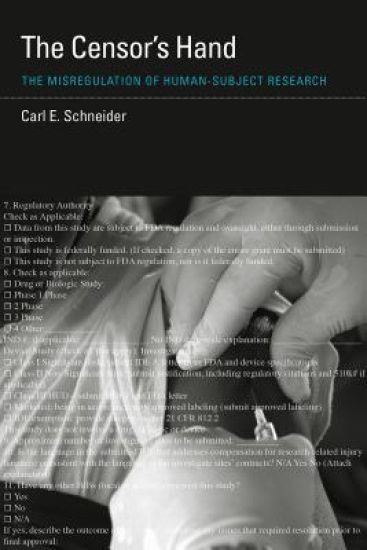
An argument that the system of boards that license human-subject research is so fundamentally misconceived that it inevitably does more harm than good.Medical and social progress depend on research with human subjects. When that research is done in institutions getting federal money, it is regulated (often minutely) by federally required and supervised bureaucracies called "institutional review boards" (IRBs). Do-can-these IRBs do more harm than good? In The Censor's Hand, Schneider addresses this crucial but long-unasked question. Schneider answers the question by consulting a critical but ignored experience-the law's learning about regulation-and by amassing empirical evidence that is scattered around many literatures. He concludes that IRBs were fundamentally misconceived. Their usefulness to human subjects is doubtful, but they clearly delay, distort, and deter research that can save people's lives, soothe their suffering, and enhance their welfare. IRBs demonstrably make decisions poorly. They cannot be expected to make decisions well, for they lack the expertise, ethical principles, legal rules, effective procedures, and accountability essential to good regulation. And IRBs are censors in the place censorship is most damaging-universities. In sum, Schneider argues that IRBs are bad regulation that inescapably do more harm than good. They were an irreparable mistake that should be abandoned so that research can be conducted properly and regulated sensibly.
Perhaps no kind of regulation is more common or less useful than mandated disclosure--requiring one party to a transaction to give the other information. It is the iTunes terms you assent to, the doctor's consent form you sign, the pile of papers you get with your mortgage. Reading the terms, the form, and the papers is supposed to equip you to choose your purchase, your treatment, and your loan well. More Than You Wanted to Know surveys the evidence and finds that mandated disclosure rarely works. But how could it? Who reads these disclosures? Who understands them? Who uses them to make better choices? Omri Ben-Shahar and Carl Schneider put the regulatory problem in human terms. Most people find disclosures complex, obscure, and dull. Most people make choices by stripping information away, not layering it on. Most people find they can safely ignore most disclosures and that they lack the literacy to analyze them anyway. And so many disclosures are mandated that nobody could heed them all. Nor can all this be changed by simpler forms in plainer English, since complex things cannot be made simple by better writing. Furthermore, disclosure is a lawmakers' panacea, so they keep issuing new mandates and expanding old ones, often instead of taking on the hard work of writing regulations with bite. Timely and provocative, More Than You Wanted to Know takes on the form of regulation we encounter daily and asks why we must encounter it at all.