Kirjojen hintavertailu. Mukana 12 657 676 kirjaa ja 12 kauppaa.

Kirjailija

Carlo Cercignani

Kirjat ja teokset yhdessä paikassa: 12 kirjaa, julkaisuja vuosilta 1987-2014, suosituimpien joukossa Ludwig Boltzmann. Vertaile teosten hintoja ja tarkista saatavuus suomalaisista kirjakaupoista.

12 kirjaa

Kirjojen julkaisuhaarukka 1987-2014.

Ludwig Boltzmann

Ludwig Boltzmann

Carlo Cercignani; Roger Penrose

Oxford University Press
2006
nidottu
This book presents the life and personality, the scientific and philosophical work of Ludwig Boltzmann, one of the great scientists who marked the passage from 19th- to 20th-Century physics. His rich and tragic life, ending by suicide at the age of 62, is described in detail. A substantial part of the book is devoted to discussing his scientific and philosophical ideas and placing them in the context of the second half of the 19th century. The fact that Boltzmann was the man who did most to establish that there is a microscopic, atomic structure underlying macroscopic bodies is documented, as is Boltzmann's influence on modern physics, especially through the work of Planck on light quanta and of Einstein on Brownian motion. Boltzmann was the centre of a scientific upheaval, and he has been proved right on many crucial issues. He anticipated Kuhn's theory of scientific revolutions and proposed a theory of knowledge based on Darwin. His basic results, when properly understood, can also be stated as mathematical theorems. Some of these have been proved: others are still at the level of likely but unproven conjectures. The main text of this biography is written almost entirely without equations. Mathematical appendices deepen knowledge of some technical aspects of the subject.
Ludwig Boltzmann

Ludwig Boltzmann

Carlo Cercignani

Clarendon Press
1998
sidottu
The book presents the life and personality, the scientific and philosophical work of Ludwig Boltzmann, one of the great scientists who marked the passage from 19th to 20th century physics. His rich and tragic life, ending by suicide at the age of 62, is described in detail. A substantial part of the book is devoted to discussing his scientific and philosophical ideas and placing them in the context of the second half of the 19th century. The fact that Boltzmann was the man who did most to establish that there is a microscopic, atomic structure underlying macroscopic bodies is documented, as is Boltzmann's influence on modern physics, especially through the work of Planck on light quanta and of Einstein on Brownian motion. Boltzmann was the centre of a scientific revolution, and he has been proved right on many crucial issues. He anticipated Kuhn's theory of scientific revolutions and proposed a theory of knowledge based on Darwin. His basic results, when properly understood, can also be stated as mathematical theorems. Some of these have been proved; others are still at the level of likely but unproven conjectures. The main text of this biography is written almost entirely without equations. Mathematical appendices deepen knowledge of some technical aspects of the subject.
The Mathematical Theory of Dilute Gases

The Mathematical Theory of Dilute Gases

Carlo Cercignani; Reinhard Illner; Mario Pulvirenti

Springer-Verlag New York Inc.
2013
nidottu
The idea for this book was conceived by the authors some time in 1988, and a first outline of the manuscript was drawn up during a summer school on mathematical physics held in Ravello in September 1988, where all three of us were present as lecturers or organizers. The project was in some sense inherited from our friend Marvin Shinbrot, who had planned a book about recent progress for the Boltzmann equation, but, due to his untimely death in 1987, never got to do it. When we drew up the first outline, we could not anticipate how long the actual writing would stretch out. Our ambitions were high: We wanted to cover the modern mathematical theory of the Boltzmann equation, with rigorous proofs, in a complete and readable volume. As the years progressed, we withdrew to some degree from this first ambition- there was just too much material, too scattered, sometimes incomplete, sometimes not rigor­ ous enough. However, in the writing process itself, the need for the book became ever more apparent. The last twenty years have seen an amazing number of significant results in the field, many of them published in incom­ plete form, sometimes in obscure places, and sometimes without technical details. We made it our objective to collect these results, classify them, and present them as best we could. The choice of topics remains, of course, subjective.
The Boltzmann Equation and Its Applications

The Boltzmann Equation and Its Applications

Carlo Cercignani

Springer-Verlag New York Inc.
2012
nidottu
Statistical mechanics may be naturally divided into two branches, one dealing with equilibrium systems, the other with nonequilibrium systems. The equilibrium properties of macroscopic systems are defined in principle by suitable averages in well-defined Gibbs's ensembles. This provides a frame­ work for both qualitative understanding and quantitative approximations to equilibrium behaviour. Nonequilibrium phenomena are much less understood at the present time. A notable exception is offered by the case of dilute gases. Here a basic equation was established by Ludwig Boltzmann in 1872. The Boltzmann equation still forms the basis for the kinetic theory of gases and has proved fruitful not only for a study of the classical gases Boltzmann had in mind but also, properly generalized, for studying electron transport in solids and plasmas, neutron transport in nuclear reactors, phonon transport in superfluids, and radiative transfer in planetary and stellar atmospheres. Research in both the new fields and the old one has undergone a considerable advance in the last thirty years.
Slow Rarefied Flows

Slow Rarefied Flows

Carlo Cercignani

Birkhauser Verlag AG
2006
sidottu
This volume is intended to coverthe presentstatus of the mathematicaltools used to deal with problems related to slow rare?ed ?ows. The meaning and usefulness of the subject, and the extent to which it is covered in the book, are discussed in some detail in the introduction. In short, I tried to present the basic concepts and the techniques used in probing mathematical questions and problems which arise when studying slow rare?ed ?ows in environmental sciences and micromachines. For the book to be up-to-date without being excessively large, it was necessary to omit some topics, which are treated elsewhere, as indicated in the introd- tion and, whenever the need arises, in the various chapters of this volume. Their omission does not alter the aim of the book, to provide an understanding of the essential mathematical tools required to deal with slow rare?ed ?ows and give the background for a study of the original literature. Although I have tried to give a rather complete bibliographical coverage,the choice of the topics and of the references certainly re?ects a personal bias and I apologize in advance for any omission. I wish to thank Lorenzo Valdettaro, Antonella Abb` a, Silva Lorenzani and Paolo Barbante for their help with pictures and especially Professor Ching Shen for his permission to reproduce his pictures on microchannel ?ows.
The Relativistic Boltzmann Equation: Theory and Applications

The Relativistic Boltzmann Equation: Theory and Applications

Carlo Cercignani; Gilberto M. Kremer

Birkhauser Verlag AG
2002
sidottu
The aim of this book is to present the theory and applications of the relativistic Boltzmann equation in a self-contained manner, even for those readers who have no familiarity with special and general relativity. Though an attempt is made to present the basic concepts in a complete fashion, the style of presentation is chosen to be appealing to readers who want to understand how kinetic theory is used for explicit calculations. The book will be helpful not only as a textbook for an advanced course on relativistic kinetic theory but also as a reference for physicists, astrophysicists and applied mathematicians who are interested in the theory and applications of the relativistic Boltzmann equation.
Scaling Limits and Models in Physical Processes

Scaling Limits and Models in Physical Processes

Carlo Cercignani; David Sattinger

Birkhauser Verlag AG
1998
nidottu
The first part of this volume presents the basic ideas concerning perturbation and scaling methods in the mathematical theory of dilute gases, based on Boltzmann's integro-differential equation. It is of course impossible to cover the developments of this subject in less than one hundred pages. Already in 1912 none less than David Hilbert indicated how to obtain approximate solutions of the scaled Boltzmann equation in the form of a perturbation of a parameter inversely proportional to the gas density. His paper is also reprinted as Chapter XXII of his treatise Grundzuge einer allgemeinen Theorie der linearen Integralgleichungen. The motive for this circumstance is clearly stated in the preface to that book ("Recently I have added, to conclude, a new chapter on the kinetic theory of gases. [ ...]. I recognize in the theory of gases the most splendid application of the theorems concerning integral equations. ") The mathematically rigorous theory started, however, in 1933 with a paper [48] by Tage Gillis Torsten Carleman, who proved a theorem of global exis- tence and uniqueness for a gas of hard spheres in the so-called space-homogeneous case. Many other results followed; those based on perturbation and scaling meth- ods will be dealt with in some detail. Here, I cannot refrain from mentioning that, when Pierre-Louis Lions obtained the Fields medal (1994), the commenda- tion quoted explicitly his work with the late Ronald DiPerna on the existence of solutions of the Boltzmann equation.
The Mathematical Theory of Dilute Gases

The Mathematical Theory of Dilute Gases

Carlo Cercignani; Reinhard Illner; Mario Pulvirenti

Springer-Verlag New York Inc.
1994
sidottu
The idea for this book was conceived by the authors some time in 1988, and a first outline of the manuscript was drawn up during a summer school on mathematical physics held in Ravello in September 1988, where all three of us were present as lecturers or organizers. The project was in some sense inherited from our friend Marvin Shinbrot, who had planned a book about recent progress for the Boltzmann equation, but, due to his untimely death in 1987, never got to do it. When we drew up the first outline, we could not anticipate how long the actual writing would stretch out. Our ambitions were high: We wanted to cover the modern mathematical theory of the Boltzmann equation, with rigorous proofs, in a complete and readable volume. As the years progressed, we withdrew to some degree from this first ambition- there was just too much material, too scattered, sometimes incomplete, sometimes not rigor­ ous enough. However, in the writing process itself, the need for the book became ever more apparent. The last twenty years have seen an amazing number of significant results in the field, many of them published in incom­ plete form, sometimes in obscure places, and sometimes without technical details. We made it our objective to collect these results, classify them, and present them as best we could. The choice of topics remains, of course, subjective.
The Boltzmann Equation and Its Applications

The Boltzmann Equation and Its Applications

Carlo Cercignani

Springer-Verlag New York Inc.
1987
sidottu
Statistical mechanics may be naturally divided into two branches, one dealing with equilibrium systems, the other with nonequilibrium systems. The equilibrium properties of macroscopic systems are defined in principle by suitable averages in well-defined Gibbs's ensembles. This provides a frame­ work for both qualitative understanding and quantitative approximations to equilibrium behaviour. Nonequilibrium phenomena are much less understood at the present time. A notable exception is offered by the case of dilute gases. Here a basic equation was established by Ludwig Boltzmann in 1872. The Boltzmann equation still forms the basis for the kinetic theory of gases and has proved fruitful not only for a study of the classical gases Boltzmann had in mind but also, properly generalized, for studying electron transport in solids and plasmas, neutron transport in nuclear reactors, phonon transport in superfluids, and radiative transfer in planetary and stellar atmospheres. Research in both the new fields and the old one has undergone a considerable advance in the last thirty years.
The Relativistic Boltzmann Equation: Theory and Applications

The Relativistic Boltzmann Equation: Theory and Applications

Carlo Cercignani; Gilberto M. Kremer

Birkhauser Verlag AG
2012
nidottu
The aim of this book is to present the theory and applications of the relativistic Boltzmann equation in a self-contained manner, even for those readers who have no familiarity with special and general relativity. Though an attempt is made to present the basic concepts in a complete fashion, the style of presentation is chosen to be appealing to readers who want to understand how kinetic theory is used for explicit calculations. The book will be helpful not only as a textbook for an advanced course on relativistic kinetic theory but also as a reference for physicists, astrophysicists and applied mathematicians who are interested in the theory and applications of the relativistic Boltzmann equation.
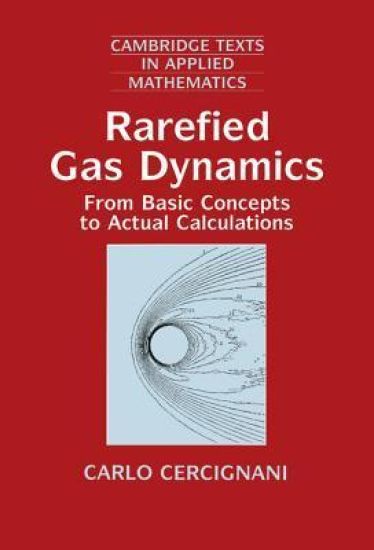
Rarefied Gas Dynamics

Rarefied Gas Dynamics

Carlo Cercignani

Cambridge University Press
2000
sidottu
This book presents the concepts, methods and applications of kinetic theory to rarefied gas dynamics. After introducing the basic tools, problems in plane geometry are treated using approximation techniques (perturbation and numerical methods). These same techniques are later used to deal with two- and three-dimensional problems. The models include not only monatomic but also polyatomic gases, mixtures, chemical reactions. A special chapter is devoted to evaporation and condensation phenomena. Each section is accompanied by problems which are mainly intended to demonstrate the use of the material in the text and to outline additional subjects, results and equations. This will help ensure that the book can be used for a range of graduate courses in aerospace engineering or applied mathematics.