Kirjojen hintavertailu. Mukana 12 595 353 kirjaa ja 12 kauppaa.

Kirjailija

Carlos A. Berenstein

Kirjat ja teokset yhdessä paikassa: 5 kirjaa, julkaisuja vuosilta 1991-2011, suosituimpien joukossa Residue Currents and Bezout Identities. Vertaile teosten hintoja ja tarkista saatavuus suomalaisista kirjakaupoista.

5 kirjaa

Kirjojen julkaisuhaarukka 1991-2011.

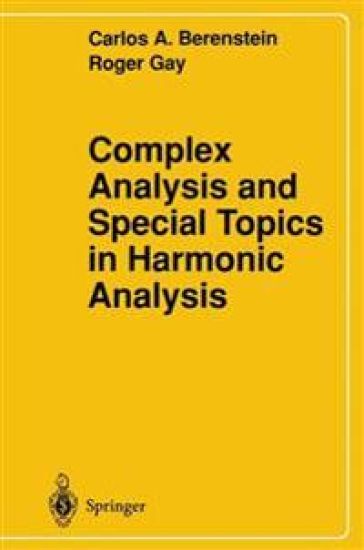
Complex Analysis and Special Topics in Harmonic Analysis

Complex Analysis and Special Topics in Harmonic Analysis

Carlos A. Berenstein; Roger Gay

Springer-Verlag New York Inc.
2011
nidottu
A companion volume to the text "Complex Variables: An Introduction" by the same authors, this book further develops the theory, continuing to emphasize the role that the Cauchy-Riemann equation plays in modern complex analysis. Topics considered include: Boundary values of holomorphic functions in the sense of distributions; interpolation problems and ideal theory in algebras of entire functions with growth conditions; exponential polynomials; the G transform and the unifying role it plays in complex analysis and transcendental number theory; summation methods; and the theorem of L. Schwarz concerning the solutions of a homogeneous convolution equation on the real line and its applications in harmonic function theory.
Complex Variables

Complex Variables

Carlos A. Berenstein; Roger Gay

Springer-Verlag New York Inc.
2011
nidottu
Textbooks, even excellent ones, are a reflection of their times. Form and content of books depend on what the students know already, what they are expected to learn, how the subject matter is regarded in relation to other divisions of mathematics, and even how fashionable the subject matter is. It is thus not surprising that we no longer use such masterpieces as Hurwitz and Courant's Funktionentheorie or Jordan's Cours d'Analyse in our courses. The last two decades have seen a significant change in the techniques used in the theory of functions of one complex variable. The important role played by the inhomogeneous Cauchy-Riemann equation in the current research has led to the reunification, at least in their spirit, of complex analysis in one and in several variables. We say reunification since we think that Weierstrass, Poincare, and others (in contrast to many of our students) did not consider them to be entirely separate subjects. Indeed, not only complex analysis in several variables, but also number theory, harmonic analysis, and other branches of mathematics, both pure and applied, have required a reconsidera­ tion of analytic continuation, ordinary differential equations in the complex domain, asymptotic analysis, iteration of holomorphic functions, and many other subjects from the classic theory of functions of one complex variable. This ongoing reconsideration led us to think that a textbook incorporating some of these new perspectives and techniques had to be written.
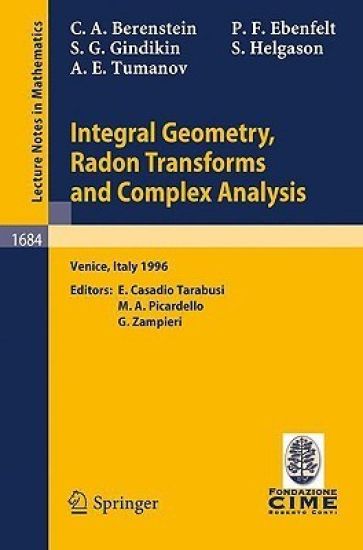
Integral Geometry, Radon Transforms and Complex Analysis

Integral Geometry, Radon Transforms and Complex Analysis

Carlos A. Berenstein; Peter Ebenfelt; Simon Gindikin; Sigurdur Helgason; Alexander Tumanov

Springer-Verlag Berlin and Heidelberg GmbH Co. K
1998
nidottu
This book contains the notes of five short courses delivered at the "Centro Internazionale Matematico Estivo" session "Integral Geometry, Radon Transforms and Complex Analysis" held in Venice (Italy) in June 1996: three of them deal with various aspects of integral geometry, with a common emphasis on several kinds of Radon transforms, their properties and applications, the other two share a stress on CR manifolds and related problems. All lectures are accessible to a wide audience, and provide self-contained introductions and short surveys on the subjects, as well as detailed expositions of selected results.
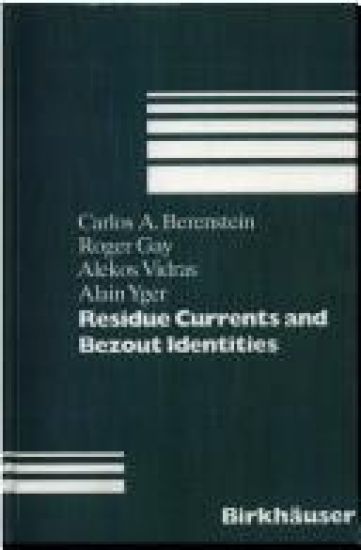
Residue Currents and Bezout Identities

Residue Currents and Bezout Identities

Carlos A. Berenstein; Roger Gay; Alekos Vidras; Alain Yger

Birkhauser Verlag AG
1993
sidottu
The objective of this monograph is to present a coherent picture of the almost mysterious role that analytic methods and, in particular, multidimensional residue have recently played in obtaining effective estimates for problems in commutative algebra. Bezout identifies, i.e.,f1g1+...+fmgm=1, appear naturally in many problems, for example in commutative algebra in the Nullstellensatz, and in signal processing in the deconvolution problem. One way to solve them is by using explicit interpolation formulas in Cn, and these depend on the theory of multidimensional residues. The authors present this theory in detail, in a form developed by them, and illustrate its applications to the effective Nullstellensatz and to the Fundamental Principle for convolution equations.
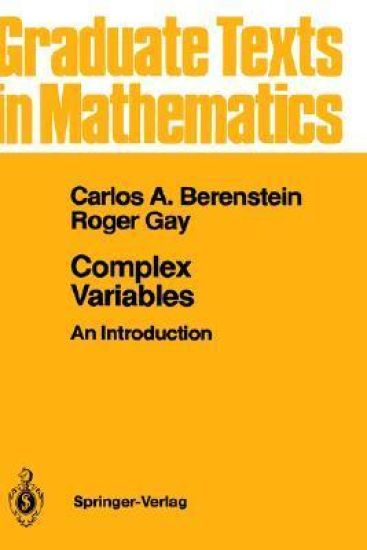
Complex Variables

Complex Variables

Carlos A. Berenstein; Roger Gay

Springer-Verlag New York Inc.
1991
sidottu
Textbooks, even excellent ones, are a reflection of their times. Form and content of books depend on what the students know already, what they are expected to learn, how the subject matter is regarded in relation to other divisions of mathematics, and even how fashionable the subject matter is. It is thus not surprising that we no longer use such masterpieces as Hurwitz and Courant's Funktionentheorie or Jordan's Cours d'Analyse in our courses. The last two decades have seen a significant change in the techniques used in the theory of functions of one complex variable. The important role played by the inhomogeneous Cauchy-Riemann equation in the current research has led to the reunification, at least in their spirit, of complex analysis in one and in several variables. We say reunification since we think that Weierstrass, Poincare, and others (in contrast to many of our students) did not consider them to be entirely separate subjects. Indeed, not only complex analysis in several variables, but also number theory, harmonic analysis, and other branches of mathematics, both pure and applied, have required a reconsidera­ tion of analytic continuation, ordinary differential equations in the complex domain, asymptotic analysis, iteration of holomorphic functions, and many other subjects from the classic theory of functions of one complex variable. This ongoing reconsideration led us to think that a textbook incorporating some of these new perspectives and techniques had to be written.