Kirjojen hintavertailu. Mukana 12 390 323 kirjaa ja 12 kauppaa.
Kirjailija
Carol Gilligan
Kirjat ja teokset yhdessä paikassa: 22 kirjaa, julkaisuja vuosilta 1991-2026, suosituimpien joukossa Mystics, Mavericks, and Merrymakers. Vertaile teosten hintoja ja tarkista saatavuus suomalaisista kirjakaupoista.
A rare look into the lives of Hasidic youth From the ardently religious young woman who longs for the life of a male scholar to the young rebel who visits a strip club, smokes pot, and agonizes over her loss of faith to the proud Lubavitcher with a desire for a high-powered career, Stephanie Wellen Levine provides a rare glimpse into the inner worlds and daily lives of these Hasidic girls. Lubavitcher Hasidim are famous for their efforts to inspire secular Jews to become more observant and for their messianic fervor. Strict followers of Orthodox Judaism, they maintain sharp gender-role distinctions. Levine spent a year living in the Lubavitch community of Crown Heights, Brooklyn, participating in the rhythms of Hasidic girlhood. Drawing on many intimate hours among Hasidim and over 30 in-depth interviews, Mystics, Mavericks, and Merrymakers offers rich portraits of individual Hasidic young women and how they deal with the conflicts between the regimented society in which they live and the pull of mainstream American life. This superbly crafted book offers intimate stories from Hasidic teenagers' lives, providing an intriguing twist to a universal theme: the struggle to grow up and define who we are within the context of culture, family, and life-driving beliefs.


A brilliant but restless dancer discovers the true meaning of love and intimacy through the ebbs and flows of her marriage in this exquisitely written novel--from the bestselling author and psychologist whose feminist classic, In a Different Voice, revolutionized our understanding of women's lives "A literary tour de force . . . an irresistible read."--Daphne Merkin Boston, 1969. Eve, a dancer whose feelings are expressed through the body and movement, senses an inexplicable distance growing between herself and her husband, Gabe, a journalist and father of her two children. Feeling lost and alone, she begins an affair; Gabe detects it immediately and begins one himself. Yet somehow they find their way back to each other, and when Eve gives birth to a daughter, their marriage becomes vital again. Years later, when Gabe returns from a reporting trip to the Middle East and Berlin, Eve again perceives something is wrong in her marriage. Gabe no longer seems like the man she once knew. He has always had a darkness she could not fathom--deep psychological scars from his childhood, when Gabe escaped Nazi Germany on the Kindertransport. Amsterdam, 1991. Newly separated from Gabe, Eve has accepted a fellowship to choreograph a dance inspired by the story of Adam and Eve. When a colleague introduces her to a new translation of the ancient text, Eve begins to redefine the way she thinks about women, men, and relationships--and, perhaps, to see another path back to her marriage. In this emotionally riveting novel, Carol Gilligan draws on her unsurpassed psychological understanding of women's lives to explore a new vision of love and intimacy. Sweeping across decades and continents, attuned to the rhythms of life and time, Solstice is a provocative and profound portrait of what it takes to truly love another.
Carol Gilligan's landmark book In a Different Voice – the "little book that started a revolution" – brought women's voices to the fore in work on the self and moral development, enabling women to be heard in their own right, and with their own integrity, for the first time. Forty years later, Gilligan returns to the subject matter of her classic book, re-examining its central arguments and concerns from the vantage point of the present. Thanks to the work that she and others have done in recent decades, it is now possible to clarify and articulate what couldn't quite be seen or said at the time of the original publication: that the "different voice" (of care ethics), although initially heard as a "feminine" voice, is in fact a human voice; that the voice it differs from is a patriarchal voice (bound to gender binaries and hierarchies); and that where patriarchy is in force or enforced, the human voice is a voice of resistance, and care ethics is an ethics of liberation. While gender is central to the story Gilligan tells, this is not a story about gender: it is a human story. With this clarification, it becomes evident why In a Different Voice continues to resonate strongly with people's experience and, perhaps more crucially, why the different voice is a voice for the 21st century.
"There could not be a more perfect work of the American imagination."-D. H. LawrenceIn colonial New England, beautiful, young Hester Pryne bears a child although her husband is presumed lost at sea. She refuses to name the father and is condemned to wear a scarlet "A" and live as an outcast. As she transforms the badge of shame into a symbol of freedom, Hawthorne's dramatic masterpiece envisions an authentic relation between the sexes-and a different way of imagining love, sin, and redemption-that can form the basis for America's radical project of a true democracy.
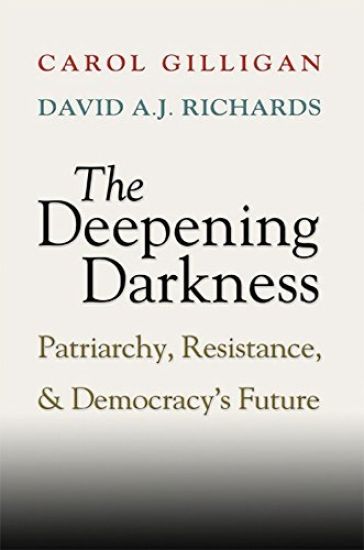
In the fall of 2016 those promoting patriarchal ideals saw their champion Donald Trump elected president of the United States and showed us how powerful patriarchy still is in American society and culture. Darkness Now Visible: Patriarchy's Resurgence and Feminist Resistance explains how patriarchy and its embrace of misogyny, racism, xenophobia, homophobia, and violence are starkly visible and must be recognized and resisted. Carol Gilligan and David A. J. Richards offer a bold and original thesis: that gender is the linchpin that holds in place the structures of unjust oppression through the codes of masculinity and femininity that subvert the capacity to resist injustice. Feminism is not an issue of women only, or a battle of women versus men - it is the key ethical movement of our age.
The election of an unabashedly patriarchal man as US President was a shock for many—despite decades of activism on gender inequalities and equal rights, how could it come to this? What is it about patriarchy that seems to make it so resilient and resistant to change? Undoubtedly it endures in part because some people benefit from the unequal advantages it confers. But is that enough to explain its stubborn persistence? In this highly original and persuasively argued book, Carol Gilligan and Naomi Snider put forward a different view: they argue that patriarchy persists because it serves a psychological function. By requiring us to sacrifice love for the sake of hierarchy, patriarchy protects us from the vulnerability of loving and becomes a defense against loss. Uncovering the powerful psychological mechanisms that underpin patriarchy, the authors show how forces beyond our awareness may be driving a politics that otherwise seems inexplicable.
In the fall of 2016 those promoting patriarchal ideals saw their champion Donald Trump elected president of the United States and showed us how powerful patriarchy still is in American society and culture. Darkness Now Visible: Patriarchy's Resurgence and Feminist Resistance explains how patriarchy and its embrace of misogyny, racism, xenophobia, homophobia, and violence are starkly visible and must be recognized and resisted. Carol Gilligan and David A. J. Richards offer a bold and original thesis: that gender is the linchpin that holds in place the structures of unjust oppression through the codes of masculinity and femininity that subvert the capacity to resist injustice. Feminism is not an issue of women only, or a battle of women versus men - it is the key ethical movement of our age.
This is the little book that started a revolution, making women’s voices heard, in their own right and with their own integrity, for virtually the first time in social scientific theorizing about women. Its impact was immediate and continues to this day, in the academic world and beyond. Translated into sixteen languages, with more than 700,000 copies sold around the world, In a Different Voice has inspired new research, new educational initiatives, and political debate—and helped many women and men to see themselves and each other in a different light.Carol Gilligan believes that psychology has persistently and systematically misunderstood women—their motives, their moral commitments, the course of their psychological growth, and their special view of what is important in life. Here she sets out to correct psychology’s misperceptions and refocus its view of female personality. The result is truly a tour de force, which may well reshape much of what psychology now has to say about female experience.
Adolescent girls’special needs in the teen-age years are thoroughly examined in Women, Girls & Psychotherapy, a compelling book focusing on the vitality of resistance in young girls. Drawing on studies of women’s and girls’development, clinical work with girls and women, and their personal experiences, the voices of adolescent girls are used to reframe and greater understand their resistance against debilitating conventions of feminine behavior. As adolescent girls are often overlooked in feminist books in psychotherapy, this is an important volume as it looks positively at resistance, both as a political strategy and a health-sustaining process.The chapters cover such diverse topics as reconceptualizations of women’s and girls’psychological development and the psychotherapy relationship; adolescent female sexuality; new approaches to psychological problems commonly seen in girls and women; female adolescent health; and diverse perspectives and experiences of growing up female. The voices of young women are increasingly important in the exploration of the field of psychotherapy and among the voices included are those from African-Americans, Asian-Americans, and lesbians. An enlightening look at resistance in females in the growing up years, this volume provides valuable insight on their experiences. The work of many researchers,therapists, and educators with diverse backgrounds, Women, Girls & Psychotherapy is an informative book on distinct psychological issues facing young females.
Why is America again unjustly at war? Why is its politics distorted by wedge issues like abortion and gay marriage? Why is anti-Semitism still so powerfully resurgent? Such contradictions within democracies arise from a patriarchal psychology still alive in our personal and political lives in tension with the equal voice that is the basis of democracy. This book joins a psychological approach with a political-theoretical one that traces both this psychology (based on loss in intimate life) and resistance to it (based on the love of equals) to the Roman Republic and Empire and to three Latin masterpieces: Virgil's Aeneid, Apuleius's The Golden Ass, and Augustine's Confessions. In addition, this book explains many other aspects of our present situation including why movements of ethical resistance are often accompanied by a freeing of sexuality and why we are witnessing an aggressive fundamentalism at home and abroad.
On the way to womanhood, what does a girl give up? For five years, Lyn Mikel Brown and Carol Gilligan, asking this question, listened to one hundred girls who were negotiating the rough terrain of adolescence. This book invites us to listen, too, and to hear in these girls' voices what is rarely spoken, often ignored, and generally misunderstood: how the passage out of girlhood is a journey into silence, disconnection, and dissembling, a troubled crossing that our culture has plotted with dead ends and detours. In the course of their research, Brown and Gilligan developed a Listener's Guide - a method of following the pathways of girls' thoughts and feelings, of distinguishing what girls are saying by the way they say it. We witness the struggle girls undergo as they enter adolescence only to find that what they feel and think and know can no longer be said directly. We see them at a cultural impasse, and listen as they make the painful, necessary adjustments, outspokenness giving way to circumspection, self-knowledge to uncertainty, authority to compliance. These changes mark the edge of adolescence as a watershed in women's psychological development, a time of wrenching disjunctions between body and psyche, voice and desire, self and relationship. Brown and Gilligan open their method to us and share their discoveries as they encourage girls at different ages to speak about themselves in conversation with women. They follow some of these girls over time, listening to changes in their distinct voices from one year to the next, addressing their successes and failures as they confront one barrier after another. This groundbreaking work offers major new insights into girls' development and women's psychology. But perhaps more importantly, it provides women with the means of meeting girls at the critical crossroads of adolescence, of harkening to the voices of girlhood and sustaining their sell-affirming notes.
Since the publication of her landmark book In a Different Voice, Carol Gilligan has transformed the way we think about women and men and the relations between them. It was ‘the little book that started a revolution’, and with more than 800,000 copies in print it has become one of the most widely read and influential books ever written on gender and human development. In her new book Joining the Resistance Carol Gilligan reflects on the evolution of her thinking and shows how her key ideas were interwoven with her own life experiences. Her work began with the question of voice: who is speaking to whom, in what body, telling what stories about which relationships? By listening carefully she heard a voice that had been held in silence, and in the process realized the extent to which we – both women and men – had been telling false stories about ourselves. In her subsequent work Gilligan found that adolescent girls resisted pressures to disengage themselves from their honest voices, and by joining their resistance she opened the way for the development of a more humane way of thinking about personal and political relationships. For the central conviction of her work today – and the central thesis of this book – is that the requisites for love and the requisites for citizenship in a democratic society are one and the same. Both voice and the desire to live in relationships inherent in our human nature, together with the capacity to resist false authority. Combining autobiographical reflection with an analysis of key questions about gender and human development, this timely and highly readable book by one of America’s greatest contemporary thinkers will appeal to a wide readership.
Why is America again unjustly at war? Why is its politics distorted by wedge issues like abortion and gay marriage? Why is anti-Semitism still so powerfully resurgent? Such contradictions within democracies arise from a patriarchal psychology still alive in our personal and political lives in tension with the equal voice that is the basis of democracy. This book joins a psychological approach with a political-theoretical one that traces both this psychology (based on loss in intimate life) and resistance to it (based on the love of equals) to the Roman Republic and Empire and to three Latin masterpieces: Virgil's Aeneid, Apuleius's The Golden Ass, and Augustine's Confessions. In addition, this book explains many other aspects of our present situation including why movements of ethical resistance are often accompanied by a freeing of sexuality and why we are witnessing an aggressive fundamentalism at home and abroad.
The Birth of Pleasure rings with the voices of girls and boys, mothers and fathers, lovers and couples and echoes with telling readings of familiar writers, from Greek tragedy to Anne Frank, from Shakespeare to Proust, from Freud to Toni Morrison.
The author of the classic In a Different Voice offers a brilliant, provocative book about love that has powerful implications for the way we live and love today. "Compelling ... A thrilling new paradigm." --The Times Literary SupplementCarol Gilligan, whose In a Different Voice revolutionized the study of human psychology, now asks: Why is love so often associated with tragedy? Why are our experiences of pleasure so often shadowed by loss? And can we change these patterns? Gilligan observes children at play and adult couples in therapy and discovers that the roots of a more hopeful view of love are all around us. She finds evidence in new psychological research and traces a path leading from the myth of Psyche and Cupid through Shakespeare's plays and Freud's case histories, to Anne Frank's diaries and contemporary novels.