Kirjojen hintavertailu. Mukana 12 595 353 kirjaa ja 12 kauppaa.

Kirjailija

Carol Graham

Kirjat ja teokset yhdessä paikassa: 8 kirjaa, julkaisuja vuosilta 2007-2026, suosituimpien joukossa The Power of Hope. Vertaile teosten hintoja ja tarkista saatavuus suomalaisista kirjakaupoista.

8 kirjaa

Kirjojen julkaisuhaarukka 2007-2026.

The Power of Hope

The Power of Hope

Carol Graham

PRINCETON UNIVERSITY PRESS
2026
pokkari
Why hope matters as a metric of economic and social well-being In a society marked by extreme inequality of income and opportunity, why should economists care about how people feel? The truth is that feelings of well-being are critical metrics that predict future life outcomes. In this timely and innovative account, economist Carol Graham argues for the importance of hope—little studied in economics at present—as an independent dimension of well-being. Given America’s current mental health crisis, thrown into stark relief by COVID, hope may be the most important measure of well-being, and researchers are tracking trends in hope as a key factor in understanding the rising numbers of “deaths of despair” and premature mortality. Graham, an authority on the study of well-being, points to empirical evidence demonstrating that hope can improve people’s life outcomes and that despair can destroy them. These findings, she argues, merit deeper exploration. Graham discusses the potential of novel well-being metrics as tracking indicators of despair, reports on new surveys of hope among low-income adolescents, and considers the implications of the results for the futures of these young adults. Graham asks how and why the wealthiest country in the world has such despair. What are we missing? She argues that public policy problems—from joblessness and labor force dropout to the lack of affordable health care and inadequate public education—can’t be solved without hope. Drawing on research in well-being and other disciplines, Graham describes strategies for restoring hope in populations where it has been lost. The need to address despair, and to restore hope, is critical to America’s future.
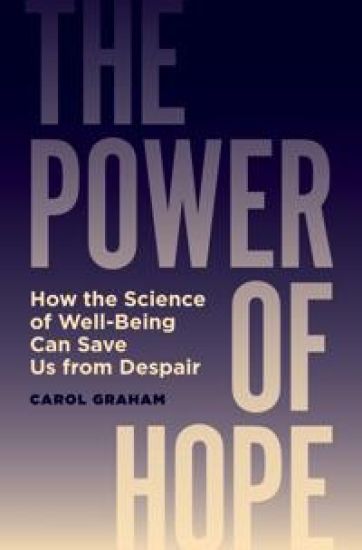
The Power of Hope

The Power of Hope

Carol Graham

PRINCETON UNIVERSITY PRESS
2023
sidottu
Why hope matters as a metric of economic and social well-beingIn a society marked by extreme inequality of income and opportunity, why should economists care about how people feel? The truth is that feelings of well-being are critical metrics that predict future life outcomes. In this timely and innovative account, economist Carol Graham argues for the importance of hope—little studied in economics at present—as an independent dimension of well-being. Given America’s current mental health crisis, thrown into stark relief by COVID, hope may be the most important measure of well-being, and researchers are tracking trends in hope as a key factor in understanding the rising numbers of “deaths of despair” and premature mortality.Graham, an authority on the study of well-being, points to empirical evidence demonstrating that hope can improve people’s life outcomes and that despair can destroy them. These findings, she argues, merit deeper exploration. Graham discusses the potential of novel well-being metrics as tracking indicators of despair, reports on new surveys of hope among low-income adolescents, and considers the implications of the results for the futures of these young adults.Graham asks how and why the wealthiest country in the world has such despair. What are we missing? She argues that public policy problems—from joblessness and labor force dropout to the lack of affordable health care and inadequate public education—can’t be solved without hope. Drawing on research in well-being and other disciplines, Graham describes strategies for restoring hope in populations where it has been lost. The need to address despair, and to restore hope, is critical to America’s future.

Tiny Little Cracks

Tiny Little Cracks

Carol Graham

Staghorn Ridge Publications
2021
sidottu
Author, Dr. Carol Graham is a National Board Certified Reading and Language Arts Teacher Specialist, who worked for many years as an elementary teacher and principal in West Virginia. She is currently a teacher in Coeur d'Alene, Idaho, and lives in the awe-inspiring mountains overlooking Lake Coeur d' Alene. Dr. Graham grew up on beautiful Echo Ranch, near Kalispell, Montana, which provided many childhood and adult experiences in the rugged northwestern Rocky Mountains. She fondly remembers riding her registered quarter horse, "Whimper Duke," herding cattle hundreds of miles throughout the thickly forested, unfenced open range, encountering crystal clear blue lakes, and crossing frigid mountain streams. Later, she attended Montana State University to attain her degree in teaching, then continued on to obtain master's and doctorate degrees. As a teacher in Idaho, her interactions with children, teachers, parents, and administrators throughout the state, as well as her wealth of experiences from the state of West Virginia and her childhood memories, provide the setting and backdrop for the poems found in this book, and her children's books and illustrations.
Happiness for All?

Happiness for All?

Carol Graham

Princeton University Press
2020
pokkari
How the optimism gap between rich and poor is creating an increasingly divided societyThe Declaration of Independence states that all people are endowed with certain unalienable rights. Among them is the pursuit of happiness. But is happiness available equally to everyone in America? How about elsewhere in the world? Carol Graham draws on cutting-edge research linking income inequality with well-being to show how the widening prosperity gap has led to rising inequality in people's beliefs, hopes, and aspirations. The result is an optimism gap between rich and poor that, if left unchecked, could lead to an increasingly divided society. Happiness for All? highlights the importance of well-being measures in identifying and monitoring trends in life satisfaction and optimism, and demonstrates how hope and happiness can lead to improved economic outcomes.
Happiness for All?

Happiness for All?

Carol Graham

PRINCETON UNIVERSITY PRESS
2017
sidottu
How the optimism gap between rich and poor is creating an increasingly divided society The Declaration of Independence states that all people are endowed with certain unalienable rights, and that among these is the pursuit of happiness. But is happiness available equally to everyone in America today? How about elsewhere in the world? Carol Graham draws on cutting-edge research linking income inequality with well-being to show how the widening prosperity gap has led to rising inequality in people's beliefs, hopes, and aspirations. For the United States and other developed countries, the high costs of being poor are most evident not in material deprivation but rather in stress, insecurity, and lack of hope. The result is an optimism gap between rich and poor that, if left unchecked, could lead to an increasingly divided society. Graham reveals how people who do not believe in their own futures are unlikely to invest in them, and how the consequences can range from job instability and poor education to greater mortality rates, failed marriages, and higher rates of incarceration. She describes how the optimism gap is reflected in the very words people use--the wealthy use words that reflect knowledge acquisition and healthy behaviors, while the words of the poor reflect desperation, short-term outlooks, and patchwork solutions. She also explains why the least optimistic people in America are poor whites, not poor blacks or Hispanics. Happiness for All? highlights the importance of well-being measures in identifying and monitoring trends in life satisfaction and optimism--and misery and despair--and demonstrates how hope and happiness can lead to improved economic outcomes.
After the Spring

After the Spring

Magdi Amin; Ragui Assaad; Nazar al-Baharna; Kemal Dervis; Raj M. Desai; Navtej S. Dhillon; Ahmed Galal; Hafez Ghanem; Carol Graham; Daniel Kaufmann

Oxford University Press Inc
2012
sidottu
The Arab Spring constitutes perhaps the most far-reaching political and economic transition since the end of communism in Europe. For too long, the economic aspirations of the people in the region, especially young people, have been ignored by leaders in Arab countries and abroad. Competing views as to how best to meet these aspirations are now being debated in the region. The outcome will shape Arab societies for generations to come. The authors of this book argue that significant economic reforms must accompany the major political transitions that are underway. Although each country has a different economic structure and history and must make its own way forward, there are spill-overs from trade and investment linkages, the contagion of news cycles, interaction of people and sharing of expectations that are too great to ignore. Some common foundation of the new Arab economies is needed. Towards that end, this volume addresses four central challenges of economic reform in the Arab world. First, with two-thirds of the population under the age of 30, the disproportionate burdens of unemployment and poor education can no longer be heaped on youth. Second, while some government policies may have improved the living standards of Arab citizens in the past, they have also entrenched cronies, enriched a small elite, and become unaffordable. Third, if Arab economies are to compete in the 21st century they cannot depend solely on oil and gas money, remittances, and tourism, but will require active, independent private sectors. And finally, the relative isolation of Arab economies--both from each other and from the world--must end. Rather than providing specific lists of recommendations, this book sets forth a set of guidelines and priorities for reformers who will begin creating new opportunities for youth, rebuilding the institutions of the state, diversifying the private sector, and cooperating with each other and integrating with the world economy.
Happiness Around the World

Happiness Around the World

Carol Graham

Oxford University Press
2012
nidottu
For centuries the pursuit of happiness was the preserve of either the philosopher or the voluptuary and took second place to the basic need to survive on the one hand, and the pressure to conform to social conventions and morality on the other. More recently there is a burgeoning interest in the study of happiness, in the social sciences and in the media. Can we really answer the question what makes people happy? Is it really grounded in credible methods and data? Is there consistency in the determinants of happiness across countries and cultures? Are happiness levels innate to individuals or can policy and the environment make a difference? How is happiness affected by poverty? By economic progress? Is happiness a viable objective for policy? This book is an attempt to answer these questions, based on research on the determinants of happiness in countries around the world, ranging from Peru and Russia to the U.S. and Afghanistan. The book reviews the theory and concepts of happiness, explaining how these concepts underpin a line of research which is both an attempt to understand the determinants of happiness and a tool for understanding the effects of a host of phenomena on human well being. The research finds surprising consistency in the determinants of happiness across levels of development. Yet there is still much debate over the relationship between happiness and income. The book explores the effects of many mediating factors in that relationship, ranging from macroeconomic trends and democracy to inequality and crime. It also reviews what we know about happiness and health and how that relationship varies according to income levels and health status. It concludes by discussing the potential - and the potential pitfalls - of using happiness surveys to contribute to better public policy.