Kirjojen hintavertailu. Mukana 12 595 353 kirjaa ja 12 kauppaa.

Kirjailija

Carol Peters

Kirjat ja teokset yhdessä paikassa: 3 kirjaa, julkaisuja vuosilta 2001-2014, suosituimpien joukossa Multilingual Information Retrieval. Vertaile teosten hintoja ja tarkista saatavuus suomalaisista kirjakaupoista.

3 kirjaa

Kirjojen julkaisuhaarukka 2001-2014.

Multilingual Information Retrieval

Multilingual Information Retrieval

Carol Peters; Martin Braschler; Paul Clough

Springer-Verlag Berlin and Heidelberg GmbH Co. K
2014
nidottu
We are living in a multilingual world and the diversity in languages which are used to interact with information access systems has generated a wide variety of challenges to be addressed by computer and information scientists. The growing amount of non-English information accessible globally and the increased worldwide exposure of enterprises also necessitates the adaptation of Information Retrieval (IR) methods to new, multilingual settings.Peters, Braschler and Clough present a comprehensive description of the technologies involved in designing and developing systems for Multilingual Information Retrieval (MLIR). They provide readers with broad coverage of the various issues involved in creating systems to make accessible digitally stored materials regardless of the language(s) they are written in. Details on Cross-Language Information Retrieval (CLIR) are also covered that help readers to understand how to develop retrieval systems that cross language boundaries. Their work is divided into six chapters and accompanies the reader step-by-step through the various stages involved in building, using and evaluating MLIR systems. The book concludes with some examples of recent applications that utilise MLIR technologies. Some of the techniques described have recently started to appear in commercial search systems, while others have the potential to be part of future incarnations.The book is intended for graduate students, scholars, and practitioners with a basic understanding of classical text retrieval methods. It offers guidelines and information on all aspects that need to be taken into consideration when building MLIR systems, while avoiding too many ‘hands-on details’ that could rapidly become obsolete. Thus it bridges the gap between the material covered by most of the classical IR textbooks and the novel requirements related to the acquisition and dissemination of information in whatever language it is stored.
Multilingual Information Retrieval

Multilingual Information Retrieval

Carol Peters; Martin Braschler; Paul Clough

Springer-Verlag Berlin and Heidelberg GmbH Co. K
2012
sidottu
We are living in a multilingual world and the diversity in languages which are used to interact with information access systems has generated a wide variety of challenges to be addressed by computer and information scientists. The growing amount of non-English information accessible globally and the increased worldwide exposure of enterprises also necessitates the adaptation of Information Retrieval (IR) methods to new, multilingual settings.Peters, Braschler and Clough present a comprehensive description of the technologies involved in designing and developing systems for Multilingual Information Retrieval (MLIR). They provide readers with broad coverage of the various issues involved in creating systems to make accessible digitally stored materials regardless of the language(s) they are written in. Details on Cross-Language Information Retrieval (CLIR) are also covered that help readers to understand how to develop retrieval systems that cross language boundaries. Their work is divided into six chapters and accompanies the reader step-by-step through the various stages involved in building, using and evaluating MLIR systems. The book concludes with some examples of recent applications that utilise MLIR technologies. Some of the techniques described have recently started to appear in commercial search systems, while others have the potential to be part of future incarnations.The book is intended for graduate students, scholars, and practitioners with a basic understanding of classical text retrieval methods. It offers guidelines and information on all aspects that need to be taken into consideration when building MLIR systems, while avoiding too many ‘hands-on details’ that could rapidly become obsolete. Thus it bridges the gap between the material covered by most of the classical IR textbooks and the novel requirements related to the acquisition and dissemination of information in whatever language it is stored.
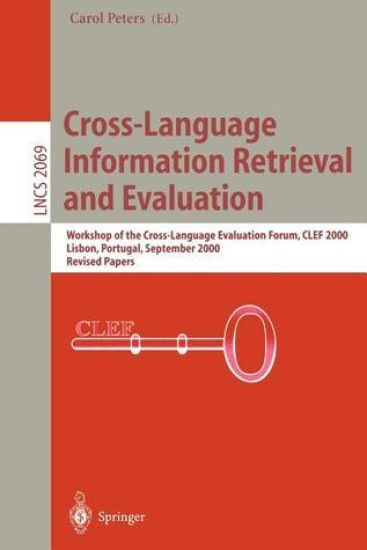
Cross-Language Information Retrieval and Evaluation

Cross-Language Information Retrieval and Evaluation

Carol Peters

Springer-Verlag Berlin and Heidelberg GmbH Co. K
2001
nidottu
The first evaluation campaign of the Cross-Language Evaluation Forum (CLEF) for European languages was held from January to September 2000. The campaign cul- nated in a two-day workshop in Lisbon, Portugal, 21 22 September, immediately following the fourth European Conference on Digital Libraries (ECDL 2000). The first day of the workshop was open to anyone interested in the area of Cross-Language Information Retrieval (CLIR) and addressed the topic of CLIR system evaluation. The goal was to identify the actual contribution of evaluation to system development and to determine what could be done in the future to stimulate progress. The second day was restricted to participants in the CLEF 2000 evaluation campaign and to their - periments. This volume constitutes the proceedings of the workshop and provides a record of the campaign. CLEF is currently an activity of the DELOS Network of Excellence for Digital - braries, funded by the EC Information Society Technologies to further research in digital library technologies. The activity is organized in collaboration with the US National Institute of Standards and Technology (NIST). The support of DELOS and NIST in the running of the evaluation campaign is gratefully acknowledged. I should also like to thank the other members of the Workshop Steering Committee for their assistance in the organization of this event.