Kirjojen hintavertailu. Mukana 12 657 676 kirjaa ja 12 kauppaa.

Kirjailija

Caroline Coffin

Kirjat ja teokset yhdessä paikassa: 9 kirjaa, julkaisuja vuosilta 2002-2016, suosituimpien joukossa Teaching Academic Writing. Vertaile teosten hintoja ja tarkista saatavuus suomalaisista kirjakaupoista.

9 kirjaa

Kirjojen julkaisuhaarukka 2002-2016.

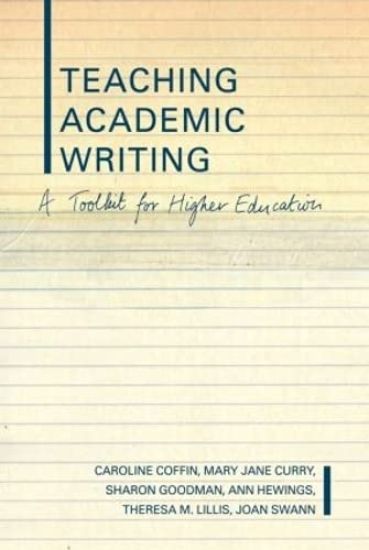
Teaching Academic Writing

Teaching Academic Writing

Caroline Coffin; Mary Jane Curry; Sharon Goodman; Ann Hewings; Theresa Lillis; Joan Swann

Routledge
2002
sidottu
Student academic writing is at the heart of teaching and learning in higher education. Students are assessed largely by what they write, and need to learn both general academic conventions as well as disciplinary writing requirements in order to be successful in higher education.Teaching Academic Writing is a 'toolkit' designed to help higher education lecturers and tutors teach writing to their students. Containing a range of diverse teaching strategies, the book offers both practical activities to help students develop their writing abilities and guidelines to help lecturers and tutors think in more depth about the assessment tasks they set and the feedback they give to students. The authors explore a wide variety of text types, from essays and reflective diaries to research projects and laboratory reports. The book draws on recent research in the fields of academic literacy, second language learning, and linguistics. It is grounded in recent developments such as the increasing diversity of the student body, the use of the Internet, electronic tuition, and issues related to distance learning in an era of increasing globalisation.Written by experienced teachers of writing, language, and linguistics, Teaching Academic Writing will be of interest to anyone involved in teaching academic writing in higher education.
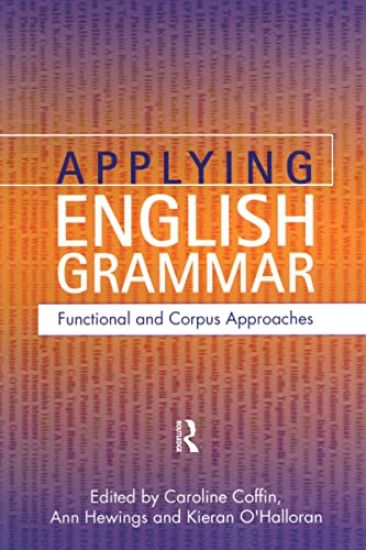
Applying English Grammar.

Applying English Grammar.

Caroline Coffin; Ann Hewings; Kieran O'Halloran

Routledge
2016
sidottu
This edited collection is about the application of English grammar and specialises in 'functional' and'corpus' approaches, approaches which are increasingly recognised as providing significant insights into English language in action. It aims to stimulate interest and understanding of grammar as an applied tool not just for grammarians or language learners, but for all those interested in how language is organized to shape our view of events in the world.As the chapters in this book show, functional and corpus approaches allow us to make observations that would not be amenable through more traditional forms of grammatical analysis. They also illustrate how researchers can fruitfully bring together corpus and functional approaches to reveal how grammar and lexis create and transmit values, identities and ideologies. Research in Critical Discourse Analysis (CDA) has a long tradition of drawing on functional grammar but has only relatively recently begun to draw on corpus linguistics. As such, the book is unusual in presenting work on CDA which draws on corpus linguistics. But not only that, it is also unique in presenting work in CDA which brings together the methodologies of corpus linguistics and functional grammar, demonstrating their combined potential for illuminating ideological perspectives, particularly in media texts.Given this focus and given the increasing value of empirical data, the book will be of interest to those in a range of disciplines including the humanities and media and cultural studies.Chapters comprise both newly commissioned and previously published works that illustrate the two methodological approaches to grammatical analysis and how they can be applied to deepen our understanding of language.
Exploring English Grammar

Exploring English Grammar

Caroline Coffin; Jim Donohue; Sarah North

Routledge
2009
sidottu
This engaging textbook bridges the gap between traditional and functional grammar. Starting with a traditional approach, students will develop a firm grasp of traditional tools for analysis and learn how SFG (Systemic Functional Grammar) can be used to enrich the traditional formal approach. Using a problem-solving approach, readers explore how grammatical structures function in different contexts by using a wide variety of thought-provoking and motivating texts including advertisements, cartoons, phone calls and chatroom dialogue. Each chapter focuses on a real world issue or problem that can be investigated linguistically, such as "mis"-translation or problems arising from a communication disorder. By working on these problems, students will become equipped to understand and analyze formal and functional grammar in different genres and styles. With usable and accessible activities throughout, Exploring English Grammar is ideal for upper undergraduate and postgraduate students of English language and linguistics.
Exploring English Grammar

Exploring English Grammar

Caroline Coffin; Jim Donohue; Sarah North

Routledge
2009
nidottu
This engaging textbook bridges the gap between traditional and functional grammar. Starting with a traditional approach, students will develop a firm grasp of traditional tools for analysis and learn how SFG (Systemic Functional Grammar) can be used to enrich the traditional formal approach. Using a problem-solving approach, readers explore how grammatical structures function in different contexts by using a wide variety of thought-provoking and motivating texts including advertisements, cartoons, phone calls and chatroom dialogue. Each chapter focuses on a real world issue or problem that can be investigated linguistically, such as "mis"-translation or problems arising from a communication disorder. By working on these problems, students will become equipped to understand and analyze formal and functional grammar in different genres and styles. With usable and accessible activities throughout, Exploring English Grammar is ideal for upper undergraduate and postgraduate students of English language and linguistics.
Historical Discourse

Historical Discourse

Caroline Coffin

Continuum International Publishing Group Ltd.
2009
nidottu
This is an important analysis of the language of time, cause and evaluation in historical texts studied by students at secondary school, looking at the implications for making meaning in historical writing."Historical Discourse" analyses the importance of the language of time, cause and evaluation in both texts which students at secondary school are required to read, and their own writing for assessment. In contrast to studies which have denied that history has a specialised language, Caroline Coffin demonstrates through a detailed study of historical texts, that writing about the past requires different genres, lexical and grammatical structures. In this analysis, language emerges as a powerful tool for making meaning in historical writing.Presupposing no prior knowledge of systemic functional linguistics, this insightful book will be of interest to researchers in applied linguistics and discourse analysis, as well as history educators. Discourse is one of the most significant concepts of contemporary thinking in the humanities and social sciences as it concerns the ways language mediates and shapes our interactions with each other and with the social, political and cultural formations of our society. "The Continuum Discourse" series aims to capture the fast-developing interest in discourse to provide students, new and experienced teachers and researchers in applied linguistics, ELT and English language with an essential bookshelf. Each book deals with a core topic in discourse studies to give an in-depth, structured and readable introduction to an aspect of the way language in used in real life.
Historical Discourse

Historical Discourse

Caroline Coffin

Continuum International Publishing Group Ltd.
2006
sidottu
'Coffin's functional linguistics perspective provides a rigorous and comprehensive analysis of the texts of secondary school history, both those that students read and those they need to learn to write. This is an original and welcome contribution to debates about how to develop students' historical understanding' - Professor Mary Schleppegrell, University of Michigan. 'This book makes a major contribution to the study of historical discourse and while it will be of interest to teachers of history, it will in addition be of considerable interest to those who work in discourse studies generally- linguists, applied linguists and educational linguists.' - Frances Christie, Emeritus Professor, University of Melbourne and Honorary Professor, University of Sydney. "Historical Discourse" analyses the importance of the language of time, cause and evaluation in both texts which students at secondary school are required to read, and their own writing for assessment. In contrast to studies which have denied that history has a specialised language, Caroline Coffin demonstrates through a detailed study of historical texts, that writing about the past requires different genres, lexical and grammatical structures. In this analysis, language emerges as a powerful tool for making meaning in historical writing. Presupposing no prior knowledge of systemic functional linguistics, this insightful book will be of interest to researchers in applied linguistics and discourse analysis, as well as history educators.
Applying English Grammar.

Applying English Grammar.

Caroline Coffin; Ann Hewings; Kieran O'Halloran

Hodder Education
2004
nidottu
This edited collection is about the application of English grammar and specialises in 'functional' and'corpus' approaches, approaches which are increasingly recognised as providing significant insights into English language in action. It aims to stimulate interest and understanding of grammar as an applied tool not just for grammarians or language learners, but for all those interested in how language is organized to shape our view of events in the world.As the chapters in this book show, functional and corpus approaches allow us to make observations that would not be amenable through more traditional forms of grammatical analysis. They also illustrate how researchers can fruitfully bring together corpus and functional approaches to reveal how grammar and lexis create and transmit values, identities and ideologies. Research in Critical Discourse Analysis (CDA) has a long tradition of drawing on functional grammar but has only relatively recently begun to draw on corpus linguistics. As such, the book is unusual in presenting work on CDA which draws on corpus linguistics. But not only that, it is also unique in presenting work in CDA which brings together the methodologies of corpus linguistics and functional grammar, demonstrating their combined potential for illuminating ideological perspectives, particularly in media texts.Given this focus and given the increasing value of empirical data, the book will be of interest to those in a range of disciplines including the humanities and media and cultural studies.Chapters comprise both newly commissioned and previously published works that illustrate the two methodological approaches to grammatical analysis and how they can be applied to deepen our understanding of language.
Teaching Academic Writing

Teaching Academic Writing

Caroline Coffin; Mary Jane Curry; Sharon Goodman; Ann Hewings; Theresa Lillis; Joan Swann

Routledge
2002
nidottu
Student academic writing is at the heart of teaching and learning in higher education. Students are assessed largely by what they write, and need to learn both general academic conventions as well as disciplinary writing requirements in order to be successful in higher education.Teaching Academic Writing is a 'toolkit' designed to help higher education lecturers and tutors teach writing to their students. Containing a range of diverse teaching strategies, the book offers both practical activities to help students develop their writing abilities and guidelines to help lecturers and tutors think in more depth about the assessment tasks they set and the feedback they give to students. The authors explore a wide variety of text types, from essays and reflective diaries to research projects and laboratory reports. The book draws on recent research in the fields of academic literacy, second language learning, and linguistics. It is grounded in recent developments such as the increasing diversity of the student body, the use of the Internet, electronic tuition, and issues related to distance learning in an era of increasing globalisation.Written by experienced teachers of writing, language, and linguistics, Teaching Academic Writing will be of interest to anyone involved in teaching academic writing in higher education.