Kirjojen hintavertailu. Mukana 12 145 931 kirjaa ja 12 kauppaa.

Kirjailija

Caroline Hobson

Kirjat ja teokset yhdessä paikassa: 2 kirjaa, julkaisuja vuosilta 2019-2020, suosituimpien joukossa Making Residential Care Work. Vertaile teosten hintoja ja tarkista saatavuus suomalaisista kirjakaupoista.

2 kirjaa

Kirjojen julkaisuhaarukka 2019-2020.

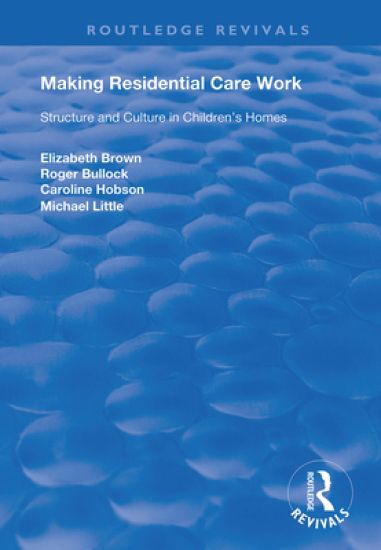
Making Residential Care Work

Making Residential Care Work

Elizabeth Brown; Roger Bullock; Caroline Hobson; Michael Little

Routledge
2020
nidottu
This book was originally published in 1998, when over 6,000 children lived in residential homes in England and Wales. The fact that some children's homes are better than others is well established, but why should this be so? Past answers have tended to be tautologous - rather on the lines of 'a good home is one where children do well; children do well because they are in a good home.' This study examines various aspects of children's homes and explores the connections between them in an attempt to break down the old circular argument. Structures are discernible in the relationship between different types of goals - societal, formal and belief; the variable balance between these goals determines staff cultures, which, in turn, shape the child cultures that develop. Such relationships are important because of their close association with outcomes - whether the children do well, whether the homes prosper. The model described in the book provides a conceptual framework and a set of causal relationships that should help professionals to plan and manage residential care better and so meet the needs of vulnerable children more effectively.
Making Residential Care Work

Making Residential Care Work

Elizabeth Brown; Roger Bullock; Caroline Hobson; Michael Little

Routledge
2019
sidottu
This book was originally published in 1998, when over 6,000 children lived in residential homes in England and Wales. The fact that some children's homes are better than others is well established, but why should this be so? Past answers have tended to be tautologous - rather on the lines of 'a good home is one where children do well; children do well because they are in a good home.' This study examines various aspects of children's homes and explores the connections between them in an attempt to break down the old circular argument. Structures are discernible in the relationship between different types of goals - societal, formal and belief; the variable balance between these goals determines staff cultures, which, in turn, shape the child cultures that develop. Such relationships are important because of their close association with outcomes - whether the children do well, whether the homes prosper. The model described in the book provides a conceptual framework and a set of causal relationships that should help professionals to plan and manage residential care better and so meet the needs of vulnerable children more effectively.