Kirjojen hintavertailu. Mukana 12 335 718 kirjaa ja 12 kauppaa.

Kirjailija

Carrie Tirado Bramen

Kirjat ja teokset yhdessä paikassa: 2 kirjaa, julkaisuja vuosilta 2001-2017, suosituimpien joukossa The Uses of Variety. Vertaile teosten hintoja ja tarkista saatavuus suomalaisista kirjakaupoista.

2 kirjaa

Kirjojen julkaisuhaarukka 2001-2017.

American Niceness

American Niceness

Carrie Tirado Bramen

Harvard University Press
2017
sidottu
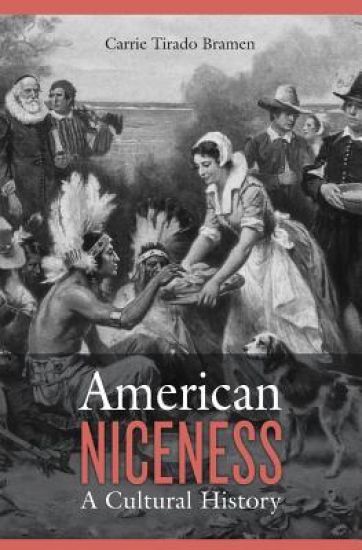
The cliché of the Ugly American—loud, vulgar, materialistic, chauvinistic—still expresses what people around the world dislike about their Yankee counterparts. Carrie Tirado Bramen recovers the history of a very different national archetype—the nice American—which has been central to ideas of U.S. identity since the nineteenth century.Niceness is often assumed to be a superficial concept unworthy of serious analysis. Yet the distinctiveness of Americans has been shaped by values of sociality and likability for which the adjective “nice” became a catchall. In America’s fledgling democracy, niceness was understood to be the indispensable trait of a people who were refreshingly free of Old World snobbery. Bramen elucidates the role niceness plays in a particular fantasy of American exceptionalism, one based not on military and economic might but on friendliness and openness. Niceness defined the attitudes of a plucky (and white) settler nation, commonly expressed through an affect that Bramen calls “manifest cheerfulness.”To reveal its contested inflections, Bramen shows how American niceness intersects with ideas of femininity, Native American hospitality, and black amiability. Who claimed niceness and why? Despite evidence to the contrary, Americans have largely considered themselves to be a fundamentally nice and decent people, from the supposedly amicable meeting of Puritans and Native Americans at Plymouth Rock to the early days of American imperialism when the mythology of Plymouth Rock became a portable emblem of goodwill for U.S. occupation forces in the Philippines.
The Uses of Variety

The Uses of Variety

Carrie Tirado Bramen

Harvard University Press
2001
sidottu
At the turn of the century, amid the excesses of the Gilded Age, variety became a key notion for Americans - a sign of national progress and development, reassurance that the modern nation would not fall into monotonous dullness or disorderly chaos. Carrie Tirado Bramen pursues this idea through the works of a wide range of regional and cosmopolitan writers, journalists, theologians and politicians who rewrote the narrative of American exceptionalism through a celebration of variety. Exploring cultural and institutional spheres ranging from intra-urban walking tours in popular magazines to the 1893 World's Parliament of religions in Chicago, she shows how the rhetoric of variety became naturalized and nationalized as quintessentially American and inherently democratic. By focusing on the uses of the term in the work of William James, Anna Julia Cooper, W.E.B. Du Bois, Hamlin Garland and Wong Chin Foo, among many others, Bramen reveals how the perceived innocence and goodness of variety were used to construct contradictory and mutually exclusive visions of modern Americanism. Bramen's innovation is to look at the debates of a century ago that established diversity as the distinctive feature of US culture. In the late-19th-century conception, which emphasized the openness of variety while at the same time acknowledging its limits, she finds a useful corrective to the contemporary tendency to celebrate the United States as a postmodern melange or a carnivalesque utopia of hybridity and difference.